
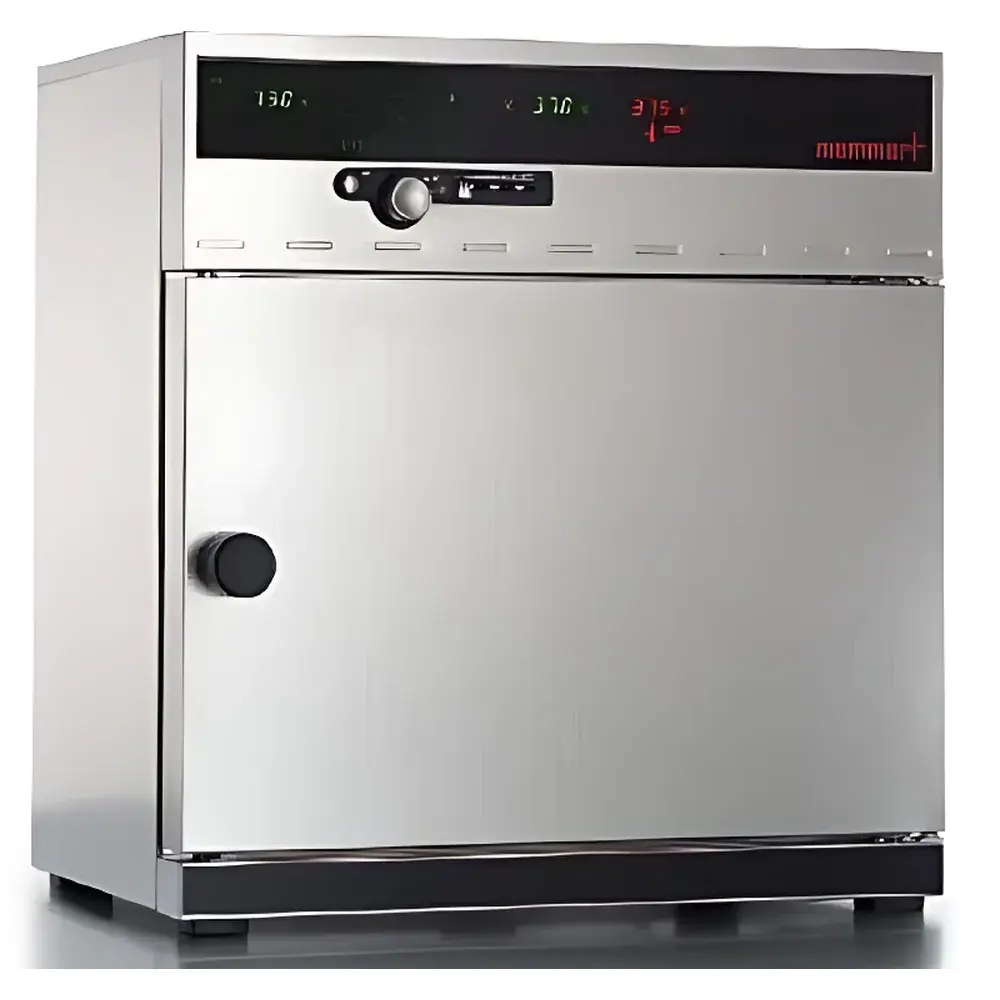
MEMMERT INE200 Natural Convection Incubator
| Origin | Germany |
|---|---|
| Manufacturer Type | Authorized Distributor |
| Origin Category | Imported |
| Model | INE200 |
| Pricing | Upon Request |
Overview
The MEMMERT INE200 is a precision-engineered natural convection incubator designed for stable, reproducible temperature-controlled environments in life science laboratories. Unlike forced-air systems, it relies on buoyancy-driven airflow—eliminating mechanical turbulence and minimizing sample disturbance—making it ideal for sensitive cell cultures, microbiological assays, and long-term stability studies where uniform thermal conditions and low vibration are critical. Its core architecture integrates dual A-class Pt100 sensors with four-wire measurement circuits, enabling simultaneous real-time monitoring of chamber temperature at two independent points. Temperature control is executed via a PID-based microprocessor system enhanced with fuzzy logic algorithms, ensuring rapid stabilization, minimal overshoot, and high repeatability across the operational range (20 °C to 70 °C standard; optional up to 250 °C or 300 °C upon specification). The unit complies with DIN 12880 for temperature homogeneity and meets GLP data integrity requirements through built-in 1024 kB circular memory logging.
Key Features
- Natural convection design with manually adjustable fresh-air mixing damper and dedicated exhaust port with throttle valve
- Dual A-class Pt100 temperature sensors (four-wire configuration) for redundant monitoring and fault-tolerant operation
- PID + fuzzy logic microprocessor controller with integrated self-diagnostic system and error indication
- 7-day programmable timer with real-time clock; temperature ramping, hold, delay start, and cycling (1–99 cycles or infinite loop)
- Four-segment digital timer: each segment configurable from 1 minute to 999 hours for sequential heating, cooling, or dwell phases
- High-resolution LED display showing setpoint, actual temperature, day/time, program status, and diagnostic codes (0.1 °C resolution)
- Triple-layer overtemperature protection: electronic TWW controller (Class 3.1), mechanical TB limiter (~10 K above max chamber temp), and fixed-setpoint cutoff (~3 K above setpoint for INE200 series)
- Stainless steel interior (1.4301 / ASTM 304), deep-drawn and electropolished for corrosion resistance and ease of decontamination
- Double-locking insulated stainless steel door with internal tempered glass window and four-point adjustment mechanism
- RS232 interface and free Celsius 2007 software for remote programming, real-time monitoring, and compliant data export (CSV, PDF)
Sample Compatibility & Compliance
The INE200 accommodates standard Petri dishes, multiwell plates, flasks, and test tubes on three sliding stainless steel shelves (max. load 30 kg total; 30 kg per shelf). Its natural convection profile ensures minimal desiccation and avoids shear stress on adherent or suspension cultures—critical for stem cell expansion, fungal growth, and BSL-1/BSL-2 applications. The chamber volume (32 L) and geometry support ISO 14644-1 Class 5 cleanroom-compatible workflows when operated in controlled environments. Regulatory alignment includes full traceability per GLP (Good Laboratory Practice): all temperature setpoints, actual readings, alarms, and timestamps are logged with date/time stamps and stored in non-volatile memory (1024 kB ring buffer ≈ 6 months at 1-min intervals). Optional STERI chip card enables validated 160 °C dry-heat sterilization cycles. The device ships with a certified 37 °C calibration certificate (traceable to national standards) and conforms to EN 61010-1 (safety), EN 61326-1 (EMC), and IEC 60068-2-1/2 (environmental testing).
Software & Data Management
Celsius 2007 (Windows-compatible, tested on NT4 through Windows Vista) provides full bidirectional communication via RS232. Users can define unlimited temperature ramps—including simultaneous control of damper position and fan speed (where applicable)—generate audit trails, and export time-stamped datasets compliant with FDA 21 CFR Part 11 requirements when paired with appropriate IT infrastructure. The internal logger records setpoint, actual temperature, error codes, and operational mode continuously. Data export supports PCL3-compatible printers (via parallel port adapter) and direct CSV/PDF generation. Firmware updates and parameter backups are supported via USB-to-RS232 adapters. All user actions—including parameter changes, program starts/stops, and alarm acknowledgments—are timestamped and retained in the event log, supporting GxP-compliant review and audit readiness.
Applications
- Cell culture incubation (mammalian, insect, primary cells) requiring low-disturbance thermal environments
- Bacterial and fungal growth studies under standardized ISO/ASTM protocols (e.g., ISO 8583, ASTM D3273)
- Enzyme activity assays, protein denaturation kinetics, and thermal stability profiling
- Pharmaceutical stability testing per ICH Q1A(R2) guidelines (long-term, accelerated conditions)
- Seed germination, plant tissue culture, and entomological rearing
- Material aging tests for polymers and composites under controlled thermal exposure
- Quality control in food microbiology (e.g., APC, coliform enumeration per ISO 4833-1)
FAQ
What is the temperature uniformity specification at 37 °C?
At 37 °C, temperature uniformity across the working chamber complies with DIN 12880 and is specified as ≤ ±0.6 °C.
Does the INE200 support regulatory-compliant electronic records?
Yes—the built-in 1024 kB circular memory logs all critical parameters with timestamps, and Celsius 2007 enables export of audit-ready reports meeting GLP and FDA 21 CFR Part 11 expectations when implemented with appropriate validation controls.
Can the incubator be validated for GMP environments?
Absolutely—the dual Pt100 sensors, triple overtemperature protection, calibration certificate, and deterministic firmware architecture support IQ/OQ/PQ execution per Annex 15 and EU GMP guidelines.
Is remote monitoring possible without continuous PC connection?
While real-time remote viewing requires active RS232 connection, the internal logger operates autonomously; data can be retrieved post-experiment via software or printed directly using a PCL3-compatible printer.
What materials are used in the chamber construction?
Interior: deep-drawn 1.4301 stainless steel (ASTM 304), electropolished and passivated; exterior: stainless steel front/sides, galvanized steel rear panel; door: double-insulated stainless steel with laminated safety glass.



