
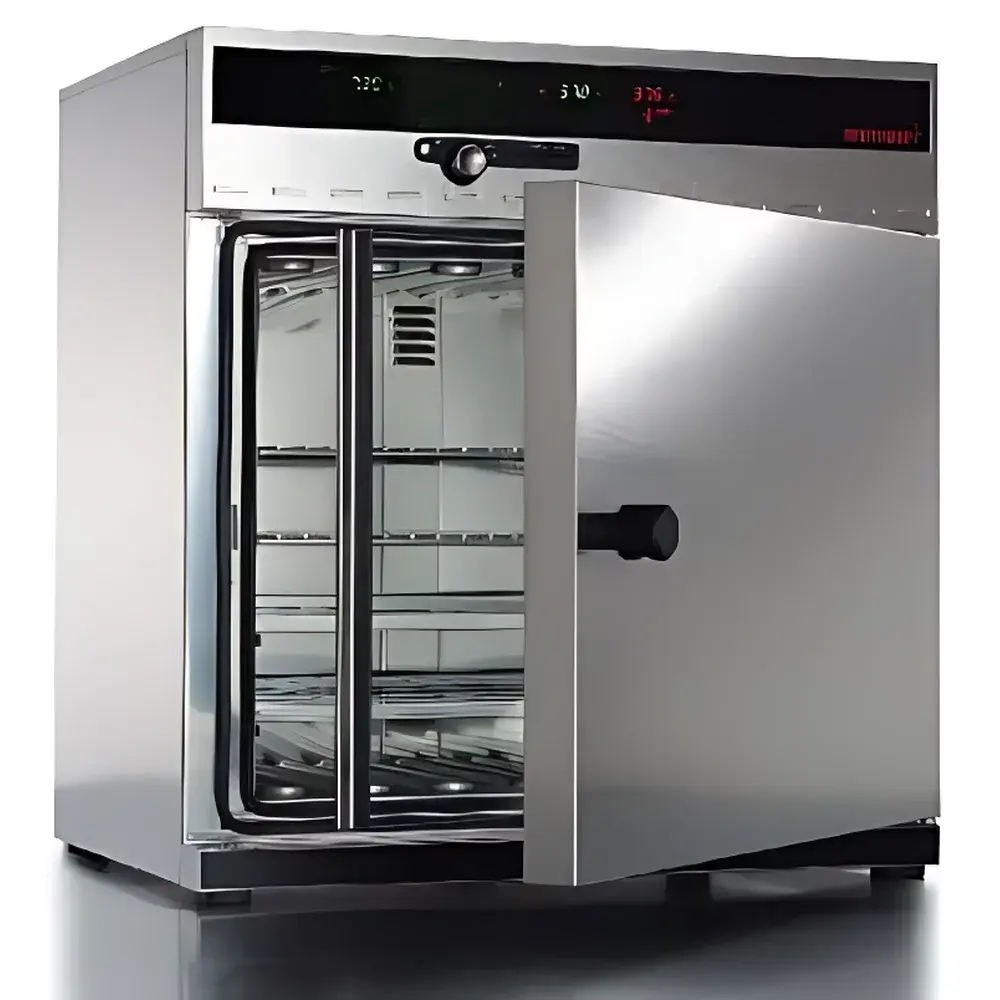
MEMMERT INE500 Natural Convection Incubator
| Origin | Germany |
|---|---|
| Manufacturer Type | Authorized Distributor |
| Origin Category | Imported |
| Model | INE500 |
| Pricing | Upon Request |
Overview
The MEMMERT INE500 is a precision-engineered natural convection incubator designed for stable, reproducible temperature-controlled environments in life science laboratories. Unlike forced-air systems, it relies on gravity-driven air movement—eliminating turbulence and shear stress on sensitive biological samples such as cell cultures, microbiological specimens, and enzymatic assays. Its core thermal architecture integrates four-sided, full-surface heating elements within a fully insulated stainless-steel chamber (material 1.4301 / ASTM 304), ensuring uniform heat distribution and rapid thermal recovery after door openings. The unit operates across a broad temperature range of 20 °C to 70 °C (standard configuration), with optional extension up to 250 °C (U-series) or 300 °C (upon specification). All operational parameters—including temperature setpoint, ramp profiles, dwell times, and real-time deviation—are governed by a dual-Pt100 A-class sensor system with four-wire measurement circuitry, delivering high metrological integrity and redundancy for uninterrupted monitoring.
Key Features
- Natural convection design optimized for low-stress sample incubation—no internal fan-induced airflow or vibration
- Dual A-class Pt100 temperature sensors (four-wire configuration) with independent monitoring and fault-tolerant operation
- PID-based microprocessor controller with fuzzy logic algorithm and integrated self-diagnostic system featuring error code display
- 7-day programmable timer with real-time clock; temperature ramps and holds configurable to the minute
- Up to 4 sequential program segments, each adjustable from 1 minute to 999 hours; supports delay start, temperature hold, and infinite cycling (1–99× or ∞)
- GLP-compliant internal data logger with 1024 kB circular memory—stores setpoints, actual values, timestamps, and system errors at user-defined intervals
- Triple-layer safety architecture: (1) electronic overtemperature protection (TWW, Class 3.1, cut-off at +3 °C above setpoint), (2) mechanical thermostat (TB, cut-off at +10 °C above max chamber limit), and (3) independent solid-state switching circuitry
- Stainless-steel exterior (back panel zinc-coated steel), double-locking insulated door with tempered glass inner pane, and deep-drawn 304 stainless-steel interior chamber
- RS232 interface compatible with MEMMERT’s Celsius 2007 software for remote programming, real-time monitoring, and audit-trail-compliant data export
- Includes factory-issued calibration certificate traceable to national standards (valid at 37 °C, center-point verification per DIN 12880)
Sample Compatibility & Compliance
The INE500 accommodates standard microbiological and cell culture vessels—including Petri dishes, flasks, multiwell plates, and test tubes—on five adjustable stainless-steel perforated shelves (max. 30 kg load per shelf, 60 kg total chamber capacity). Its natural convection profile minimizes condensation and thermal stratification, making it suitable for long-term incubation of suspension cultures, agar-based media, and temperature-sensitive reagents. The device conforms to key international standards including DIN 12880 (incubator performance testing), EN 61000-6-3 (EMC emissions), and EN 61000-6-2 (immunity). Its firmware and data logging architecture support GLP/GMP workflows: all logged entries include date/time stamps, parameter identifiers, and operator-accessible metadata. While not inherently 21 CFR Part 11 compliant out-of-the-box, Celsius 2007 software enables electronic signature implementation and audit trail generation when deployed on validated Windows platforms (tested on Windows NT4 through Windows Vista).
Software & Data Management
Celsius 2007 is MEMMERT’s proprietary PC-based control and analysis software, provided free of charge. It supports bidirectional communication via RS232 and allows unlimited ramp/soak programming, real-time graphing of temperature profiles, and export of time-stamped CSV or PDF reports. The internal 1024 kB memory functions as a ring buffer, retaining approximately six months of data at 1-minute logging intervals. Optional accessories include a parallel printer interface (PCL3-compatible inkjet printers) and STERI memory cards for automated sterilization cycles (e.g., 4 h @ 160 °C). For enhanced portability, the XL memory card (32 kB) stores up to 40 program segments and can be used offline for instrument configuration transfer between labs.
Applications
- Microbiological growth studies (bacterial, fungal, and yeast cultures)
- Cell line maintenance and passaging under defined thermal conditions
- Enzyme activity assays requiring stable ambient-temperature incubation
- Pharmaceutical stability testing (ICH Q1A–Q1E guidelines)
- Quality control of sterile medical devices and packaging materials
- Educational laboratory instruction in molecular biology and microbiology
- Long-term storage of temperature-sensitive reagents and standards
FAQ
What is the temperature uniformity specification at 37 °C?
At 37 °C, the chamber achieves ≤ ±0.6 °C temperature consistency (DIN 12880, measured at 9 points), verified at the geometric center during factory calibration.
Does the INE500 support remote monitoring over Ethernet or USB?
No—only RS232 serial communication is natively supported; USB connectivity requires an external RS232-to-USB converter (not included).
Can the internal data logger be exported directly to LIMS?
Yes—Celsius 2007 exports timestamped CSV files compatible with most LIMS and ELN platforms; raw binary logs require conversion via MEMMERT’s utility tools.
Is the 37 °C calibration certificate NIST-traceable?
The certificate references DAkkS-accredited calibration laboratories (Germany); full NIST traceability is available upon request with additional documentation.
What is the maximum ambient operating temperature for the INE500?
Rated for continuous operation in ambient environments up to 30 °C; derating is recommended above this threshold to maintain thermal stability and component longevity.
Related Products





