
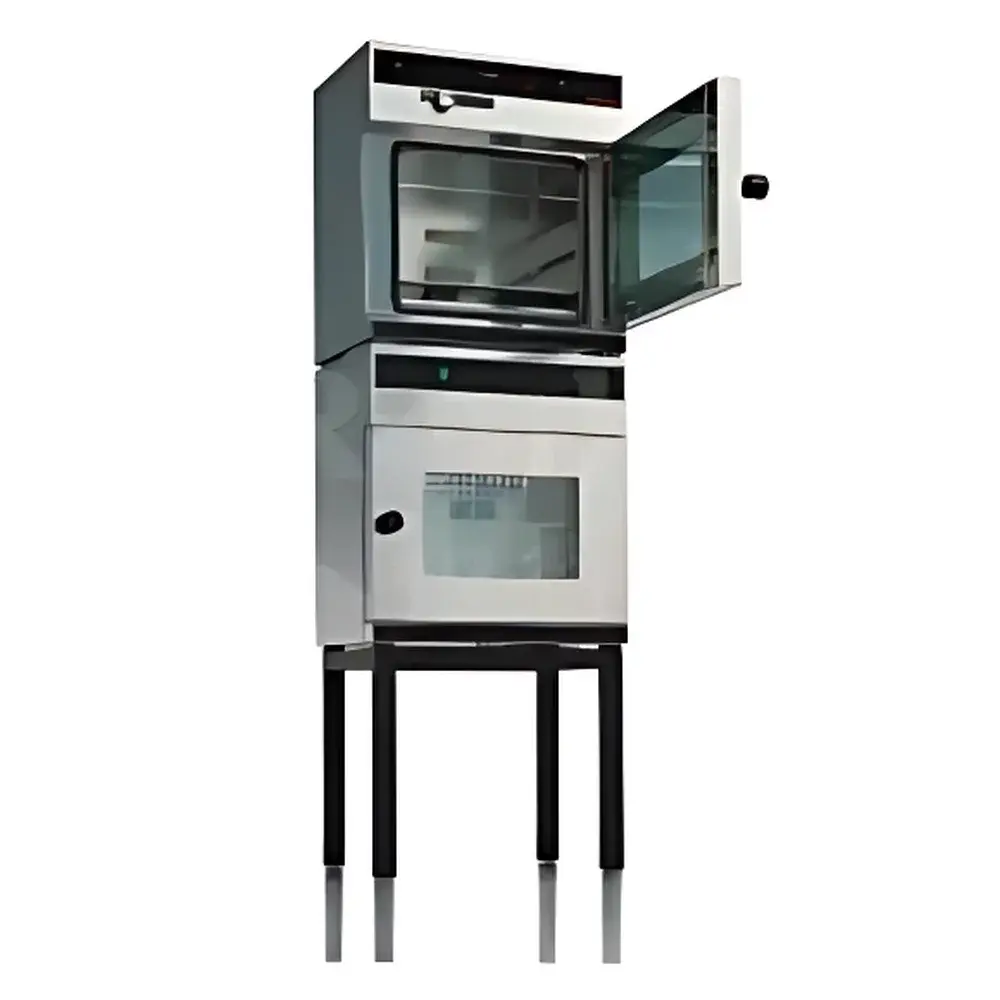
MEMMERT VO200 Vacuum Oven
| Brand | MEMMERT |
|---|---|
| Origin | Germany |
| Model | VO200 |
| Instrument Type | Vacuum Oven |
| Temperature Range | +20 °C to +200 °C |
| Temperature Uniformity (at 160 °C / 50 mbar) | ≤ ±5 °C (on shelf surface) |
| Temperature Stability | ±0.3 °C (per DIN 12880) |
| Chamber Volume | ~29 L |
| Internal Dimensions (W×H×D) | 385 × 305 × 205 mm |
| External Dimensions (W×H×D) | 550 × 600 × 400 mm |
| Shelf Capacity | Up to 3 stainless steel shelves |
| Shelf Spacing | 75 mm |
| Max Load per Shelf | 20 kg |
| Max Total Load | 40 kg |
| Chamber Material | Electropolished AISI 316L stainless steel (EN 1.4404 / ASTM A240) |
| Outer Casing | Textured stainless steel with galvanized steel rear panel |
| Heating System | Direct-backplate MLC (Multi-Level Control) resistive heating elements integrated into each shelf |
| Temperature Sensing | Pt100 Class A, 4-wire, per-shelf independent probes |
| Vacuum Control | Digital electromagnetic valve with programmable setpoint range 5–1100 mbar (display resolution 1 mbar) |
| Gas Inlets | Two digitally controlled, programmable inlets (air + optional process gas) |
| Pressure Regulation | Closed-loop digital pressure control with real-time feedback |
| Safety Systems | Dual independent overtemperature protection (MLOP + mechanical TB), ASF (Automatic Setpoint Linking), microprocessor-based fault diagnostics with audible/visual alarms |
| Programming | Up to 40 temperature–vacuum profiles |
| Compliance | Designed and manufactured in accordance with EN 61010-1, EN 61000-6-3, EN 61000-6-4, and meets essential requirements of EU Machinery Directive 2006/42/EC and EMC Directive 2014/30/EU |
Overview
The MEMMERT VO200 Vacuum Oven is a precision-engineered laboratory drying system designed for applications demanding strict thermal control, minimal oxidation, and reproducible moisture removal under reduced pressure. Operating on the principle of vacuum-assisted thermal desorption, the VO200 eliminates ambient oxygen and lowers the boiling point of volatile solvents and bound water—enabling gentle, low-temperature drying of heat-sensitive, hygroscopic, or oxidation-prone materials. Its core architecture integrates direct-shelf heating via Multi-Level Control (MLC), where high-efficiency resistive elements are bonded directly to the rear of electropolished AISI 316L stainless steel shelves. This design minimizes thermal path length, reduces energy loss, and ensures rapid, uniform heat transfer—achieving up to 75% shorter heating times compared to conventional external-heating vacuum ovens. The chamber’s seamless, deep-drawn 1.4404 stainless steel construction (equivalent to ASTM A240 316L) provides exceptional corrosion resistance and surface integrity, critical for GLP-compliant sample handling and long-term vacuum integrity.
Key Features
- Direct-backplate MLC heating: Independent Pt100 Class A (4-wire) temperature sensors embedded in each shelf enable real-time, per-shelf thermal monitoring and closed-loop control—ensuring sample-level accuracy within ±0.3 °C (per DIN 12880).
- Digital vacuum regulation: Electromagnetic valve with full-range programmable setpoint (5–1100 mbar), real-time digital display, and automatic compensation for chamber load and thermal drift.
- Programmable dual-gas inlet system: Two independently controllable, digitally regulated ports—one for ambient air, one for inert or reactive process gases (e.g., N₂, Ar, forming gas), constructed from corrosion-resistant 1.4571 stainless steel (ASTM 316Ti).
- Integrated drying cycle logic: Combines time- and pressure-triggered transitions between vacuum hold, venting, and heating phases—accelerating moisture removal while preserving sample morphology and chemical stability.
- Comprehensive safety architecture: Dual redundant overtemperature protection (multi-level electronic MLOP + mechanical temperature limiter TB), ASF (Automatic Setpoint Linking) for coordinated shelf-to-chamber response, and microprocessor-based diagnostics with audible/visual alarm outputs.
- Advanced programmability: Supports up to 40 multi-segment temperature–vacuum profiles; each segment configurable from 1 minute to 999 hours. Full PC-based programming via MEMoryControl software (freely available), plus offline editing and transfer using MEMoryCard XL.
Sample Compatibility & Compliance
The VO200 accommodates a broad spectrum of sample types—including pharmaceutical intermediates, polymer precursors, ceramic green bodies, battery electrode coatings, biological tissue sections, and analytical reference standards—without risk of thermal degradation or oxidative alteration. Its electropolished 316L chamber meets stringent cleanliness requirements for ISO Class 5–7 environments and resists chloride-induced pitting during repeated solvent exposure. All wetted components comply with FDA-relevant material specifications (USP , ASTM F899), and the system’s sealed construction maintains leak rates ≤0.01 bar/h—verified per DIN EN ISO 20484. While not inherently 21 CFR Part 11 compliant, the VO200 supports audit-ready operation when paired with MEMmert’s validated software packages and external electronic lab notebook (ELN) integration protocols. It conforms to EN 61010-1 (safety), EN 61000-6-3/-6-4 (EMC), and EU Machinery Directive 2006/42/EC.
Software & Data Management
MEMmert’s MEMoryControl software enables full remote configuration, real-time data logging (temperature, pressure, program stage), and export of timestamped CSV reports compatible with LIMS and quality management systems. The controller logs all operational events—including power cycles, alarm triggers, manual interventions, and vacuum ramp deviations—with non-volatile memory retention. Optional MEMoryCard XL provides tamper-evident, encrypted profile storage and execution traceability. For regulated environments, users may implement procedural controls around software version validation, user access levels, and electronic signature workflows—aligning with ALCOA+ data integrity principles and supporting GMP/GLP audit readiness.
Applications
- Residual solvent removal from active pharmaceutical ingredients (APIs) and excipients per ICH Q5C guidelines.
- Drying of nanomaterial dispersions and catalyst supports without agglomeration.
- Moisture conditioning and outgassing of aerospace composites prior to adhesive bonding.
- Preparation of calibration standards for elemental analysis (ICP-MS, XRF) requiring ultra-low background contamination.
- Thermal stabilization of lithium-ion battery cathode materials under inert gas purge.
- Accelerated aging studies of packaging films and medical device polymers under controlled humidity/vacuum cycling.
FAQ
What is the maximum allowable operating temperature and corresponding vacuum level?
The VO200 is rated for continuous operation up to +200 °C at atmospheric pressure; under vacuum, the recommended upper limit remains +200 °C, though prolonged use above 180 °C at pressures below 10 mbar requires verification of seal longevity and sample compatibility.
Can the VO200 be used for inert-atmosphere processing?
Yes—its dual programmable gas inlets support automated purging, backfilling, and dynamic atmosphere control with nitrogen, argon, or other process gases certified for compatibility with 1.4571 stainless steel components.
Is the internal chamber volume verified per ISO 17025 calibration practices?
Chamber dimensions are factory-measured and documented in the Declaration of Conformity; volumetric verification for specific applications (e.g., gravimetric drying) should be performed using traceable NIST-traceable calibrators as part of user-defined IQ/OQ protocols.
Does the system support remote monitoring via Ethernet or USB?
The VO200 features RS232 and optional Ethernet interfaces; real-time telemetry and profile uploads/downloads are fully supported through MEMoryControl software, enabling integration into centralized facility monitoring platforms.
How is temperature uniformity validated across the working volume?
Uniformity is specified per DIN 12880 at 160 °C and 50 mbar (≤ ±5 °C on shelf surface); users performing qualification per ISO/IEC 17025 should conduct mapping per ICH Q5C Annex 5 or ASTM E2297 using calibrated multi-point sensors.



