
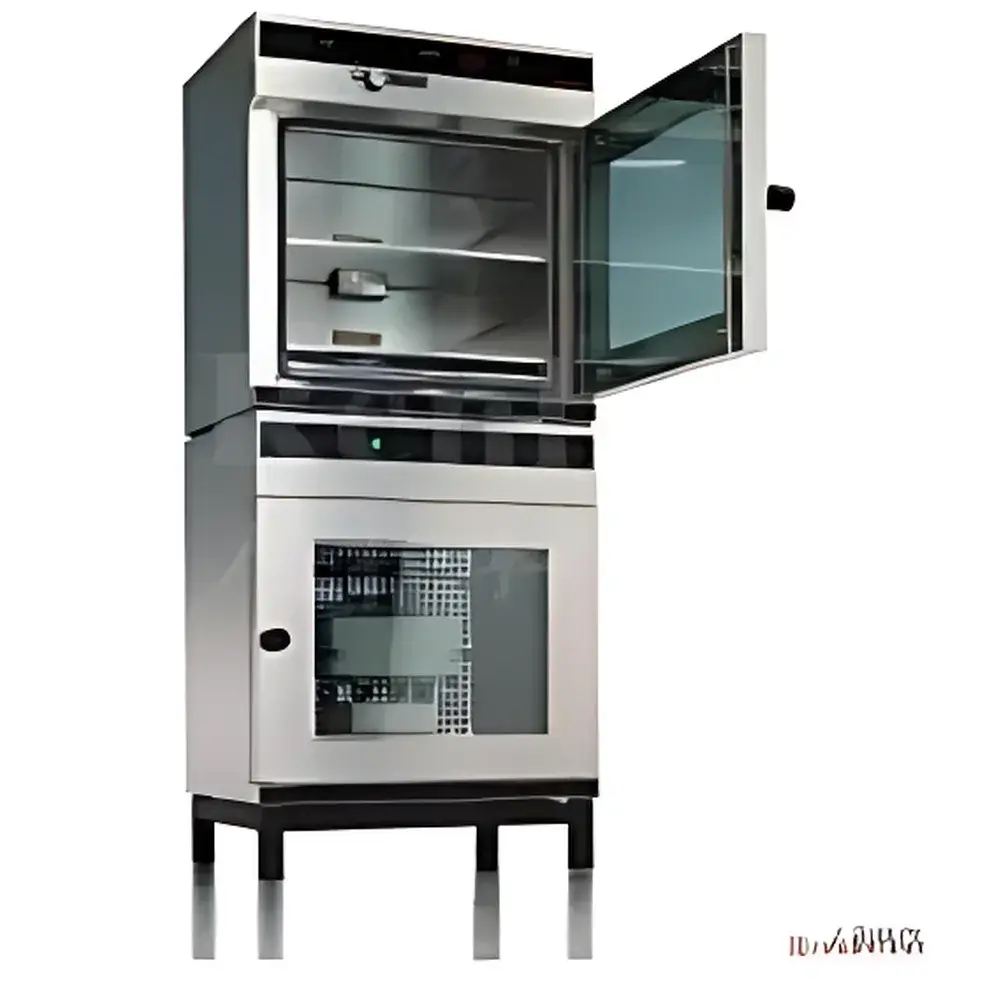
MEMMERT VO500 Vacuum Drying Oven
| Brand | MEMMERT |
|---|---|
| Origin | Germany |
| Model | VO500 |
| Instrument Type | Vacuum Oven |
| Temperature Range | Ambient + 5 °C to 200 °C |
| Temperature Uniformity (at 160 °C / 50 mbar) | ≤ ±5 °C (surface) |
| Temperature Stability | ±0.3 °C |
| Chamber Dimensions (W×H×D) | 545 × 465 × 400 mm |
| External Dimensions (W×H×D) | 710 × 760 × 550 mm |
| Chamber Volume | ~101 L |
| Interior Material | Electropolished Stainless Steel 1.4404 (ASTM 316L) |
| Exterior Material | Textured Stainless Steel with Galvanized Steel Back Panel |
| Heating Method | Internal Multi-Level Control (MLC) with Direct-Attached PTC Heating Elements on Perforated Stainless Steel Shelves |
| Shelf Configuration | Up to 4 Adjustable Shelves (95 mm spacing), Load Capacity: 20 kg/shelf (60 kg total) |
| Vacuum Control | Digital Electromagnetic Valve, Adjustable Range: 5–1100 mbar (displayed), Programmable Setpoint from 10–1100 mbar |
| Pressure Accuracy | ±5 mbar |
| Gas Inlets | 2 Independently Controlled (Air & Optional Process Gas), Tubing Material: 1.4571 (ASTM 316Ti) |
| Safety Systems | Dual Pt100 Class A Sensors per Shelf (4-wire), MLOP Multi-Level Overheat Protection, Mechanical Temperature Limiter (TB), Microprocessor-Based Thermal Monitoring with ASF (Automatic Setpoint Linking), Audible/Visual Alarms, Door-Interlocked Rapid Venting, Leak Rate ≤ 0.01 bar/h, Final Vacuum ≤ 0.01 mbar |
| Programming | 40 Programmable Temperature–Vacuum Profiles, Each with Up to 99 Segments |
| Compliance | Designed and tested per DIN 12880, EN 61000-6-3, EN 61000-6-4, IEC 61010-1, and compatible with GLP/GMP documentation requirements including audit-trail-capable operation when used with MEMControl software |
Overview
The MEMMERT VO500 Vacuum Drying Oven is an engineered solution for precision-controlled, low-thermal-stress drying, degassing, and moisture removal in research laboratories, pharmaceutical QC environments, and materials science facilities. Operating on the principle of reduced-pressure thermal processing, the VO500 eliminates convective heat transfer limitations by evacuating ambient air—thereby suppressing oxidation, lowering boiling points of solvents, and enabling gentle drying of thermolabile or hygroscopic samples. Its core innovation lies in the Multi-Level Control (MLC) heating architecture: high-efficiency PTC heating elements are directly bonded to the rear surface of electropolished stainless steel shelves (material 1.4404 / ASTM 316L), minimizing thermal resistance and achieving up to 75% reduction in heating time compared to conventional external-jacket vacuum ovens. Each shelf integrates a dedicated Class A Pt100 sensor (4-wire configuration) for direct, real-time measurement of shelf surface temperature—ensuring that the thermal setpoint reflects actual sample-contact conditions rather than chamber air or wall temperature.
Key Features
- Direct-shelf MLC heating system with integrated PTC elements and individual Pt100 sensing per shelf—enabling true shelf-surface temperature control with ±0.3 °C stability.
- Digital electromagnetic vacuum regulation with continuous pressure monitoring (5–1100 mbar range), programmable setpoints, and dual independent gas inlets (air and process gas) constructed from corrosion-resistant 1.4571 stainless steel (ASTM 316Ti).
- Electropolished 1.4404 (316L) interior chamber—deep-drawn, seamless, and passivated—to ensure chemical inertness, ease of cleaning, and compliance with ISO 14644-1 Class 5 cleanroom-compatible surface finish.
- Comprehensive safety architecture: multi-tier overheat protection (MLOP), mechanical temperature limiter (TB), microprocessor-based thermal watchdog with automatic setpoint linking (ASF), and door-interlocked rapid venting without vacuum setpoint disturbance.
- Advanced programmability: 40 user-defined temperature–vacuum profiles, each supporting up to 99 time–temperature–pressure segments; weekly scheduling (e.g., Mon–Fri cycles); real-time clock with remaining-time display; and full PC-based programming via free MEMControl software with exportable log files.
- Ergonomic design with tempered safety glass door (ESG), spring-loaded closure mechanism, and textured stainless steel housing over galvanized structural backing for long-term mechanical stability and EMI shielding.
Sample Compatibility & Compliance
The VO500 accommodates a broad spectrum of sample formats—including Petri dishes, weighing boats, glass vials, polymer films, ceramic substrates, and coated wafers—across industries requiring validated thermal processing. Its electropolished 316L chamber and inert gas inlets support applications involving halogenated solvents, acidic vapors, or oxygen-sensitive compounds. The system complies with DIN 12880 for laboratory drying ovens and meets essential requirements of IEC 61010-1 (safety) and EN 61000-6-3/-6-4 (EMC). When operated with MEMControl software and MEMoryCard XL, it supports ALCOA+ data integrity principles: all parameter changes, alarm events, and profile executions are timestamped and stored with operator ID (if networked), fulfilling foundational expectations for GLP and GMP environments. While not inherently 21 CFR Part 11 compliant, its audit-trail-ready architecture enables qualification under FDA-regulated workflows when deployed with appropriate procedural controls and electronic signature protocols.
Software & Data Management
MEMControl—a free, Windows-based application—provides full remote configuration, real-time monitoring, and post-run analysis. Users can define unlimited temperature–vacuum profiles offline, synchronize system clocks, export CSV-formatted temperature/pressure/time logs with millisecond resolution, and generate PDF reports with embedded metadata (operator, date, profile ID, chamber ID). The MEMoryCard XL USB interface allows offline profile transfer and firmware updates without PC connection. All critical operational parameters—including vacuum ramp rates, shelf-specific thermal offsets, and alarm thresholds—are editable and retained across power cycles. Data storage resides both onboard (non-volatile memory) and externally (via USB or network), ensuring traceability aligned with ISO/IEC 17025 Clause 7.5.2 and EU Annex 11 expectations for electronic records.
Applications
- Pharmaceutical: Residual solvent removal from APIs and excipients per ICH Q5C guidelines; moisture content validation per USP <921>; stability-indicating drying of lyophilized intermediates.
- Materials Science: Degassing of composites and adhesives prior to curing; controlled dehydration of MOFs and zeolites; outgassing of thin-film substrates for PVD/CVD processes.
- Electronics: Moisture extraction from PCB assemblies pre-conformal coating; desiccation of MEMS components and ceramic capacitors.
- Academic Research: Solvent-free drying of nanomaterial dispersions; thermal conditioning of battery electrode slurries; gravimetric analysis of hygroscopic salts (e.g., CaCl₂, LiBr).
- Quality Control Labs: Standardized drying protocols for loss-on-drying (LOD) testing per ASTM E1868 and ISO 558.
FAQ
What vacuum level can the VO500 achieve, and how is it maintained?
The VO500 achieves a final vacuum of ≤ 0.01 mbar using optional high-vacuum pump modules (e.g., MEMMERT VP 1000); base configuration maintains 5–1100 mbar with digital electromagnetic valve control and continuous leak-rate monitoring (≤ 0.01 bar/h).
Is shelf temperature independently controllable?
No—shelf temperatures follow the programmed chamber setpoint, but each shelf’s actual surface temperature is measured independently via dedicated Pt100 sensors, enabling precise feedback-driven thermal regulation.
Can the VO500 be integrated into a LIMS or MES environment?
Yes—via RS485 Modbus RTU or optional Ethernet interface (with MEMControl Pro), enabling bidirectional communication for profile push, status polling, and event logging.
Does the VO500 support inert gas purging during drying?
Yes—two digitally regulated gas inlets allow sequential or simultaneous introduction of nitrogen, argon, or other process gases, with flow-independent pressure control between 10–1100 mbar.
What documentation is provided for IQ/OQ/PQ validation?
MEMMERT supplies Factory Acceptance Test (FAT) reports, calibration certificates for Pt100 sensors and pressure transducers, and a comprehensive User Requirement Specification (URS) template compatible with GAMP5 methodology.



