
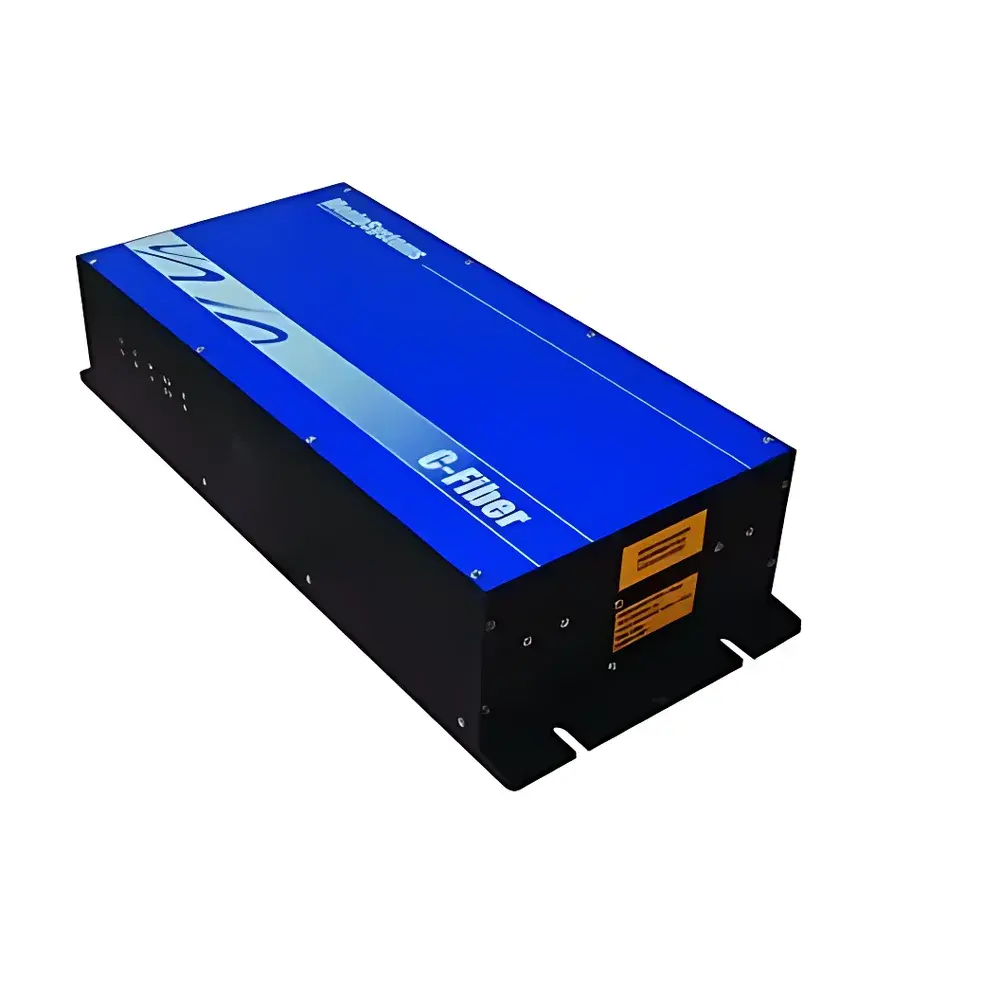
Menlo Systems C-Fiber Series High-Stability Femtosecond Fiber Laser
| Brand | Menlo Systems |
|---|---|
| Origin | Germany |
| Model | C-Fiber Series |
| Wavelength | 1560 ± 20 nm (fundamental), 780 ± 10 nm (SHG) |
| Average Power | >100 mW (C-Fiber), >180 mW (C-Fiber-780 HP) |
| Pulse Energy | >1.0 nJ (C-Fiber), >1.8 nJ (C-Fiber-780 HP) |
| Pulse Width | <90 fs (chirped, fundamental), <120 fs (SHG, <80 fs optional) |
| Repetition Rate | 100 MHz (50–250 MHz configurable) |
| Timing Jitter | <2 fs rms |
| Frequency Stability | <1 ppm over 90 h |
| Output | Polarization-Maintaining fiber or free-space beam |
| Technology | Figure-9® mode-locked oscillator with all-PM fiber architecture |
Overview
The Menlo Systems C-Fiber Series is a high-stability, turnkey femtosecond fiber laser platform engineered for demanding ultrafast science and industrial applications. Based on Menlo’s proprietary Figure-9® mode-locking technology, the system delivers exceptional long-term amplitude and phase stability without active feedback loops—enabling uninterrupted operation over extended periods. Unlike conventional solid-state or bulk-fiber oscillators, the C-Fiber leverages an all-polarization-maintaining (all-PM) fiber architecture from oscillator to output, eliminating alignment-sensitive free-space components and minimizing environmental sensitivity. The laser operates at a fundamental wavelength of 1560 nm (±20 nm), with optional intracavity second-harmonic generation (SHG) producing diffraction-limited 780 nm output. This dual-wavelength capability supports both near-infrared and visible ultrafast experiments while preserving timing fidelity and pulse quality. Designed for integration into complex optical setups—including pump-probe spectrometers, THz generation systems, and multiphoton microscopes—the C-Fiber meets stringent requirements for low timing jitter (<2 fs rms), high repetition-rate stability (<1 ppm over 90 h), and reproducible single-pulse mode-locking.
Key Features
- All-PM fiber design ensures mechanical and thermal robustness, eliminating realignment needs and enabling stable operation in non-laboratory environments
- Figure-9® cavity architecture provides self-starting, environmentally insensitive mode-locking with sub-60-second warm-up time
- Integrated SHG module delivers high-brightness, collimated 780 nm output with minimal pulse broadening (<120 fs, optionally <80 fs)
- Configurable repetition rate (50–250 MHz) via cavity length tuning—preserving pulse energy and spectral bandwidth
- Low-amplitude noise (<0.1% RMS, 10 Hz–10 MHz) and ultra-low phase noise ideal for heterodyne detection and optical frequency comb referencing
- Front-panel interface and remote control via Ethernet/USB support seamless integration into automated test benches and OEM platforms
Sample Compatibility & Compliance
The C-Fiber Series is compatible with standard SMF-28 or PM1550 fiber pigtails (FC/APC or FC/PC connectors), as well as free-space beam delivery options using kinematic mounts. All models comply with IEC 60825-1:2014 Class 4 laser safety standards and include interlock-ready hardware for integration into ISO 13849-1 compliant enclosures. For regulated environments—including GLP/GMP laboratories and medical device R&D—the system supports optional audit-trail-enabled firmware (conforming to FDA 21 CFR Part 11 requirements) when paired with Menlo’s SynchroScan software suite. The laser’s spectral purity, temporal coherence, and long-term frequency stability align with ASTM E2912–21 guidelines for ultrafast source qualification in metrology-critical applications.
Software & Data Management
Control and monitoring are managed through Menlo’s SynchroScan software—a cross-platform application supporting Windows, Linux, and macOS. The software provides real-time oscilloscope-style diagnostics (power, pulse train, RF spectrum), automated power stabilization routines, and programmable parameter sweeps (e.g., repetition rate vs. pulse energy). Data export is native to HDF5 and CSV formats, ensuring compatibility with Python-based analysis pipelines (NumPy, SciPy, Matplotlib) and MATLAB. Remote operation is supported via TCP/IP and SCPI command sets, enabling synchronization with delay stages, detectors, and data acquisition systems. Optional LabVIEW drivers and Python APIs facilitate custom automation in QC/QA workflows and academic research infrastructure.
Applications
- Bioimaging: Two-photon excitation microscopy (TPEF) and second-harmonic generation (SHG) imaging benefit from the C-Fiber’s high peak power, low jitter, and 780 nm output optimized for Ti:sapphire replacement
- THz Generation & Spectroscopy: Optical rectification in ZnTe or DAST crystals requires precise carrier-envelope phase (CEP)-stable pulses; the C-Fiber’s intrinsic low-noise performance enables reliable broadband THz emission
- Ultrafast Pump-Probe Spectroscopy: Sub-100 fs pulses with <2 fs timing jitter ensure high signal-to-noise ratio in transient absorption and coherent anti-Stokes Raman scattering (CARS) measurements
- OEM Seed Sources: Compact footprint and vibration-insensitive design make the C-Fiber ideal as a master oscillator for chirped-pulse amplification (CPA) systems, including Yb-doped fiber and thin-disk amplifier front-ends
- Additive Manufacturing: Dual-wavelength capability supports multi-photon polymerization (MPP) for sub-diffraction-limit 3D nanofabrication, with pulse energy scalability up to 3.5 nJ in HP configurations
FAQ
Is the C-Fiber Series suitable for cleanroom or industrial floor deployment?
Yes—the all-fiber construction, passive thermal management, and absence of moving parts or water cooling enable reliable operation in ISO Class 7 cleanrooms and factory-floor environments with ambient temperature fluctuations up to ±5 °C.
Can I synchronize multiple C-Fiber units for interferometric applications?
Absolutely—each unit features a dedicated RF sync output (SMA) referenced to the pulse train, with jitter <2 fs rms. External triggering and optical synchronization options are available for multi-laser coherence transfer.
Does the system require periodic maintenance or realignment?
No—Menlo Systems designs the C-Fiber as a maintenance-free instrument. No optical alignment, gas replenishment, or consumable replacement is required over its operational lifetime.
What certifications are provided for export and regulatory compliance?
Each unit ships with CE marking, RoHS 2011/65/EU declaration, and full EC Declaration of Conformity. Optional IEC 61000-6-3/6-4 EMC test reports and laser safety certification packages are available upon request.
How does the Figure-9® technology differ from traditional nonlinear polarization evolution (NPE) or semiconductor saturable absorber mirror (SESAM) mode-locking?
Figure-9® employs an unbalanced nonlinear amplifying loop mirror (NALM) within an all-PM fiber cavity, delivering self-starting, environmentally stable mode-locking without sensitive alignment or temperature-dependent absorbers—resulting in superior long-term reliability and lower timing jitter compared to SESAM-based systems.



