
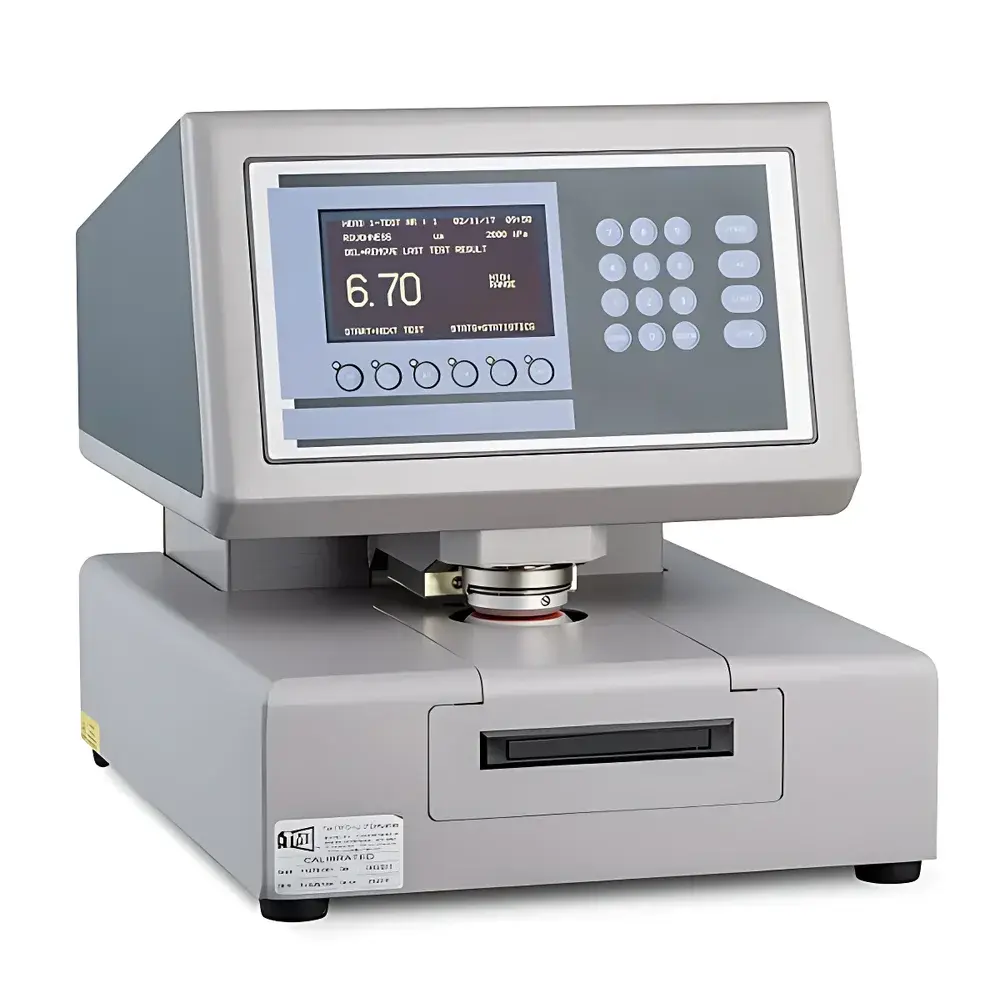
Messmer Buchel 58-06 PPS Surface Roughness Tester
| Brand | Messmer Buchel |
|---|---|
| Origin | Netherlands |
| Model | 58-06 |
| Test Pressure Range | 490–5000 kPa (adjustable) |
| Standard Test Pressure | 1980 kPa |
| Measurement Range | 0.2–6.5 µm (normal mode) |
| Measuring Ring Width | 51 µm |
| Measuring Ring Circumference | 10.0 cm |
| Clamping Pressure Options | 500 / 1000 / 2000 kPa (100–5000 kPa fully adjustable) |
| Air Permeability Range (optional) | 0–10000 mL/min |
| Power Supply | 110 V/60 Hz or 220 V/50 Hz |
| Compressed Air Requirement | 600 kPa, clean and dry |
| Dimensions (L×W×H) | 558 × 430 × 380 mm |
| Weight | 39 kg |
| Data Output | RS-232 or thermal printer |
| Compliance | GB/T 2679, ISO 8791-4, TAPPI T555 |
Overview
The Messmer Buchel 58-06 PPS (Parker Print-Surface) Surface Roughness Tester is a precision-engineered instrument designed specifically for quantifying the surface topography of paper, paperboard, and flexible packaging substrates under controlled,印刷-relevant mechanical loading conditions. Developed in collaboration with Dr. J. R. Parker in the early 1970s, the PPS method employs an air-leakage principle based on controlled compression between a calibrated annular measuring ring and the sample surface—mirroring actual printing nip pressures. Unlike conventional smoothness testers (e.g., Bekk, Bendtsen), the 58-06 operates at significantly higher test pressures—up to 5000 kPa—enabling direct correlation with offset, gravure, and letterpress print performance. Its measurement principle relies on the volumetric flow rate of air escaping radially from the compressed interface between the sample and a standardized backing material; this flow is linearly related to surface micro-geometry under defined pressure and dwell time. The instrument’s robust architecture, dual-ring guard design, and pneumatic pressure control minimize mechanical drift and vibration artifacts, ensuring high reproducibility across laboratories and production environments.
Key Features
- Pneumatically actuated clamping system delivering precise, repeatable test pressures from 100 to 5000 kPa—including factory presets at 500, 1000, and 2000 kPa per TAPPI and ISO recommendations for gravure, offset, and letterpress substrates.
- Annular measuring ring with 10.0 cm circumference and 51 µm width—geometrically aligned with international standard reference geometry for comparative data integrity.
- Dual concentric guard rings surrounding the primary measuring ring reduce edge effects and enhance measurement stability by isolating the active leakage zone from peripheral airflow disturbances.
- Integrated surface blow-off function removes loose fibers and dust prior to measurement, improving inter-laboratory agreement and reducing outlier events.
- Modular configuration supports optional dual-head operation (model 58-07) for parallel testing or comparative analysis of front/back surfaces.
- RS-232 serial interface enables direct connection to LIMS or QA databases; thermal printer output available for audit-ready hardcopy records.
Sample Compatibility & Compliance
The 58-06 is validated for use with a broad spectrum of fibrous and laminated substrates including coated and uncoated papers, newsprint, copy paper, corrugated board liners, metallized films (e.g., aluminum foil laminates), and polymer-based packaging films. Backing material selection is user-configurable to simulate real-world press conditions—standard options include rubber-covered steel plates, silicone elastomers, and compressible felts, all referenced in ISO 8791-4 Annex B. The instrument meets the metrological requirements of GB/T 2679.7 (China), ISO 8791-4:2019 (International Organization for Standardization), and TAPPI T555 om-22 (Technical Association of the Pulp and Paper Industry). Its pressure calibration traceability aligns with ISO/IEC 17025-accredited procedures, supporting GLP-compliant validation protocols and FDA 21 CFR Part 11–ready software configurations when paired with GraphMaster™.
Software & Data Management
When integrated with the optional GraphMaster™ software suite, the 58-06 transforms into a fully networked data acquisition platform. GraphMaster™ provides real-time visualization of air flow decay curves, automated pass/fail flagging against user-defined specification limits, statistical process control (SPC) charting (X̄/R, Cpk), and export to CSV, PDF, or XML formats compatible with enterprise MES and ERP systems. Audit trails record operator ID, timestamp, calibration status, environmental conditions (optional sensor input), and raw flow vs. time datasets—fulfilling ALCOA+ (Attributable, Legible, Contemporaneous, Original, Accurate, Complete, Consistent, Enduring, Available) data integrity criteria. Software validation documentation (IQ/OQ/PQ templates) and electronic signature support are available upon request for regulated environments.
Applications
- Pre-press substrate qualification for gravure, offset, and flexographic printing lines—correlating PPS values with ink transfer uniformity and dot gain behavior.
- Coating uniformity assessment of calcium carbonate, clay, or polymer-coated paperboards used in premium packaging applications.
- Quality gate monitoring for recycled fiber-based linerboards where surface roughness directly impacts print fidelity and varnish adhesion.
- R&D evaluation of calendering parameters, surface sizing formulations, and nanostructured barrier coatings.
- Comparative analysis of film-to-paper lamination interfaces, particularly in pharmaceutical blister packaging where micro-roughness affects peel strength and seal integrity.
- Supporting ISO 12647-2 process control workflows through linkage with G7 grayscale calibration targets and tone value increase (TVI) modeling.
FAQ
What is the fundamental difference between PPS and Bekk smoothness measurements?
PPS measures surface roughness under high, printing-relevant pressure (up to 5000 kPa) using air leakage; Bekk assesses air absorption at low pressure (1.0 kPa), reflecting bulk porosity rather than surface topography.
Can the 58-06 perform air permeance testing?
Yes—when fitted with the optional air permeability test head (SKU 58-06-AP), it complies with ISO 5636-3 and TAPPI T460, covering 0–10000 mL/min at 1.0 kPa differential pressure.
Is calibration traceable to national standards?
Yes—pressure transducers are calibrated annually against NIST-traceable deadweight testers; flow sensors are verified using certified laminar flow elements per ISO/IEC 17025.
Does the instrument support automated calibration verification?
Yes—the built-in calibration routine uses certified reference shims (0.5 µm, 2.0 µm, 5.0 µm) and prompts operators to log verification results with digital timestamps.
What environmental conditions are recommended for optimal operation?
23 ± 2 °C and 50 ± 5 % RH, per ISO 187; compressed air must be filtered to ISO 8573-1 Class 2:2:2 and dried to a dew point ≤ −40 °C.






