
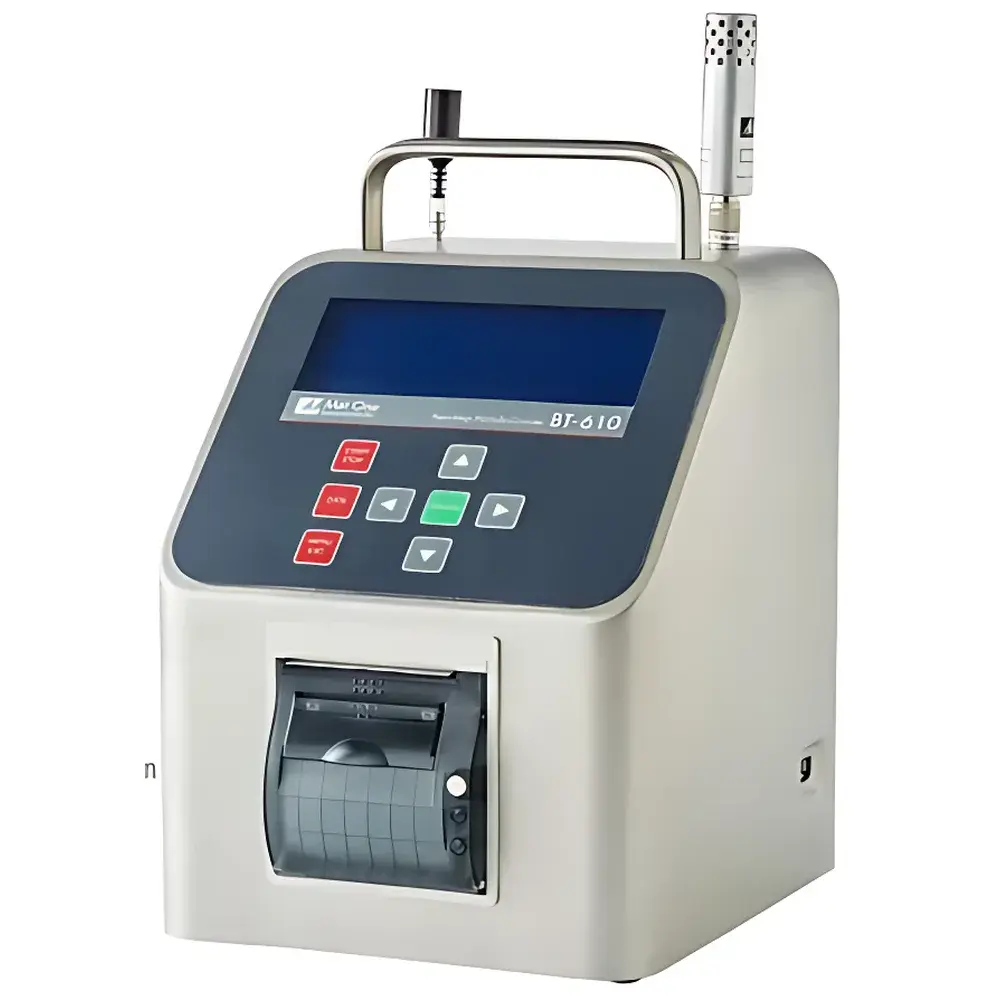
Met One BT-610 Desktop Six-Channel Airborne Particle Counter
| Brand | Met One |
|---|---|
| Origin | USA |
| Model | BT-610 |
| Flow Rate | 1.0 cfm (28.3 L/min) |
| Flow Accuracy | ±5% |
| Timing Accuracy | ±10% |
| Repeatability | ±5% |
| Size Channel Resolution | 0.3–10.0 µm (6 calibrated channels at 0.3, 0.5, 1.0, 2.0, 5.0, 10.0 µm) |
| User-Selectable Sizing | 0.3–2.0 µm in 0.1 µm increments |
| Concentration Range | 0–3,000,000 particles/ft³ (0–105,900 particles/m³) |
| Measurement Accuracy | ±10% (per ISO 21501-4 calibration aerosol) |
| Data Storage Capacity | >8,000 sample events |
| Power | Internal 14.8 V Li-ion battery (8 h continuous / 24 h intermittent) |
| Communication Interfaces | RS-232, RS-485, USB, SD card slot |
| Analog Output | 0–5 VDC |
| Environmental Operating Range | 0–40 °C, 10–90% RH (non-condensing) |
| Dimensions (H×W×D) | 22.2 × 17.1 × 21.5 cm (3.67 kg) |
| Compliance | ISO 21501-4, ISO 14644-1, 21 CFR Part 11, CE, ISO 9001 |
Overview
The Met One BT-610 Desktop Six-Channel Airborne Particle Counter is a precision-engineered instrument designed for real-time, quantitative monitoring of airborne particulate contamination in controlled environments. It operates on the principle of light scattering—using a 780 nm laser diode to detect and size individual particles as they pass through a precisely controlled laminar airflow path. With a certified flow rate of 1.0 cubic foot per minute (28.3 liters per minute), the BT-610 delivers high-fidelity particle concentration data across six user-configurable size channels—from 0.3 µm to 10.0 µm—enabling compliance-driven classification and trending in accordance with ISO 14644-1, EU GMP Annex 1, and FDA guidance for cleanroom environmental monitoring.
Key Features
- Integrated thermal printer with dual operational modes: real-time sample printout (including timestamp, location tag, alarm status) and retrospective data recall (user-defined date/time range).
- Robust stainless-steel enclosure rated for laboratory and industrial deployment; ergonomic desktop footprint (22.2 × 17.1 × 21.5 cm) and lightweight design (3.67 kg) support flexible placement and mobility.
- Internal rechargeable lithium-ion battery providing up to 8 hours of continuous operation or over 24 hours under typical intermittent sampling protocols—ideal for unattended monitoring or field audits.
- Dual programmable particle count alarms with independent threshold settings per channel, triggering audible alerts and visual indicators when limits are exceeded.
- Comprehensive I/O architecture: standard RS-232 and RS-485 digital interfaces, optional analog output (0–5 VDC), USB host port, and SD card slot for local data archival and offline transfer.
- Optional plug-and-play temperature and relative humidity sensor—automatically embeds ambient environmental metadata into each recorded sample event without software reconfiguration.
Sample Compatibility & Compliance
The BT-610 is validated for use with ambient air, compressed gases (e.g., medical air, nitrogen), and filtered process air streams commonly encountered in pharmaceutical manufacturing, biotechnology cleanrooms, semiconductor fabrication, and medical device assembly. Its optical detection system meets ISO 21501-4 requirements for resolution, counting efficiency, and false count rate—ensuring traceable performance against NIST-traceable PSL standards. The instrument’s firmware implements full 21 CFR Part 11 functionality, including role-based password protection, electronic audit trails, and immutable record storage—supporting GLP/GMP-regulated workflows and regulatory inspections. Calibration certificates are issued per ISO 14644-1 Annex B procedures and include uncertainty budgets compliant with ISO/IEC 17025-accredited laboratories.
Software & Data Management
Data acquisition and analysis are supported via Met One’s ParticleView™ software suite—a Windows-based application enabling remote configuration, real-time graphing, statistical reporting (e.g., UCL calculation per ISO 14644-2), and export to CSV, PDF, or XML formats. For integration into enterprise MES or SCADA systems, ASCII command-line protocol over RS-232/RS-485 allows direct parsing of raw particle counts, timestamps, and environmental parameters. All stored samples (>8,000 events) retain full metrological context—including flow verification flags, battery voltage logs, and sensor health diagnostics—to facilitate root-cause analysis during deviation investigations.
Applications
- Cleanroom certification and routine monitoring per ISO 14644-1 Class 5–8 environments.
- Environmental qualification of aseptic processing isolators and RABS in pharmaceutical and biologics manufacturing.
- Filter integrity testing and upstream/downstream challenge studies for HEPA/ULPA filtration systems.
- Particulate baseline characterization in food-grade packaging lines and sterile compounding pharmacies.
- In-process monitoring during aircraft cabin air recirculation system validation and HVAC commissioning.
- Research-grade aerosol generation and deposition studies requiring multi-channel temporal resolution.
FAQ
Does the BT-610 require annual recalibration?
Yes—per ISO 21501-4 and internal quality system requirements, annual recalibration using NIST-traceable polystyrene latex (PSL) standards is recommended. Met One-certified service centers provide full calibration reports with measurement uncertainty statements.
Can the instrument operate while charging?
Yes—the BT-610 supports hot-swap operation: it remains fully functional during AC adapter connection, with simultaneous battery charging and uninterrupted sampling.
Is the built-in printer compatible with external label printers?
No—the integrated thermal printer is fixed-function and non-replaceable; however, ASCII output via RS-232 enables seamless redirection to networked or industrial label printers using third-party terminal emulation.
What is the minimum detectable particle size, and how is sensitivity verified?
The lower detection limit is 0.3 µm, verified per ISO 21501-4 Clause 6.2.2 using monodisperse PSL aerosols. Counting efficiency at 0.3 µm is ≥50%, with ≥100% efficiency above 0.5 µm.
How does the BT-610 handle condensation or high-humidity sampling?
The instrument is rated for operation up to 90% RH non-condensing. For saturated or dew-point-critical applications, an inline desiccant dryer or heated sampling line is required upstream of the inlet to prevent optical obscuration and sensor drift.
Related Products







