
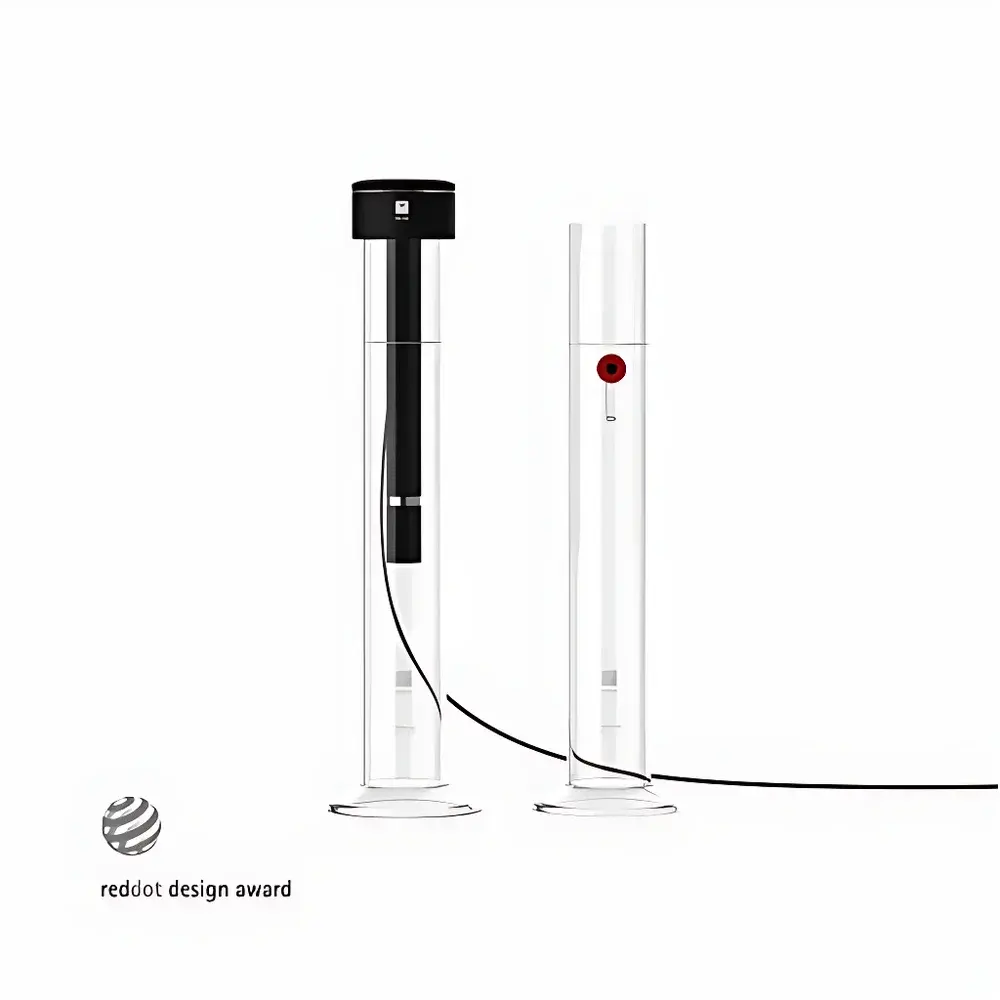
METER PARIO Plus Soil Particle Size Analyzer
| Brand | METER |
|---|---|
| Origin | Italy |
| Manufacturer Type | Authorized Distributor |
| Origin Category | Imported |
| Model | PARIO Plus |
| Price | USD 8,400 (FOB) |
| Particle Size Range | 2–63 µm |
| Estimated Mass Fraction Error | ±1.0% |
| Pressure Measurement Accuracy | ±1.0 Pa |
| Resolution | ±0.1 Pa |
| Measurement Interval | 10 s |
| Typical Suspension Volume | 1,000 mL |
| Temperature Operating Range | 15–35 °C (Optimal: 20 °C |
| Max ΔT During Measurement | ±1.5 °C) |
| Sample Mass | 25–50 g per 1 L suspension |
| Instrument Height | 293 mm |
| Diameter | 80 mm |
| Material | POM polymer & stainless steel |
| Glass Cylinder Dimensions | H 450 mm, ID 59 mm, OD 67.5 mm, Volume 1,000 cm³ |
| Material | Borosilicate Glass 3.3 |
| Power Supply | USB 5 V / 100 mA |
| Interface | USB 2.0 |
| Compliance | EM Directive 2014/30/EU, EN ISO/IEC 17050:2010 (CE Mark) |
Overview
The METER PARIO Plus Soil Particle Size Analyzer is an automated, benchtop instrument engineered for high-precision, Stokes-based sedimentation analysis of soil particle size distribution (PSD) in the silt and clay fractions (2–63 µm). Unlike laser diffraction or image analysis systems—which require empirical calibration via soil-specific transfer functions—the PARIO Plus implements a physics-first approach grounded exclusively in Stokes’ law. It eliminates reliance on optical assumptions, refractive index corrections, or shape-dependent scattering models. Instead, it continuously monitors hydrostatic pressure and temperature at a fixed depth within a vertically oriented, thermally stabilized suspension column using a high-resolution pressure transducer (±0.1 Pa resolution). This enables direct, real-time inference of suspended mass concentration as a function of settling velocity—thereby generating a continuous, differentiable PSD curve without interpolation or discrete time-point sampling. The system operates fully autonomously after initial setup: users load the prepared suspension, initiate measurement via software, and return only to open the drain valve at completion. Total measurement duration is ≤3 hours—reducing labor time by >85% compared to classical hydrometer or pipette methods—and delivers reproducible results with a certified mass fraction uncertainty of ±1.0%, validated against NIST-traceable reference soils.
Key Features
- Extended Integral Suspension Pressure Method (ISP+): An evolution of the original ISP algorithm (Durner et al., 2017), incorporating dynamic thermal compensation and multi-point pressure drift correction to improve low-concentration sensitivity in the <2 µm range.
- No Transfer Function Dependency: Unlike laser diffraction (ISO 13320) or sieve-image hybrid systems, PARIO Plus requires no site-specific calibration curves—enabling cross-laboratory comparability and method transfer without revalidation.
- Non-Invasive Measurement Architecture: No hydrometer insertion, no pipetting, and no mechanical stirring during sedimentation—minimizing flow disturbance and preserving natural settling dynamics.
- Integrated Thermal Monitoring: Onboard PT100 sensor records temperature at 10 s intervals, enabling real-time Stokes velocity correction per ASTM D422-16 Annex A3 for viscosity and density variations.
- Automated Workflow Compliance: Supports GLP-compliant metadata tagging (operator ID, sample ID, date/time stamp, environmental logs) and audit-ready export of raw pressure-time-temperature series in CSV and HDF5 formats.
Sample Compatibility & Compliance
The PARIO Plus accepts standard soil suspensions prepared per ISO 11277 (dispersion with sodium hexametaphosphate) and ASTM D422-16 (pre-treatment for organic matter removal). It is validated for mineral soils with clay content ≥1% and organic carbon ≤5%. Sand fraction (>63 µm) must be pre-removed via wet sieving (ASTM D1140); silt+clay fractions are analyzed directly. The instrument complies with CE marking requirements under the EU Electromagnetic Compatibility Directive 2014/30/EU and conforms to EN ISO/IEC 17050:2010 for declaration of conformity. While not FDA 21 CFR Part 11-certified out-of-the-box, its data export architecture supports integration into validated LIMS environments with supplementary electronic signature and audit trail modules.
Software & Data Management
PARIO Plus operates via the proprietary METER Pro software (Windows 10 64-bit required), which provides guided workflow initiation, real-time visualization of pressure decay curves, automatic baseline correction, and ISO-standard PSD reporting (logarithmic phi-scale or metric µm scale). All raw sensor data—including synchronized pressure, temperature, and elapsed time—are stored locally with SHA-256 checksum integrity verification. Export options include ISO-compliant XML (ISO 13322-2), tab-delimited ASCII, and MATLAB-compatible .mat files. Batch processing supports up to 24 samples per session with automated report generation (PDF + Excel), including statistical summaries (D10, D50, D90, clay/silt/sand %, textural class per USDA or FAO classification).
Applications
- Soil texture classification for agricultural land evaluation and irrigation scheduling (FAO 2015 guidelines)
- Clay content quantification in geotechnical site characterization per ASTM D2487
- Validation of pedotransfer functions (PTFs) used in hydrological modeling (e.g., HYDRUS, SWAT)
- Quality control of manufactured soils and growing media (EN 13041)
- Long-term monitoring of erosion-induced textural change in watershed studies
- Method comparison studies for ISO/IEC 17025-accredited laboratories seeking alternatives to manual hydrometer analysis
FAQ
Does PARIO Plus require organic matter removal prior to analysis?
Yes—organic matter must be oxidized using hydrogen peroxide or sodium hypochlorite per ISO 11277 to prevent flocculation artifacts. Failure to remove organics will bias clay estimates upward.
Can PARIO Plus measure particles outside the 2–63 µm range?
No—it is optimized for fine-grained sedimentation dynamics governed by Stokes’ law. Coarse sand (>63 µm) must be removed by wet sieving; nanoparticles (<2 µm) exhibit Brownian dominance and fall outside Stokes regime validity.
Is temperature stabilization external or internal?
The instrument includes passive thermal mass design and active ambient temperature logging, but does not incorporate active cooling/heating. Users must conduct measurements in climate-controlled labs (±1.5 °C stability over 3 h).
How is clay content calculated?
Clay is defined as the cumulative mass fraction settling slower than the 2 µm Stokes velocity threshold at 20 °C—computed directly from the integrated pressure decay curve without interpolation or fitting.
What sample preparation standards does PARIO Plus support?
Full compatibility with ISO 11277, ASTM D422-16, and DIN 18123-2; includes built-in validation checks for suspension density, dispersion adequacy, and temperature drift tolerance.







