
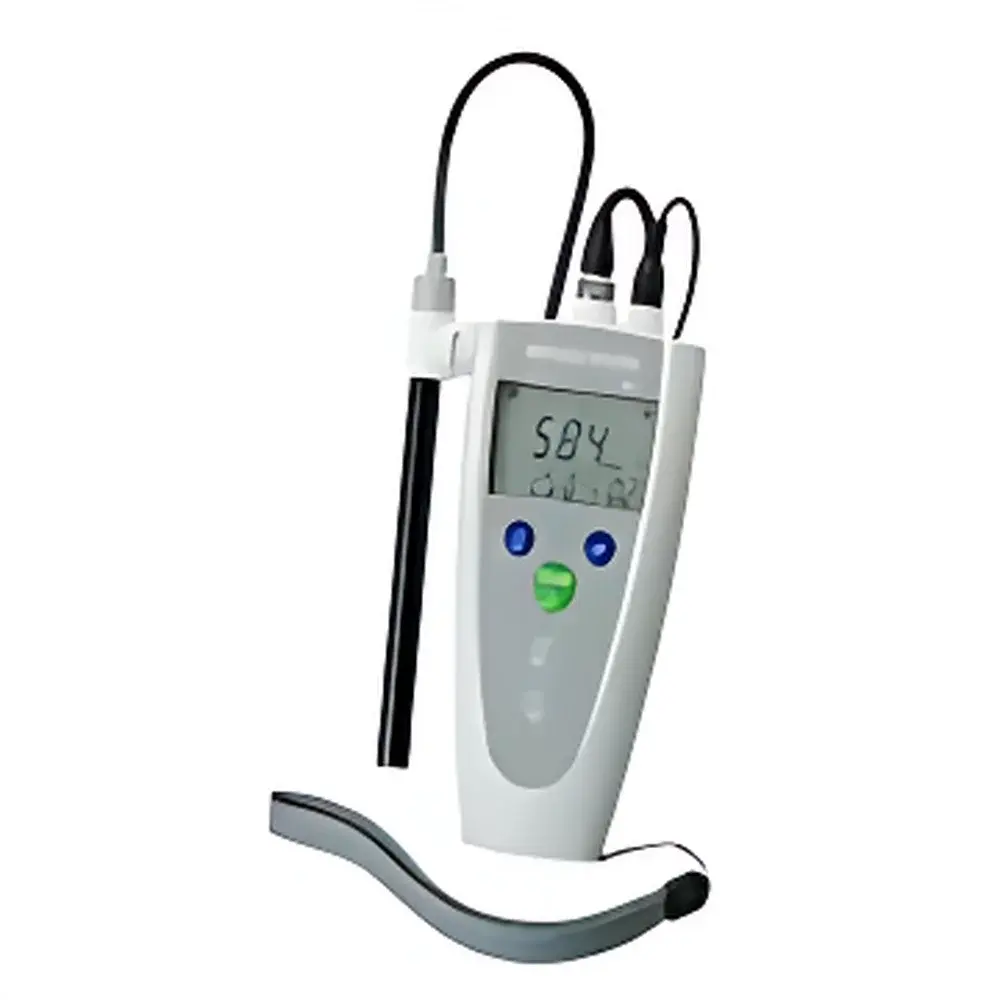
Metler Toledo FG4 Basic Portable Dissolved Oxygen Meter
| Brand | Mettler Toledo |
|---|---|
| Model | FG4 |
| Measurement Principle | Galvanic Cell (Self-Polarizing) |
| Temperature Compensation | Automatic (NTC 30 kΩ) |
| Atmospheric Pressure Compensation | Manual or Optional Barometric Sensor Input |
| Salinity Compensation | Manual Input (0–70 g/L) |
| Display | Backlit LCD with Electrode Status Indicator |
| Power Supply | 4 × AA Batteries (incl.) |
| IP Rating | IP67 |
| Operating Temperature | 0–50 °C |
| Storage Temperature | –25–70 °C |
| Compliance | CE, RoHS, ISO 5814 (Dissolved Oxygen — Electrochemical Probe Method) |
| Electrode Compatibility | LE611 (Standard), LE612 (Ruggedized) |
| Data Output | None (Standalone Unit) |
| Calibration | 1-point Air Saturation or 2-point (Air + Zero Solution) |
| Units | mg/L, % saturation, ppm, µmol/L |
| Resolution | 0.01 mg/L (DO), 0.1 °C (Temp) |
| Accuracy | ±0.2 mg/L (0–20 mg/L), ±0.5 °C (Temperature) |
Overview
The Mettler Toledo FG4 Basic Portable Dissolved Oxygen Meter is a field-deployable, galvanic cell-based instrument engineered for reliable, rapid, and maintenance-free measurement of dissolved oxygen (DO) in aqueous samples. Unlike polarographic sensors requiring polarization time, external power, and periodic membrane/electrolyte maintenance, the FG4 integrates self-polarizing galvanic electrodes (LE611/LE612) that generate a stable current proportional to oxygen partial pressure—enabling immediate measurement upon immersion. Designed as part of the FiveGo™ family of entry-level portable meters, the FG4 delivers traceable accuracy aligned with ISO 5814 for electrochemical DO determination. Its robust IP67 housing ensures operational integrity in humid, splash-prone, or outdoor environments typical of wastewater treatment plants, aquaculture ponds, surface water monitoring stations, and food & beverage process lines.
Key Features
- Galvanic cell technology: Eliminates polarization delay, external bias voltage, and routine electrolyte refills or membrane replacements—reducing total cost of ownership and operator dependency.
- Intuitive three-button interface: Dedicated Read, Calibrate, and Setup keys enable full operation without menu navigation—critical for field technicians performing multi-site surveys under time constraints.
- Real-time electrode health monitoring: On-screen icon alerts indicate declining sensor performance prior to calibration drift or signal instability, supporting proactive quality assurance.
- Comprehensive environmental compensation: Manual salinity input (0–70 g/L) and atmospheric pressure adjustment (or optional barometric sensor integration) correct for site-specific solubility variations per ISO 5814 Annex B.
- Ready-to-measure configuration: Supplied as a complete kit—including LE611 galvanic DO probe, integrated NTC temperature sensor, four AA batteries, calibration caps, and transport case—minimizing setup latency in emergency response or routine surveillance.
Sample Compatibility & Compliance
The FG4 is validated for use across freshwater, seawater, brackish effluents, fermentation broths, and chilled process streams (0–50 °C). Its galvanic electrodes exhibit minimal flow dependence above 0.3 m/s and are insensitive to hydrogen sulfide interference up to 2 mg/L—making them suitable for anaerobic digester influent screening and aquaculture hypoxia assessment. Regulatory alignment includes compliance with ISO 5814:2017 (water quality — determination of dissolved oxygen — electrochemical probe method), CE marking per EU Directive 2014/30/EU (EMC) and 2011/65/EU (RoHS), and adherence to GLP documentation practices via manual calibration log retention. While the FG4 does not support electronic audit trails or 21 CFR Part 11 compliance natively, its calibration records—including date, pressure/salinity inputs, and air-saturation reference values—meet minimum QA requirements for ISO/IEC 17025-accredited environmental labs conducting non-critical DO screening.
Software & Data Management
As a standalone portable meter, the FG4 does not feature Bluetooth, USB, or PC connectivity. All measurements are displayed in real time on the backlit LCD and retained only as visual readouts. Users manually record results—including mg/L, % saturation, temperature, and compensation parameters—in field notebooks or LIMS-compatible spreadsheets. This architecture prioritizes operational simplicity and battery longevity (>200 hours continuous use) over digital data capture—a deliberate design choice for applications where regulatory reporting thresholds do not mandate automated traceability (e.g., preliminary site assessments, educational demonstrations, or internal process checks). For laboratories requiring electronic data handling, Mettler Toledo recommends pairing the FG4 with the LabX® software suite via compatible intermediate devices or upgrading to the SevenCompact™ line with RS232 output.
Applications
- Wastewater treatment: Rapid verification of aeration basin DO levels during plant startup, troubleshooting, or regulatory spot checks—without waiting for sensor stabilization.
- Aquaculture management: Diurnal DO profiling in ponds and raceways to prevent hypoxic stress in finfish and shellfish stocks.
- Environmental field monitoring: Stream and lake surveys compliant with EPA Method 360.1 (dissolved oxygen by membrane electrode) when used with appropriate calibration protocols.
- Food & beverage QC: Verification of deaeration efficiency in carbonated beverage fillers or dissolved oxygen ingress in sterile packaging lines.
- Academic instruction: Teaching core principles of oxygen solubility, Henry’s law, and electrochemical sensing in undergraduate environmental science laboratories.
FAQ
Does the FG4 require electrode polarization before first use?
No. Galvanic cell electrodes (LE611/LE612) are self-polarizing and deliver stable signals immediately upon immersion—eliminating the 5–15 minute warm-up period typical of Clark-type sensors.
Can the FG4 measure DO in high-salinity seawater?
Yes. Manual salinity compensation (0–70 g/L) corrects for reduced oxygen solubility in marine environments, enabling accurate mg/L readings in coastal and offshore applications.
Is temperature measurement integrated or external?
Temperature is measured automatically via an integrated NTC 30 kΩ thermistor embedded in the LE611/LE612 probe body—ensuring simultaneous, co-located DO and temperature acquisition.
What calibration standards are recommended for routine verification?
A single-point air-saturation calibration at ambient pressure and temperature is sufficient for most field applications; a two-point calibration (air + sodium sulfite zero solution) is advised for laboratory-grade reproducibility.
How often should the LE611 electrode be replaced?
Under normal use (≤4 hrs/day, clean freshwater), LE611 electrodes maintain specification accuracy for 12–18 months; performance degradation is indicated by the on-screen electrode status icon prior to failure.
Related Products







