
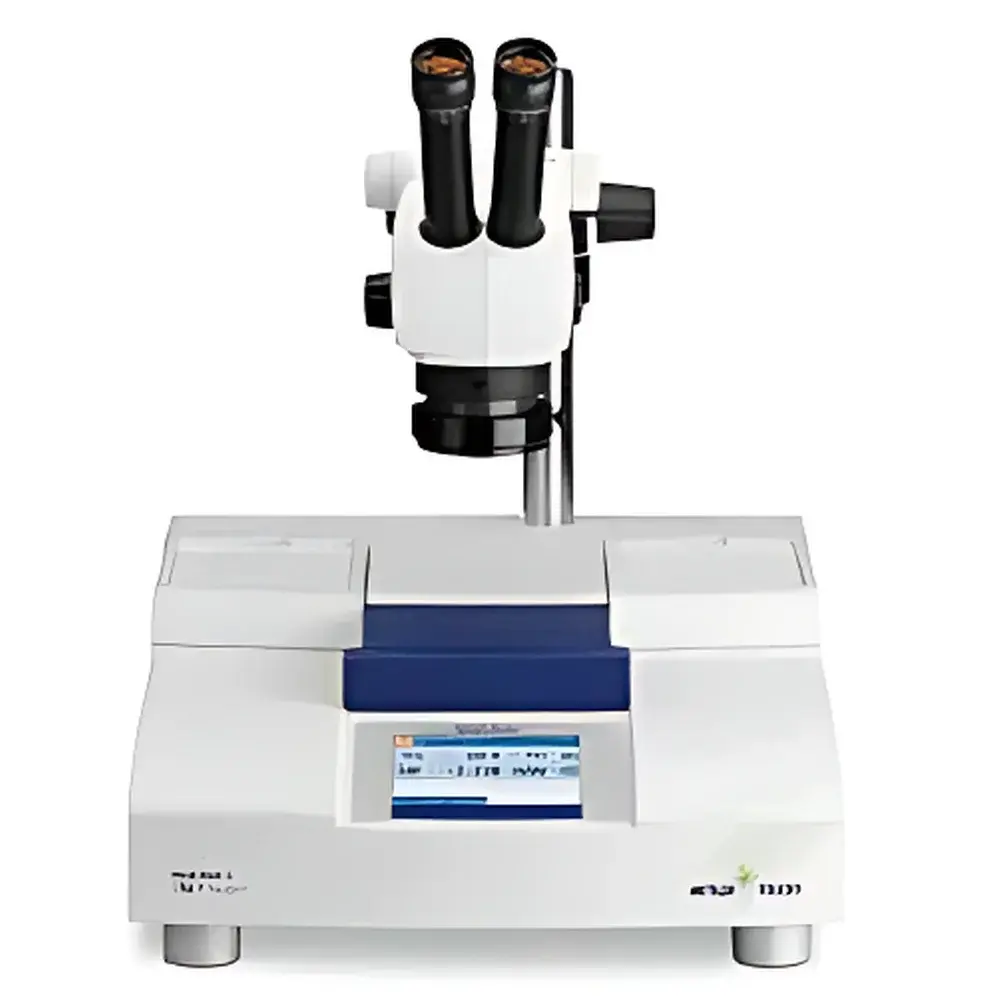
Metler Toledo Flash DSC1 Ultrafast Scanning Calorimeter
| Brand | METTLER TOLEDO |
|---|---|
| Origin | Switzerland |
| Model | Flash DSC1 |
| Heating Rate | up to 2,400,000 K/min |
| Cooling Rate | up to 240,000 K/min |
| Sensor Type | UFS1 MEMS-based chip sensor with 16 thermocouple pairs (8 on sample side, 8 on reference side) |
| Time Constant | ~1 ms |
| Measurement Principle | Dynamic power-compensated differential scanning calorimetry |
Overview
The METTLER TOLEDO Flash DSC1 is an ultrafast scanning calorimeter engineered for nanosecond-scale thermal analysis of materials undergoing non-equilibrium transitions. Unlike conventional DSC systems operating at heating rates below 100 K/min, the Flash DSC1 employs a patented dynamic power-compensation architecture coupled with a monolithic MEMS-based sensor (UFS1) to achieve controlled heating rates up to 2,400,000 K/min and cooling rates up to 240,000 K/min. This capability enables direct observation of transient structural events—such as vitrification, cold crystallization, and metastable phase formation—that are kinetically inaccessible using standard thermal analysis instrumentation. The instrument operates on the principle of differential heat flow measurement between sample and reference, where two independently controlled micro-heaters (one per side of the UFS1 chip) deliver precise thermal programs while 16 integrated thermocouple pairs simultaneously resolve minute enthalpic changes with sub-millisecond temporal resolution.
Key Features
- MEMS-based UFS1 sensor with 16 symmetrically arranged thermocouple pairs (8 per side), ensuring high spatial temperature uniformity and signal reproducibility
- Ceramic substrate mounting with integrated electrical interconnects for mechanical stability and long-term calibration integrity
- Nanosecond-scale thermal response: time constant ≈ 1 ms—three orders of magnitude faster than conventional DSC sensors
- Aluminum-coated SiN/SiO₂ membrane structure on sample side, minimizing thermal mass and enabling homogeneous temperature distribution across the active area
- Dynamic power compensation circuitry that actively balances thermal load during extreme ramp rates, suppressing baseline drift and noise
- Modular design compliant with ISO 11357 and ASTM E1269 standards for fast-scanning calorimetry applications
Sample Compatibility & Compliance
The Flash DSC1 accommodates solid-state samples ranging from 1 ng to 500 ng, including polymers, pharmaceuticals, metallic glasses, and inorganic thin films. Sample preparation is performed under inert atmosphere or vacuum to prevent oxidative degradation during ultra-rapid thermal cycles. Instrument firmware and hardware architecture support GLP/GMP-compliant operation, including full audit trail logging, user access control, and electronic signature capability per FDA 21 CFR Part 11 requirements. All calibration procedures—including temperature, enthalpy, and rate verification—are traceable to NIST-certified reference materials and documented in accordance with ISO/IEC 17025.
Software & Data Management
STARe software serves as the native platform for method development, real-time data acquisition, and advanced kinetic modeling. It supports multi-rate experimental design (e.g., variable cooling ramp sequences to probe nucleation kinetics), automatic baseline correction for ultra-fast transients, and integration with third-party modeling tools such as Kinetics Neo for Avrami and Ozawa-Flynn-Wall analysis. Data export formats include ASCII, CSV, and HDF5 for interoperability with Python-based scientific computing environments (NumPy, SciPy, Pandas). All raw and processed datasets are stored with metadata tags covering instrument configuration, environmental conditions, operator ID, and timestamped version history.
Applications
- Crystallization kinetics of semi-crystalline polymers under injection-molding-relevant cooling conditions
- Stabilization behavior of amorphous active pharmaceutical ingredients (APIs) during storage and processing
- Phase transformation mapping in bulk metallic glasses and chalcogenide alloys
- Thermal stability assessment of nanoscale thin-film coatings and 2D materials
- Decoupling of overlapping thermal events (e.g., glass transition + cold crystallization) via rate-dependent separation
- Development of structure–property relationships for rapid-processed functional materials
FAQ
What is the minimum detectable enthalpy change for Flash DSC1?
The detection limit depends on sample mass and heating rate but typically reaches ±0.1 µJ for 100 ng polymer samples at 100,000 K/min.
Can Flash DSC1 perform isothermal measurements?
Yes—it supports isothermal holds from 10 ms to several seconds, enabling direct measurement of nucleation onset and growth kinetics.
Is the UFS1 sensor replaceable by the user?
No—the UFS1 chip is factory-calibrated and permanently mounted; sensor replacement requires certified service technician intervention and recalibration.
Does STARe software support automated batch processing of multi-rate datasets?
Yes—customizable scripting modules allow sequential analysis of hundreds of curves with consistent baseline fitting, peak deconvolution, and kinetic parameter extraction.
How does Flash DSC1 ensure temperature accuracy at extreme ramp rates?
Through real-time feedback from all 16 thermocouples and adaptive PID control of the dual micro-heaters, maintaining ±0.5 K absolute accuracy across the full 25–700 °C operating range.
Related Products



