
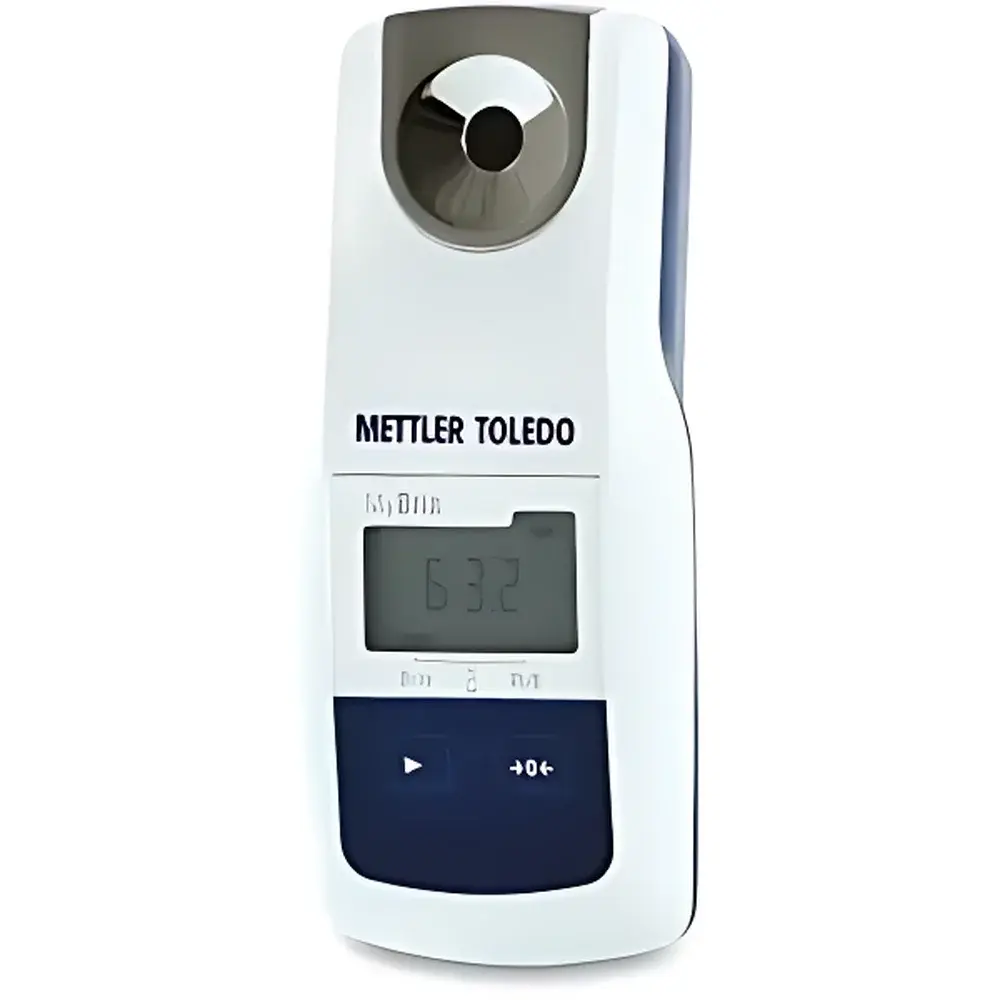
Metler Toledo MyBrix Handheld Refractometer
| Brand | METTLER TOLEDO |
|---|---|
| Origin | Switzerland |
| Model | MyBrix |
| Product Type | Handheld Refractometer |
| Display | Digital |
| Measurement Range | 0–95 °Brix |
| IP Rating | IP65 |
| Temperature Compensation | Automatic (ATC) |
| Prism Design | Shallow, Easy-Clean Geometry |
| Battery Life | Up to 10,000 measurements |
| Predefined Scales | 10 built-in scales (3 simultaneously active) |
| Weight (with batteries) | 115 g |
Overview
The METTLER TOLEDO MyBrix is a precision-engineered handheld refractometer designed for rapid, field-deployable measurement of refractive index and derived concentration units—including Brix (°Brix), refractive index (nD), alcohol content, wine must weight (Oechsle, KMW, Baumé), beer wort density (Plato), and salinity. Based on the fundamental optical principle of total internal reflection at the prism-sample interface, the instrument determines sample concentration by measuring the critical angle shift induced by changes in the sample’s refractive index. Its compact, ergonomic form factor—engineered for one-handed operation—makes it ideal for quality control in food & beverage production lines, agricultural field testing, winemaking cellars, craft brewing facilities, and laboratory benchtop verification tasks where portability and speed are essential without compromising metrological integrity.
Key Features
- High-accuracy optical system with temperature-compensated sapphire prism and LED illumination for stable, repeatable readings across ambient conditions (10–40 °C)
- Simultaneous activation of up to three user-selected scales from ten pre-programmed industry-standard units—including °Brix (0–95), nD (1.333–1.532), Oechsle (0–150), Plato (0–45), and % w/w NaCl (0–28)
- Automatic Temperature Compensation (ATC) compliant with ISO 2173 and AOAC Official Method 932.12, eliminating manual correction and ensuring traceable results across variable operating environments
- Ruggedized housing rated IP65—dust-tight and protected against low-pressure water jets—enabling reliable use in humid processing areas, outdoor orchards, or wet brewery floors
- Ergonomic rubber-overmolded body with tactile keypad and large, high-contrast LCD display for legibility under varied lighting conditions
- Shallow-angle prism geometry minimizes residual sample retention and accelerates cleaning—critical for high-throughput applications involving viscous or particulate-laden samples (e.g., fruit pulp, unfiltered wort)
- Long-life lithium battery supporting ≥10,000 measurements per charge; no memory loss during battery replacement
Sample Compatibility & Compliance
The MyBrix accommodates aqueous solutions, syrups, juices, musts, worts, brines, and other transparent to semi-transparent liquids with low turbidity (<5 NTU). It is not intended for opaque, highly scattering, or strongly colored samples requiring spectral compensation. The instrument complies with international refractometric standards including ISO 2173 (fruit juice analysis), ISO 5725 (accuracy and precision of measurement methods), and supports GLP/GMP documentation workflows through optional data export via USB interface (when used with compatible METTLER TOLEDO software tools). All factory calibrations are traceable to NIST-certified sucrose reference standards.
Software & Data Management
While the MyBrix operates as a standalone instrument, its measurement data can be exported in CSV format via USB connection to METTLER TOLEDO LabX Lite or third-party LIMS-compatible platforms. The device supports audit-trail-enabled data logging when paired with validated software configurations compliant with FDA 21 CFR Part 11 requirements—particularly relevant for regulated food safety and beverage quality assurance programs. Firmware updates are available through METTLER TOLEDO’s official support portal to ensure continued alignment with evolving metrological guidelines.
Applications
- Real-time Brix monitoring during fruit harvesting, juice extraction, and concentrate evaporation
- Wine grape maturity assessment and fermentation progress tracking in vineyards and wineries
- Wort gravity verification pre-boil and post-cooling in craft and industrial breweries
- Quality screening of dairy-based sweeteners, honey, and maple syrup prior to packaging
- In-process control of brine concentration in meat curing and vegetable pickling operations
- Educational use in chemistry and food science laboratories for teaching optical property-concentration relationships
FAQ
What calibration standards are recommended for routine verification?
Use certified 0% and 30% w/w sucrose solutions traceable to NIST SRM 849a. Daily two-point verification is advised for GMP-aligned workflows.
Can the MyBrix measure non-aqueous solvents like ethanol or glycerol?
No—the instrument’s ATC algorithm and scale algorithms are optimized for aqueous systems. Non-aqueous solvents require dedicated refractometers with solvent-specific calibration curves.
Is the prism surface scratch-resistant?
Yes—the optical prism is fabricated from synthetic sapphire (Mohs hardness 9), offering superior resistance to abrasion from routine cleaning with soft lint-free cloths and mild detergent.
Does the device meet any regulatory requirements for food safety documentation?
When integrated into a validated data capture system with electronic signatures and audit trails, the MyBrix supports compliance with HACCP, SQF Code Edition 9, and BRCGS Food Safety Issue 9 requirements for instrument-based process controls.
How often should the instrument be serviced or recalibrated?
Annual recalibration by an accredited METTLER TOLEDO service center is recommended; however, user-performed verification using reference standards should occur before each shift or batch, per ISO/IEC 17025 guidance.






