
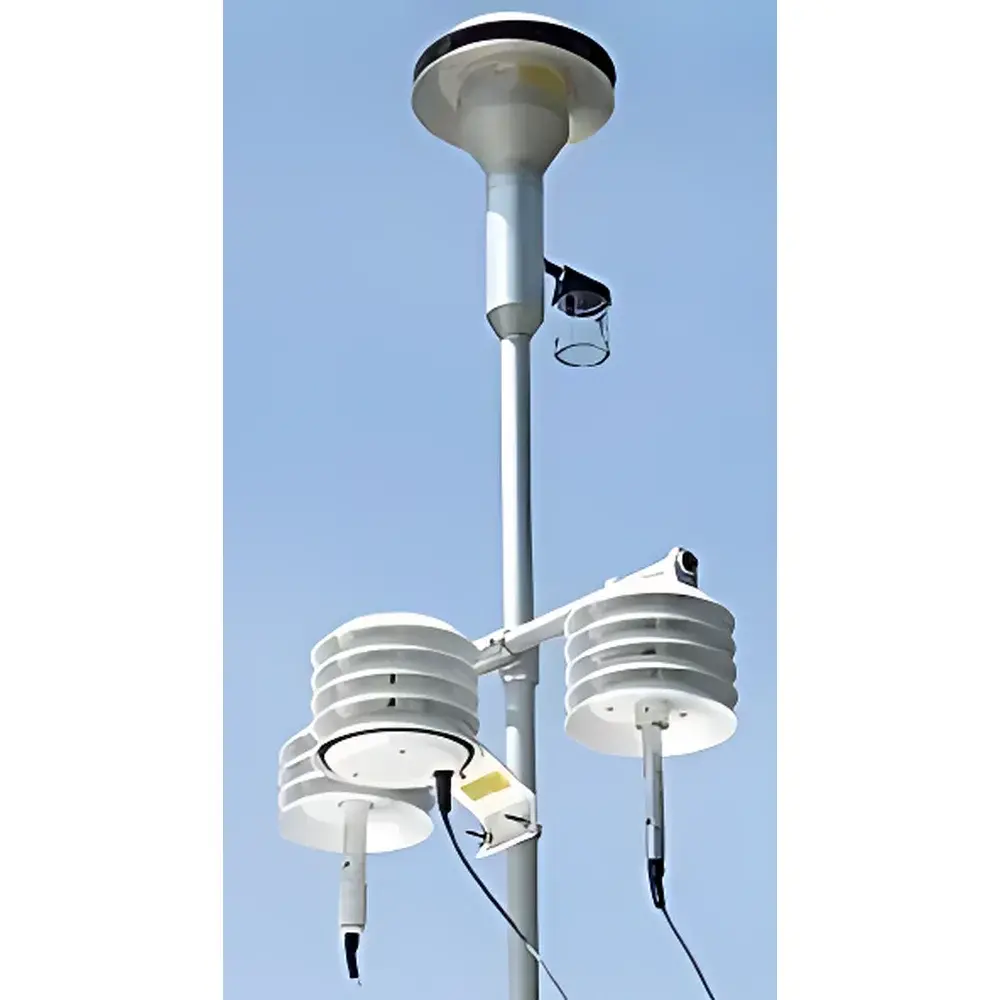
Metone BAM-1020 Beta Attenuation Monitor for PM₁₀ and PM₂.₅
| Brand | Metone |
|---|---|
| Origin | USA |
| Model | BAM-1020 |
| EPA EQPM Certification | EQPM-0798-122 |
| Measurement Principle | Beta Ray Attenuation (¹⁴C source) |
| Particle Size Cutoffs | PM₁₀, PM₂.₅, TSP |
| Measurement Range | 0–50 mg/m³ |
| Sampling Frequency | Hourly |
| Filter Tape | Rotating glass fiber tape (30-sample capacity) |
| RH Control | Integrated heater for dew point suppression |
| Data Storage | 182 days (internal) |
| Communication | RS-232 serial interface |
| Meteorological Inputs | Up to 6 sensors |
| Remote Operation | Unattended operation up to 60 days via web-based telemetry |
| Calibration | Automated zero/drift checks per cycle |
| Compliance | U.S. EPA EQPM, UK MCERTS, Korea KEPIC, China CNAS-accredited field deployment records |
| Operating Environment | -30°C to +50°C ambient |
| Power Requirement | 100–240 VAC, 50/60 Hz |
Overview
The Metone BAM-1020 Beta Attenuation Monitor is a regulatory-grade, continuous ambient particulate matter analyzer engineered for compliance with U.S. Environmental Protection Agency (EPA) Equivalent Method requirements under EQPM-0798-122. It operates on the fundamental physical principle of beta ray attenuation—where mass concentration of airborne particles is quantified by measuring the reduction in beta particle flux (emitted from a low-energy ¹⁴C radioisotope source) as particulate matter accumulates on a moving filter tape. This method provides direct, gravimetrically traceable mass concentration output in mg/m³, independent of particle morphology, optical properties, or chemical composition—making it inherently robust against biases introduced by humidity, color, or refractive index variations common in optical scattering instruments. Designed for permanent outdoor deployment in reference-grade air quality monitoring networks, the BAM-1020 supports configurable inlet configurations for PM₁₀, PM₂.₅, and total suspended particulates (TSP), enabling seamless integration into national and regional regulatory monitoring frameworks including those aligned with ISO 12103-1, EN 12341, and ASTM D6216.
Key Features
- Regulatory-compliant measurement architecture validated under U.S. EPA EQPM, UK MCERTS, Korean KEPIC, and Chinese CNAS-recognized field performance protocols.
- Automated hourly sampling cycle with integrated 30-position rotating glass fiber filter tape—eliminating manual filter changes and ensuring long-term unattended operation.
- Dual-point calibration system: real-time zero check (using clean tape segment) and drift verification (via automated insertion of NIST-traceable FRM calibration membrane) performed at the start and end of each measurement cycle.
- Active relative humidity control through precision-heated sample path—suppressing semi-volatile artifact losses and enhancing measurement stability across wide climatic ranges (−30 °C to +50 °C).
- Onboard microprocessor with LCD interface, full self-diagnostic suite, and real-time status logging—including power failure, communication loss, tape exhaustion, and sensor fault events with timestamped metadata.
- Internal data logger supporting 182 days of high-resolution (hourly) concentration data plus auxiliary meteorological inputs from up to six external sensors (wind speed/direction, temperature, pressure, RH, rainfall, solar irradiance).
- RS-232 serial interface for local data retrieval, remote firmware updates, and integration with SCADA or centralized data acquisition systems compliant with EPA 40 CFR Part 58 Appendix A-1.
Sample Compatibility & Compliance
The BAM-1020 accepts standard EPA-designated PM₁₀ and PM₂.₅ inlets (e.g., WINS, BGI SCC 1.062) and supports TSP sampling with appropriate inertial impactor configuration. All inlet assemblies are certified to meet ISO 7708:1995 particle size separation specifications. The instrument’s beta attenuation methodology satisfies the performance criteria outlined in U.S. EPA 40 CFR Part 53 for equivalent methods, including precision (≤10% RSD), accuracy (±10% bias vs. reference gravimetric analysis), and detection limit (<2 µg/m³ over 24 h). It has been successfully deployed in multi-year operational audits under GLP conditions and meets data integrity requirements for submission to national air quality databases such as AQS (Air Quality System) and EEA AirBase.
Software & Data Management
Data output conforms to EPA 40 CFR Part 58 Appendix A-2 formatting standards, including mandatory QA/QC flags (e.g., “Valid”, “Suspect”, “Invalid”) tied to diagnostic event logs. Internal memory stores raw beta counts, tape position, RH-corrected flow rate, temperature-compensated pressure, and all calibration audit trails. Remote access enables secure HTTP-based telemetry with TLS 1.2 encryption, supporting scheduled data pull or push via FTP/SFTP. Audit-ready data files include embedded digital signatures and support 21 CFR Part 11-compliant electronic record retention when interfaced with validated LIMS or environmental data management platforms. Firmware revision history, calibration certificate timestamps, and operator action logs are retained for full traceability.
Applications
- Reference-grade ambient air quality monitoring networks operated by national agencies (e.g., U.S. EPA Core Sites, EU AirBase stations, China MEP National Monitoring Network).
- Long-term trend analysis and regulatory reporting under Clean Air Act Title I and EU Directive 2008/50/EC.
- Source apportionment studies requiring chemically agnostic mass concentration baselines for receptor modeling (e.g., PMF, CMB).
- Calibration and validation of lower-cost optical particle counters and remote sensing systems.
- Industrial fence-line and community air monitoring programs requiring defensible, auditable data for permitting and public disclosure.
FAQ
What regulatory certifications does the BAM-1020 hold?
It is certified as an EPA Equivalent Method (EQPM-0798-122), approved under UK MCERTS for PM₂.₅, and accepted for official use in South Korea (KEPIC) and China (CNAS-verified field performance).
How frequently is calibration performed?
A full zero and span (drift) check occurs automatically before and after every hourly sampling cycle—no manual intervention required.
Can the BAM-1020 operate unattended for extended periods?
Yes—designed for continuous operation with 60-day remote telemetry capability and 182-day internal data storage.
Does it correct for humidity-related artifacts?
Yes—the heated sample line maintains consistent dew point control to minimize semi-volatile compound volatilization during filtration.
Is raw beta count data accessible for secondary analysis?
Yes—full-resolution detector counts, tape position indices, and environmental sensor readings are exportable via RS-232 or web interface in ASCII-delimited format.
Related Products







