
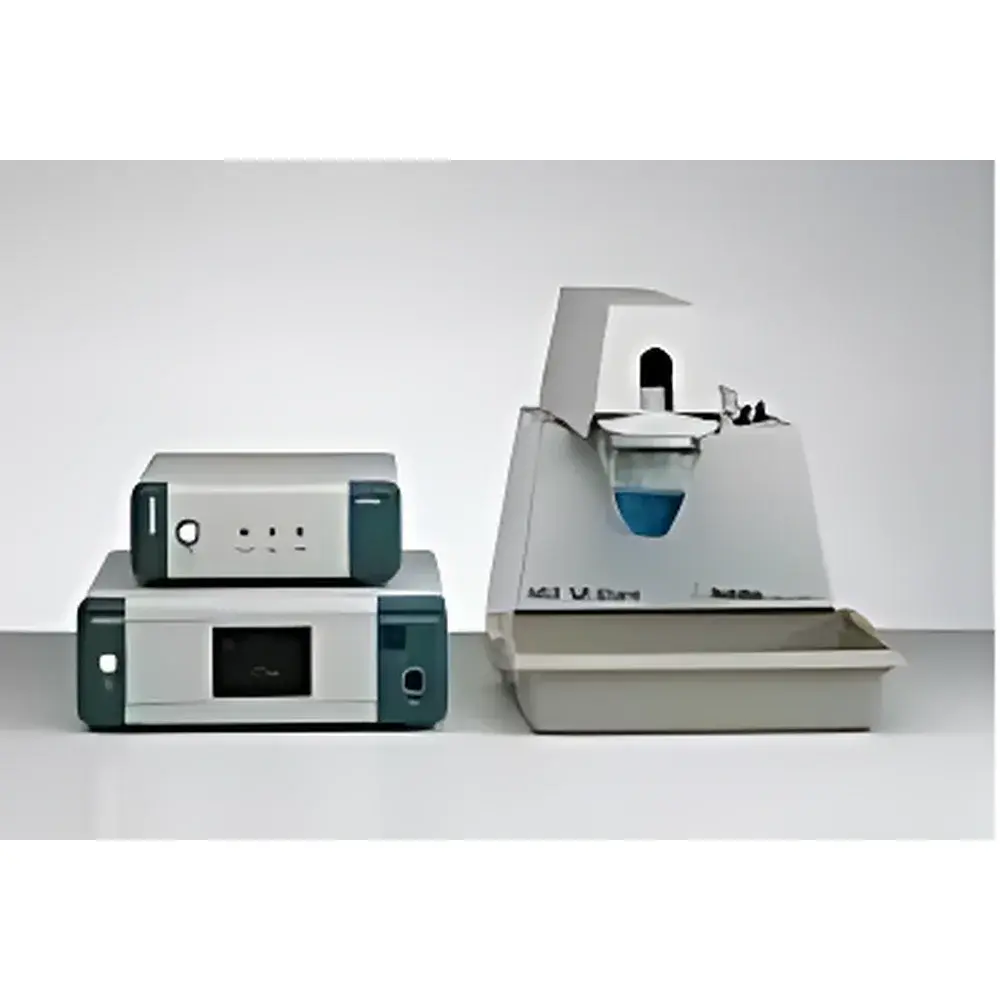
Metrohm μAUTOLAB III Electrochemical Workstation
| Brand | Metrohm |
|---|---|
| Origin | Switzerland |
| Model | μAUTOLAB III |
| Maximum Current | ±80 mA |
| Current Resolution | 30 fA |
| Potential Range | ±5 V |
| Potential Resolution | 150 µV |
| Applied Potential Accuracy | ±2 mV ±0.2% of set value |
| Current Range | 10 nA–10 mA (7 decades) |
| Potentiostat Bandwidth | 500 kHz |
| Rise/Fall Time (1 V step, 10–90%) | <1 µs |
| Input Bias Current | <1 pA @ 25 °C |
| Electrometer Input Impedance | >100 GΩ |
| Electrometer Bandwidth | >4 MHz |
| Sampling Rate | up to 50 kHz (20 µs interval) |
| Supported Techniques | CV, DPV, NPV, SWV, CA, CC, CP, PSA, ACV, PAD, LSV, Tafel, EIS (with FRA2 option), and more |
| Optional FRA2 Frequency Response Analyzer | 10 µHz–500 kHz |
Overview
The Metrohm μAUTOLAB III Electrochemical Workstation is a compact, non-modular, PC-controlled potentiostat/galvanostat engineered for high-fidelity electrochemical measurements in research, quality control, and educational environments. Based on a robust analog front-end architecture with ultra-low-noise design, it implements classical three-electrode electrochemical cell configuration—working, reference, and counter electrodes—to ensure precise potential control and current measurement across a broad dynamic range. Its core electronics feature a high-bandwidth (500 kHz) potentiostat amplifier with sub-microsecond response time (100 GΩ || <8 pF), and thermally stabilized bias current performance (<1 pA at 25 °C). Designed for reproducibility and long-term stability, the μAUTOLAB III meets essential requirements for GLP-compliant electrochemical testing and supports audit-ready data acquisition when integrated with validated software environments.
Key Features
- Integrated high-resolution analog-to-digital and digital-to-analog conversion for synchronized stimulus application and response acquisition
- Built-in coulometric integrator enabling direct chrono-coulometric and charge-integrated analyses without external hardware
- Current resolution down to 30 fA (at 10 nA range), supporting ultra-trace redox detection and low-conductivity media characterization
- Potential resolution of 150 µV over ±5 V range, with absolute accuracy of ±2 mV ±0.2% of set value
- Seven-decade programmable current range (10 nA–10 mA), each with calibrated gain and offset compensation
- Sampling rate up to 50 kHz (20 µs per point), facilitating high-temporal-resolution transient analysis
- Optional FRA2 frequency response analyzer module extending functionality to electrochemical impedance spectroscopy (EIS) from 10 µHz to 500 kHz
- Fully isolated analog I/O ports for interfacing with auxiliary equipment such as temperature controllers, flow cells, or optical detectors
Sample Compatibility & Compliance
The μAUTOLAB III is compatible with standard electrochemical cell geometries—including conventional beaker cells, microfluidic electrochemical chips, rotating disk electrodes (RDE), and screen-printed electrode (SPE) platforms. It supports aqueous and non-aqueous electrolytes, ionic liquids, and conductive polymer films. All electrical interfaces comply with IEC 61010-1 safety standards for laboratory equipment. When used with Metrohm’s NOVA software under configured audit trails and electronic signature protocols, the system satisfies FDA 21 CFR Part 11 requirements for regulated environments. Data files are stored in open-format binary (.aut) and exportable ASCII structures, ensuring interoperability with third-party analysis tools and LIMS integration. Calibration procedures follow ISO/IEC 17025 guidelines for electrochemical instrumentation validation.
Software & Data Management
Controlled exclusively via Metrohm NOVA software (v2.2 or later), the μAUTOLAB III provides a unified interface for method development, real-time visualization, and post-experiment analysis. NOVA supports full parameter scripting, multi-step experiment sequencing, and automated calibration routines. Raw data are timestamped with system clock synchronization and include metadata such as instrument ID, firmware version, environmental temperature, and user-defined annotations. Export options include CSV, TXT, and MATLAB-compatible formats. For regulated laboratories, optional NOVA Validation Package includes IQ/OQ documentation templates, change control logs, and electronic signature enforcement aligned with GxP frameworks. All data files retain cryptographic hash integrity verification to prevent tampering during archival or transfer.
Applications
- Development and characterization of enzymatic and immunosensors for clinical diagnostics
- Quantitative trace metal analysis using anodic stripping voltammetry (ASV) and adsorptive stripping voltammetry (AdSV)
- Kinetic modeling of electrode reaction mechanisms via cyclic and pulse voltammetric techniques
- In situ monitoring of electrodeposition processes in electroplating bath control systems
- Stability and charge-transfer resistance evaluation of battery electrode materials using EIS
- Teaching fundamental electrochemistry concepts including diffusion-controlled currents, Butler–Volmer kinetics, and mass transport limitations
- Electrocatalytic activity screening for fuel cell catalysts and CO2 reduction electrodes
FAQ
What electrochemical techniques does the μAUTOLAB III support natively?
Cyclic voltammetry (CV), linear sweep voltammetry (LSV), normal pulse voltammetry (NPV), differential pulse voltammetry (DPV), square wave voltammetry (SWV), chronoamperometry (CA), chronocoulometry (CC), chronopotentiometry (CP), potentiometric stripping analysis (PSA), AC voltammetry (ACV), pulsed amperometric detection (PAD), and Tafel analysis.
Is electrochemical impedance spectroscopy (EIS) included by default?
No—EIS capability requires the optional FRA2 frequency response analyzer module, which extends the system’s frequency range from 10 µHz to 500 kHz with phase accuracy better than ±0.5°.
Can the μAUTOLAB III be integrated into automated laboratory workflows?
Yes—it supports LabVIEW-compatible DLL drivers and SCPI command sets, enabling integration with robotic liquid handlers, environmental chambers, and centralized data acquisition networks.
What is the minimum detectable current under optimal shielding conditions?
With proper Faraday cage enclosure and low-noise cabling, the system achieves stable 30 fA resolution in the 10 nA range, verified per ASTM E2913-21 guidelines for low-current electrochemical instrumentation.
Does Metrohm provide factory calibration certificates with traceability to national standards?
Yes—each unit ships with a metrologically traceable calibration certificate issued by Metrohm’s accredited calibration laboratory (ISO/IEC 17025 certified), covering voltage, current, timing, and impedance verification points.
Related Products





