
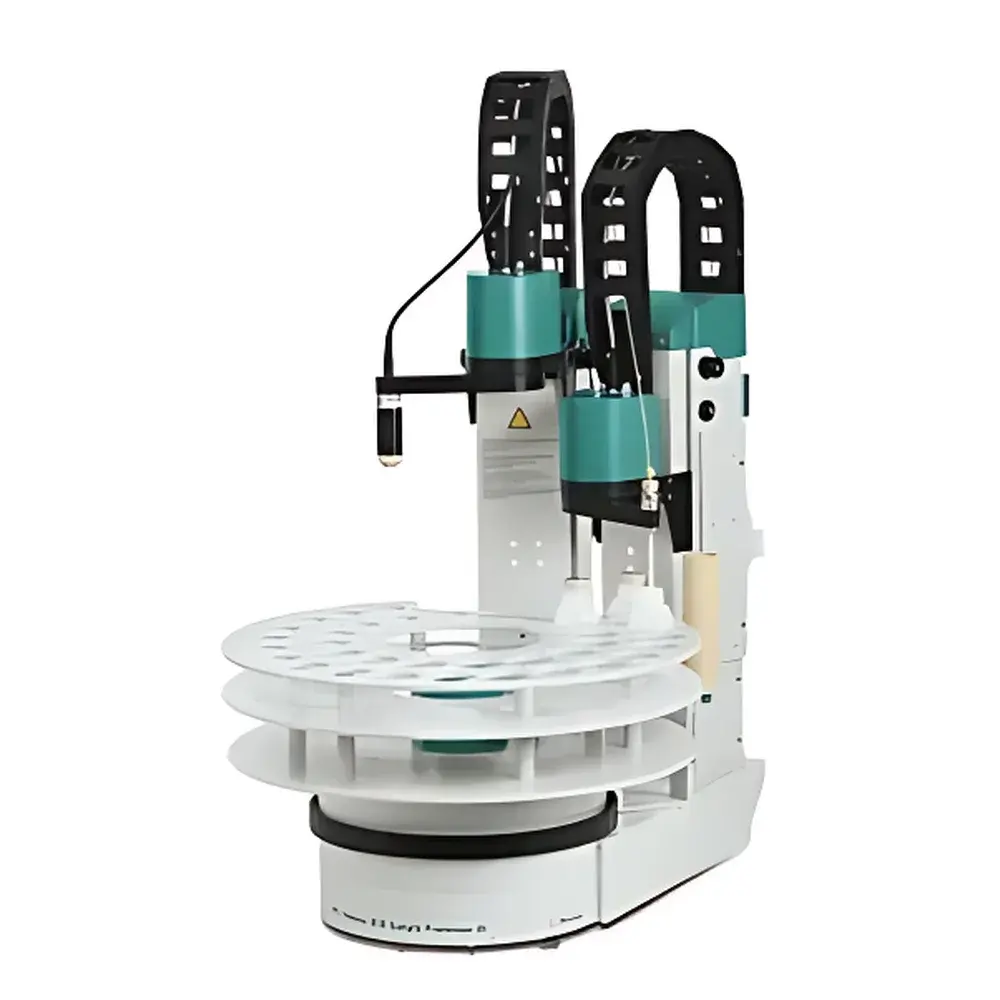
Metrohm 815 Robotic Sample Processor
| Brand | Metrohm |
|---|---|
| Origin | Switzerland |
| Manufacturer Type | Original Equipment Manufacturer (OEM) |
| Product Origin | Imported |
| Model | 815 |
| Instrument Category | Electrochemical Sample Processor |
| Sample Capacity | 28–141 positions (75 mL vials) |
| Sample Volume Range | 11–250 mL |
| Modular Configuration | Single or dual work towers |
| Fluid Handling | Up to four peristaltic pumps (configurable) |
| Robotic Arms | Dual movable arms (left/right orientation) |
| External Titration Positioning | Dual external titration stations |
| Detection | Optical sample cup identification sensor |
| Method Storage | 999 programmable methods |
| Method Structure | Three-phase architecture (Start / Sample Analysis / End), each phase supporting up to 99 discrete steps |
| Interfaces | 1× USB 2.0, 3× MSB (Metrohm Serial Bus) |
Overview
The Metrohm 815 Robotic Sample Processor is an OEM-integrated automation platform engineered for high-throughput electrochemical and volumetric analysis workflows in regulated laboratory environments. Designed exclusively for seamless interoperability with Metrohm Titrando series titrators, the 815 operates under host-controlled command via the proprietary MSB (Metrohm Serial Bus) protocol—ensuring deterministic timing, traceable command execution, and synchronized hardware coordination. Its core architecture implements a dual-tower robotic handling system governed by precision stepper-motor-driven linear actuators and optical cup recognition technology, enabling unattended processing of up to 141 samples per batch when using standard 75 mL polypropylene vials. The system adheres to fundamental principles of automated liquid handling: gravimetrically consistent aspiration/dispensing, air-gap elimination during transfer, and positionally resolved tip washing—critical for minimizing carryover in Karl Fischer coulometric and volumetric moisture determination, redox titrations, and acid-base potentiometric endpoints.
Key Features
- Dual independent robotic arms with configurable left/right orientation, supporting parallel operation across two spatially separated work zones
- Optical sample cup identification system that validates vial geometry, fill level status, and positional integrity prior to aspiration—reducing misprocessing events
- Modular peristaltic pump configuration: supports two or four independently addressable channels, each calibrated for volumetric accuracy across 11–250 mL ranges with ≤0.5% CV repeatability at mid-range volumes
- Dual external titration positioning stations compatible with Titrando’s multi-electrode modules (e.g., double-junction pH, redox, ion-selective electrodes), enabling sequential electrode conditioning and measurement without manual intervention
- Three-tier method architecture (Start / Sample Analysis / End) with hierarchical step sequencing—each tier accommodating up to 99 user-defined commands including valve actuation, pump direction reversal, stirrer speed ramping, and endpoint evaluation logic
- Non-volatile method storage for 999 protocols, retained across power cycles and firmware updates; all method metadata (author, timestamp, revision ID) logged automatically
Sample Compatibility & Compliance
The 815 accommodates standard laboratory consumables: screw-cap polypropylene vials (11–250 mL), glass Karl Fischer reagent bottles (with septum piercing capability), and custom-insert sample trays conforming to ISO 8655-7 volumetric calibration guidelines. It complies with IEC 61326-1 (electromagnetic compatibility for laboratory equipment) and meets mechanical safety requirements per EN 60204-1. When deployed in GxP environments—including GLP-compliant stability studies or GMP-regulated QC labs—the system supports audit-trail-enabling firmware (v3.2+), which records every command execution, sensor feedback event, and error state with UTC timestamps, operator ID, and digital signature verification. Full traceability aligns with FDA 21 CFR Part 11 requirements when paired with Titrando’s validated software suite (tiamo™ v3.3+).
Software & Data Management
Control and method development occur exclusively through tiamo™ software, which provides graphical workflow editors, real-time process monitoring dashboards, and integrated data reconciliation tools. All raw instrument logs—including MSB packet timestamps, pump rotation counts, optical sensor triggers, and arm position encoders—are stored in encrypted SQLite databases with SHA-256 hash integrity validation. Export formats include ASTM E1384-compliant .csv, ISO/IEC 17025-required .pdf analytical reports, and LIMS-ready XML schemas compliant with ANSI/CLSI LIS-02-A3 standards. Remote diagnostics are enabled via TLS 1.2-secured HTTP API endpoints, permitting integration into enterprise laboratory informatics systems without exposing internal network segments.
Applications
- Automated Karl Fischer titration for pharmaceutical excipient moisture content (USP , Ph. Eur. 2.5.12)
- High-volume acid number determination in lubricants (ASTM D974, D664)
- Redox titration of iron content in catalyst precursors under inert atmosphere glovebox integration
- Sequential multi-parameter electrochemical profiling (pH, mV, conductivity) across environmental water samples
- Stability-indicating assay development for biologics requiring temperature-controlled sample staging (when interfaced with Metrohm’s 859 Titrotherm module)
FAQ
Is the 815 compatible with non-Metrohm titrators?
No. The 815 communicates exclusively via Metrohm Serial Bus (MSB) and requires native tiamo™ driver stack support; third-party integration is not supported.
What maintenance intervals are recommended for the peristaltic pump tubing?
Tubing replacement is scheduled every 10,000 actuation cycles or quarterly—whichever occurs first—using Metrohm-certified silicone formulations (P/N 6.0221.100) to maintain volumetric fidelity.
Can method files be exported for offline editing?
Yes. Method binaries (.met) are portable across tiamo™ installations; however, structural edits require re-validation per ISO/IEC 17025 clause 5.4.3 prior to deployment in accredited laboratories.
Does the optical cup recognition system support barcoded vials?
No. Recognition relies solely on geometric profile scanning and fill-level contrast detection; barcode readers are not integrated and cannot be retrofitted.
How is positional accuracy verified during qualification?
Factory calibration includes laser interferometry traceable to NIST SRM 2036, with routine PQ performed using certified gauge blocks (ISO 10360-2) and volumetric error mapping per ISO 8655-6 Annex B.
Related Products




