
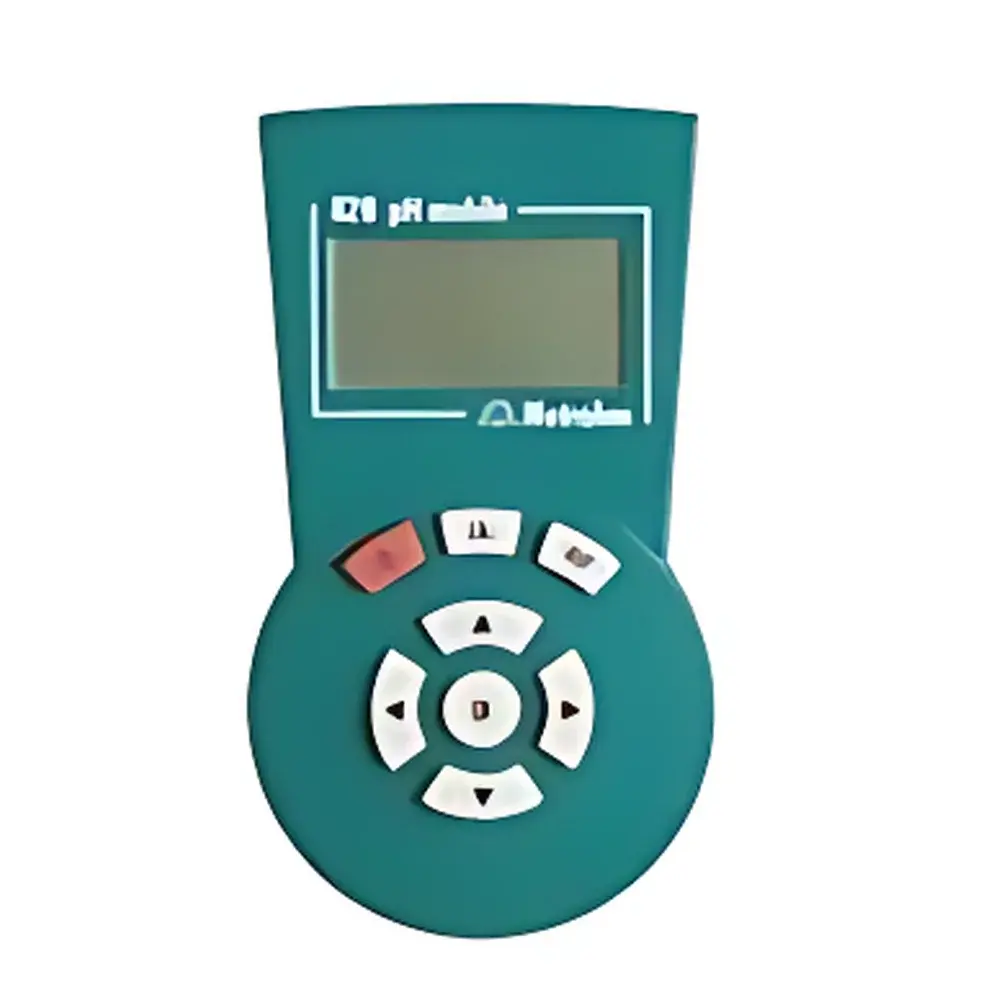
Metrohm 826 Portable pH Meter
| Brand | Metrohm |
|---|---|
| Origin | Switzerland |
| Manufacturer Type | Manufacturer |
| Origin Category | Imported |
| Model | 826 |
| Instrument Type | Portable |
| Parameter Type | Single-Parameter |
| Connectivity | IrDA (Infrared Data Association) |
| GLP Compliance | Yes |
| Data Storage Capacity | 200 measurements (with timestamp, date, and ID) |
| Power Supply | 4 × 1.5 V LR6 (AA) alkaline batteries |
| Battery Life | ≥500 hours |
| Ingress Protection Rating | IP67 |
| Electrode Compatibility | Primatrode series (e.g., 6.0228.020) |
| Calibration | Auto-buffer recognition, automatic temperature compensation (ATC), up to 3-point calibration |
| Software Integration | Metrodata VESUV 3.0, LIMS-compatible export |
| Operating Interface | Cursor-controlled text-guided menu |
| Enclosure Material | High-grade polymer with ergonomic, lab-grade finish |
| Optional Accessory | Integrated carry case with fold-out workstation surface |
Overview
The Metrohm 826 Portable pH Meter is a field-deployable, GLP-compliant electrochemical instrument engineered for high-reliability pH measurement in demanding non-laboratory environments—including environmental monitoring, wastewater treatment plants, food processing lines, pharmaceutical manufacturing sites, and academic field studies. Built upon Metrohm’s six-decade heritage in precision potentiometric instrumentation, the 826 implements a robust analog-to-digital signal chain optimized for stability under variable ambient conditions. Its core measurement principle relies on Nernstian potential detection across a glass pH electrode (e.g., Primatrode 6.0228.020) coupled with a reference junction, with real-time temperature compensation applied via integrated Pt1000 or NTC sensor input. Unlike benchtop systems, the 826 prioritizes operational resilience over multi-parameter expansion—making it purpose-built for single-parameter, mission-critical pH verification where portability, data integrity, and regulatory traceability are non-negotiable.
Key Features
- IP67-rated enclosure ensures full dust ingress protection and submersion resistance up to 1 m for 30 minutes—validated per IEC 60529—enabling reliable operation in rain, splashing, or humid industrial zones.
- Cursor-driven text-guided user interface eliminates reliance on graphical displays, reducing power consumption and enhancing readability under direct sunlight or low-light field conditions.
- Auto-buffer recognition identifies standard pH 4.01, 7.00, and 10.01 calibration solutions without manual entry, minimizing operator error during multi-point calibration routines.
- Integrated temperature compensation supports both ATC (via external probe) and manual temperature input, ensuring Nernst slope correction across 0–100 °C ranges.
- 200-measurement internal memory stores timestamped results (date, time, sample ID), each tagged with calibration status, electrode ID (if encoded), and ambient temperature—fully audit-ready for GLP/GMP workflows.
- IrDA v1.4 infrared interface enables contactless, secure wireless transfer of measurement records to compatible printers (e.g., Metrohm thermal printers) or PCs running Metrodata VESUV 3.0 software—no cables, no driver dependencies.
- Four AA alkaline batteries deliver ≥500 hours of continuous operation; low-battery indicator and auto-power-off prevent data loss during extended deployments.
Sample Compatibility & Compliance
The 826 is validated for aqueous and mildly buffered samples within typical environmental and process control matrices—including drinking water, effluent streams, fermentation broths, cleaning-in-place (CIP) rinse waters, and buffer solutions. It complies with ISO 7888 (water quality — determination of pH), ASTM D1293 (Standard Test Method for pH of Water), and supports alignment with FDA 21 CFR Part 11 requirements when used with VESUV 3.0’s electronic signature and audit trail modules. All firmware and calibration logs adhere to ALCOA+ principles (Attributable, Legible, Contemporaneous, Original, Accurate, Complete, Consistent, Enduring, Available), facilitating inspection readiness for regulatory audits.
Software & Data Management
Raw measurement data exports directly to Metrodata VESUV 3.0—a Windows-based laboratory data management platform certified for GxP environments. VESUV 3.0 provides automated report generation (PDF/CSV), trend analysis, calibration history tracking, and LIMS integration via ASTM E1384 or HL7-compliant interfaces. Audit trails record every user action—including calibration edits, memory clears, and firmware updates—with immutable timestamps and operator authentication. Exported datasets retain native metadata (electrode serial number, calibration coefficients, temperature reading at time of measurement), preserving analytical provenance.
Applications
- Field validation of municipal water distribution pH per WHO and EPA guidelines
- In-process pH monitoring during bioreactor runs or downstream purification steps
- Quality control of cleaning agents and sanitizers in pharmaceutical cleanrooms
- Environmental sampling in rivers, lakes, and groundwater wells under ISO 5667-3 protocols
- Educational field labs requiring rugged, self-contained instrumentation with minimal training overhead
- Emergency response teams assessing chemical spill impact on local water bodies
FAQ
Does the 826 support electrode diagnostics or impedance monitoring?
No—the 826 does not perform electrode impedance checks or asymmetry potential diagnostics. Users must verify electrode health manually via response time and calibration slope (typically 54–59 mV/pH at 25 °C).
Can the device store custom calibration buffers beyond pH 4.01/7.00/10.01?
No—buffer auto-recognition is limited to the three NIST-traceable standards pre-programmed into firmware.
Is the IrDA interface compatible with modern laptops lacking infrared ports?
Yes—external USB-IrDA adapters compliant with IrDA-USB v1.0 are supported; Metrohm provides compatibility guidance in Application Note AN-826-01.
What is the operating temperature range for accurate measurement?
The instrument functions from –10 to +50 °C ambient; however, optimal pH accuracy is maintained between +5 and +40 °C when using ATC.
How is GLP compliance enforced during data export?
VESUV 3.0 enforces electronic signatures, prevents post-hoc data editing, and logs all export events—including destination path, file hash, and exporting user—satisfying FDA 21 CFR Part 11 §11.10(d).





