
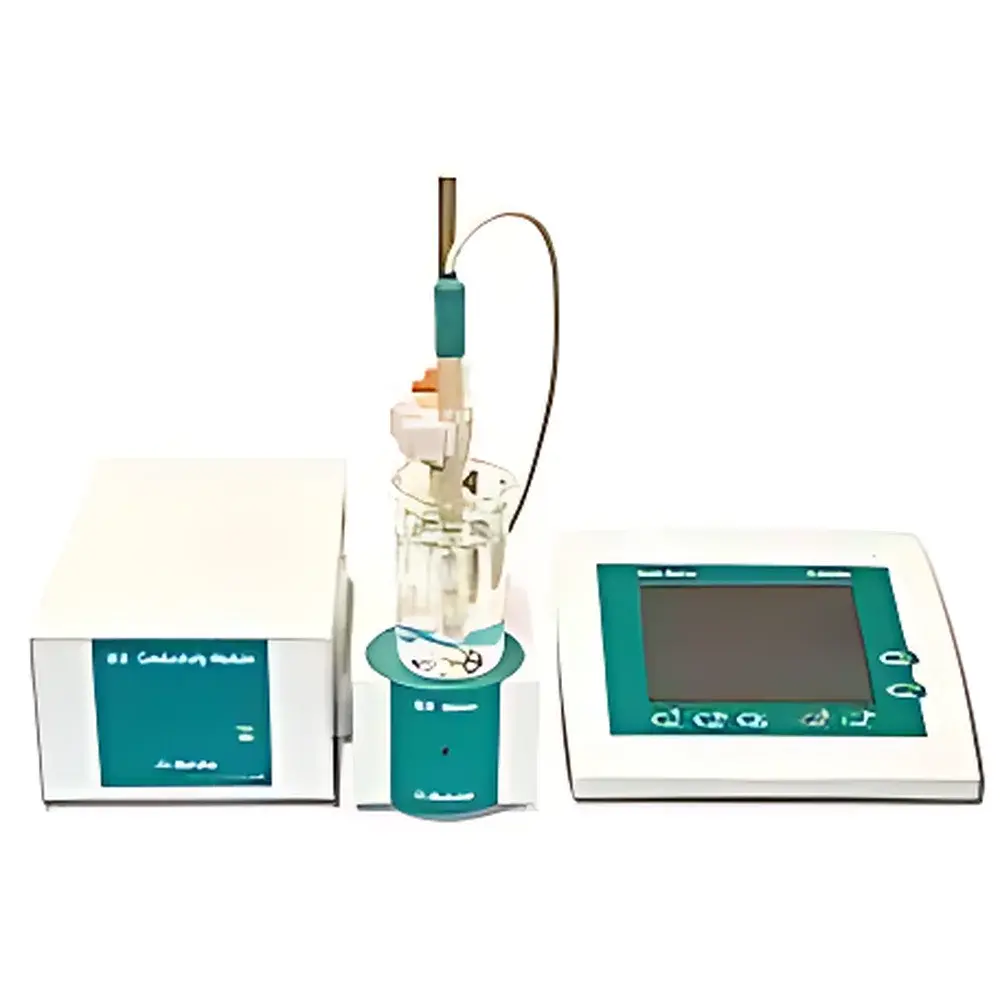
Metrohm 856 Conductivity Meter
| Brand | Metrohm |
|---|---|
| Origin | Switzerland |
| Manufacturer Type | Manufacturer |
| Origin Category | Imported |
| Model | 856 |
| Form Factor | Benchtop |
| Conductivity Range | 0.01 µS/cm – 2000 mS/cm |
| Electrode Type | 5-Ring Shielded Conductivity Cell |
| Interface | 2 × USB, 4 × MSB |
| Compatibility | Standalone operation or integrated with Titrando/tiamo platforms |
| Dual Measurement Capability | Simultaneous pH and conductivity in same vessel |
| Electrode Support | Compatible with Metrohm conductivity cells via Adapter Box |
Overview
The Metrohm 856 Conductivity Meter is a precision benchtop instrument engineered for high-accuracy, low-noise electrical conductivity measurements across an exceptionally wide dynamic range—from 0.01 µS/cm (ultrapure water monitoring) to 2000 mS/cm (concentrated electrolyte solutions). It operates on the principle of AC four-electrode (extended to five-ring) conductometric measurement, eliminating polarization effects and electrode fouling common in traditional two-electrode systems. Unlike conventional 2-ring or 4-ring cells—where platinum black plating is required or wall-induced stray currents compromise linearity—the 856 employs a proprietary 5-ring shielded electrode architecture. This design establishes a fully enclosed electromagnetic field within the measurement zone, effectively suppressing edge effects, minimizing capacitive coupling, and ensuring stable signal acquisition over the full span without recalibration drift. As a native Metrohm platform component, the 856 is designed for seamless interoperability with Titrando titration systems and tiamo™ software, enabling synchronized multi-parameter analysis in regulated laboratory environments.
Key Features
- Five-ring shielded conductivity cell: Eliminates wall effect and stray current interference; no platinum black plating required; enables direct cleaning with soft brush or ultrasonic bath.
- Extended linear dynamic range: 0.01 µS/cm to 2000 mS/cm with <0.5% relative standard deviation at mid-range and sub-µS/cm resolution under controlled temperature conditions.
- Dual-parameter capability: Integrated hardware architecture supports concurrent, time-synchronized pH and conductivity measurement in a single sample vessel—critical for titration endpoint verification and buffer characterization.
- Modular interface architecture: Two USB ports for peripheral device connectivity (e.g., printers, external storage) and four MSB (Metrohm Serial Bus) ports for daisy-chaining with Titrando modules, dosing units, or temperature probes.
- Adapter Box compatibility: Supports legacy and specialized Metrohm conductivity cells—including flow-through, immersion, and micro-volume cells—via optional 856 Adapter Box (part no. 6.0350.100), extending method flexibility without hardware replacement.
- Benchtop form factor with industrial-grade enclosure: IP20-rated housing, ESD-protected circuitry, and CE/UL certification compliant with IEC 61010-1 for safe operation in analytical laboratories.
Sample Compatibility & Compliance
The 856 is validated for use with aqueous solutions, buffer standards (e.g., KCl 0.01 mol/L, 0.1 mol/L), process streams, pharmaceutical formulations, and environmental samples (e.g., drinking water, wastewater effluent). Its measurement traceability aligns with ISO 7888 (water quality — determination of electrical conductivity) and ASTM D1125 (Standard Test Methods for Electrical Conductivity of Water). When deployed within tiamo™ workflows under GLP/GMP conditions, the system supports audit-trail-enabled data recording, electronic signatures per FDA 21 CFR Part 11, and IQ/OQ documentation packages available upon request. Calibration verification follows Metrohm’s certified reference standards (e.g., CRM 1.00011900), and temperature compensation adheres to DIN EN 27888 protocols using integrated Pt1000 sensor input.
Software & Data Management
The 856 operates natively within Metrohm’s tiamo™ software environment (v3.3+), offering full method scripting, automated calibration routines (1–5 point), real-time conductivity vs. temperature plots, and automatic cell constant calculation. Raw data—including timestamped conductivity, temperature, and pH values—is stored in encrypted .tmd format with embedded metadata (operator ID, instrument serial, calibration history). Export options include CSV, PDF reports (with configurable templates), and direct LIMS integration via OPC UA or ODBC drivers. For standalone use, the 856 Touch Control variant (model 2.856.0110) includes an integrated 7-inch capacitive touchscreen with intuitive icon-based navigation, local data logging (up to 10,000 readings), and USB flash drive export—enabling compliance with internal SOPs where networked software deployment is restricted.
Applications
- Pharmaceutical QC: USP compliant water-for-injection (WFI) and purified water conductivity testing with temperature correction to 25 °C.
- Electrolyte formulation: High-conductivity battery electrolyte screening (e.g., LiPF₆ in carbonate solvents) and concentration profiling during mixing.
- Environmental monitoring: Field-deployable lab validation of surface water conductivity trends; correlation with total dissolved solids (TDS) using programmable conversion factors.
- Chemical synthesis: Real-time reaction monitoring during acid–base neutralizations or polymerization processes where ionic strength changes indicate conversion.
- Academic research: Teaching labs requiring robust, interference-resistant conductivity measurement principles—particularly for demonstrating electromagnetic shielding efficacy versus 2-/4-ring configurations.
FAQ
Can the 856 measure conductivity and pH simultaneously in one beaker?
Yes—the instrument’s dual-channel analog front-end allows synchronized acquisition from a combined pH/conductivity probe or separate electrodes placed in the same vessel, with time-stamped alignment in tiamo™.
Is the 5-ring electrode compatible with non-Metrohm conductivity cells?
No—only Metrohm-branded conductivity cells are supported, either directly or via the 856 Adapter Box (6.0350.100); third-party cells lack MSB protocol compliance and shielding geometry.
Does the 856 require annual factory recalibration?
Not mandatory—users may perform in-house verification using NIST-traceable KCl standards; Metrohm recommends biannual performance qualification (PQ) per ISO/IEC 17025 guidelines.
What is the minimum sample volume required for accurate measurement?
With standard 5-ring dip-type cell (6.0350.110), minimum volume is 15 mL; for micro-cell variants (e.g., 6.0350.130), as low as 1.5 mL is sufficient.
How does the 856 handle temperature compensation?
It accepts input from integrated Pt1000 sensors or external thermistors, applying linear or non-linear (e.g., CaCO₃-corrected) compensation models per user-defined method parameters.





