
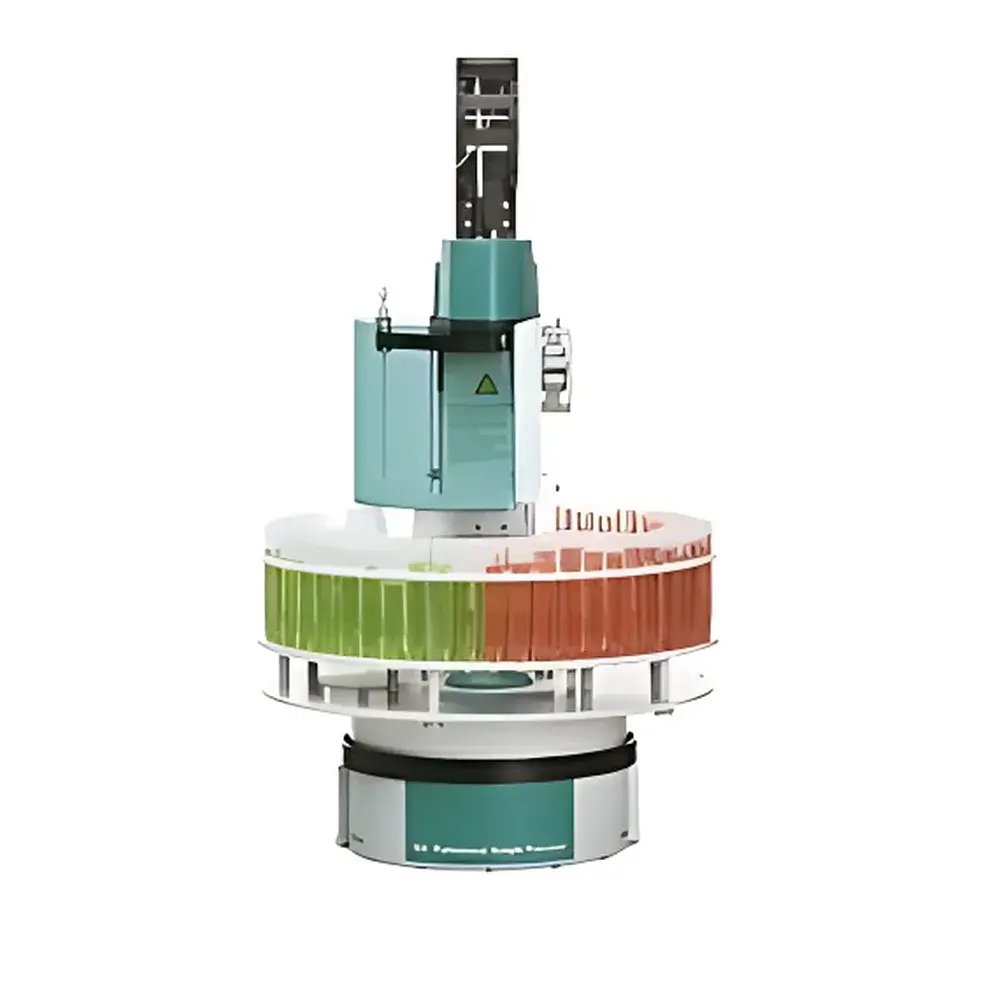
Metrohm 858 Peak Thinking™ Multifunctional Autosampler for Ion Chromatography
| Brand | Metrohm |
|---|---|
| Origin | Switzerland |
| Manufacturer | Metrohm AG |
| Product Type | Imported Instrument |
| Model | 858 |
| Instrument Category | Liquid Chromatography Autosampler |
| Interface | USB |
| Sample Rack Recognition | >30 types |
| Sample Vial Capacity | 0.5–500 mL |
| Integrated Fluid Handling | Dual-channel peristaltic pump (optional), non-metallic 6-port valve (optional), 800 Dosino dispensers |
| Online Sample Preparation Capabilities | Inline ultrafiltration, dialysis, matrix elimination, neutralization, cation removal, preconcentration, calibration correction, probe sampling |
| Software Control | MagIC Net™ |
Overview
The Metrohm 858 Peak Thinking™ Multifunctional Autosampler is an advanced, modular liquid handling platform engineered specifically for high-precision ion chromatography (IC) workflows. Designed and manufactured in Herisau, Switzerland by Metrohm AG—a leader in electrochemical and chromatographic instrumentation with over three decades of autosampler development expertise—the 858 system implements a true intelligent sample preparation architecture. Unlike conventional autosamplers limited to injection sequencing, the 858 integrates programmable fluidic control, real-time valve actuation, and adaptive sample conditioning directly into the IC workflow. Its core operational principle relies on precise, software-synchronized coordination between peristaltic pumping, non-metallic multi-position valve switching, and integrated reagent delivery modules (e.g., 800 Dosino burettes), enabling fully automated, unattended online sample pretreatment prior to chromatographic separation. This architecture supports trace-level anion and cation analysis in complex, high-matrix samples—such as dairy products, fruit juices, cereal extracts, and industrial wastewater—without manual dilution, filtration, or offline derivatization.
Key Features
- USB-based plug-and-play interface with automatic hardware detection and firmware negotiation
- Intelligent rack recognition supporting over 30 standardized and custom sample tray configurations (vial volumes: 0.5 mL to 500 mL)
- Integrated flow-path cleaning protocol with programmable rinse cycles and waste routing to minimize carryover (<0.01% typical)
- Modular hardware configuration: Base unit (2.858.0010), peristaltic pump-equipped variant (2.858.0020), and full-featured version with dual-channel peristaltic pump + non-metallic 6-port valve (2.858.0030)
- Chemically inert fluid path construction using PEEK, ETFE, and ceramic components—compatible with aggressive eluents (e.g., KOH, methanesulfonic acid) and high-salt matrices
- Real-time synchronization with Metrohm’s 850 Professional IC and 940 Professional IC systems via native MagIC Net™ communication protocol
Sample Compatibility & Compliance
The 858 Peak Thinking™ system is validated for routine use with aqueous and semi-aqueous samples containing suspended solids, proteins, organic acids, heavy metals, and particulates up to 5 µm. It meets ISO/IEC 17025 requirements for method validation in accredited laboratories and supports GLP/GMP-compliant operation through audit-trail-enabled MagIC Net™ software (21 CFR Part 11 compliant when deployed with appropriate IT infrastructure). All MISP (Metrohm Intelligent Sample Preparation) techniques—including inline ultrafiltration (0.22 µm PES membranes), dialysis (regenerated cellulose MWCO 1–10 kDa), matrix elimination (ion-exchange cartridges), and pH-neutralization (via titrant-controlled addition)—are implemented under instrument control without user intervention. The system complies with ASTM D4327 (anion analysis in water), ISO 14911 (cation analysis), and EN 14802 (determination of nitrate/nitrite in foodstuffs).
Software & Data Management
Control, method development, and data review are performed exclusively through MagIC Net™ v3.3 or later—a validated, Windows-based chromatography data system (CDS) designed for regulatory environments. MagIC Net™ provides complete sequence definition for both sampling and MISP steps, including dynamic volume allocation, conditional branching (e.g., “if conductivity > X, trigger dialysis”), and time-resolved event logging. All actions—including valve position changes, pump speed profiles, and reagent dispense volumes—are timestamped and stored with digital signatures. Raw data files (.icf) include embedded metadata describing hardware state, environmental conditions (ambient temperature, pressure), and operator identity. Audit trails are immutable and exportable in PDF/A format for internal QA review or external inspection.
Applications
- Direct analysis of raw milk and whey for lactate, chloride, phosphate, and citrate without protein precipitation
- Multi-analyte quantification in cloudy fruit juices (e.g., apple, orange) following inline ultrafiltration and pH adjustment
- High-precision fluoride and sulfate determination in municipal wastewater after matrix elimination and dilution
- Simultaneous cation/anion profiling in flour and grain extracts using sequential MISP modules (neutralization → ultrafiltration → preconcentration)
- Automated calibration verification via MISP probe sampling and bracketing standards within each analytical batch
FAQ
Is the 858 compatible with non-Metrohm IC systems?
The 858 communicates natively with Metrohm IC instruments via proprietary serial-over-USB protocol. Third-party integration requires custom driver development and is not supported under warranty.
Can the 858 perform offline sample storage or refrigeration?
No. The 858 does not include temperature-controlled sample compartments; ambient storage is assumed. For cold-chain applications, external refrigerated racks must be used.
What maintenance intervals are recommended for the peristaltic pump tubing?
Tubing life depends on chemical exposure and flow rate; Metrohm recommends replacement every 300–500 hours of active pumping or at least quarterly in routine QC labs.
Does the 858 support gradient elution during sample preparation?
No. Gradient generation occurs exclusively in the IC system’s eluent generator or mixing module; the 858 delivers isocratic reagents and samples only.
How is carryover verified during qualification?
Carryover assessment follows USP guidelines: injection of high-concentration standard followed by blank; acceptance criterion is ≤0.05% peak area relative to standard.




