
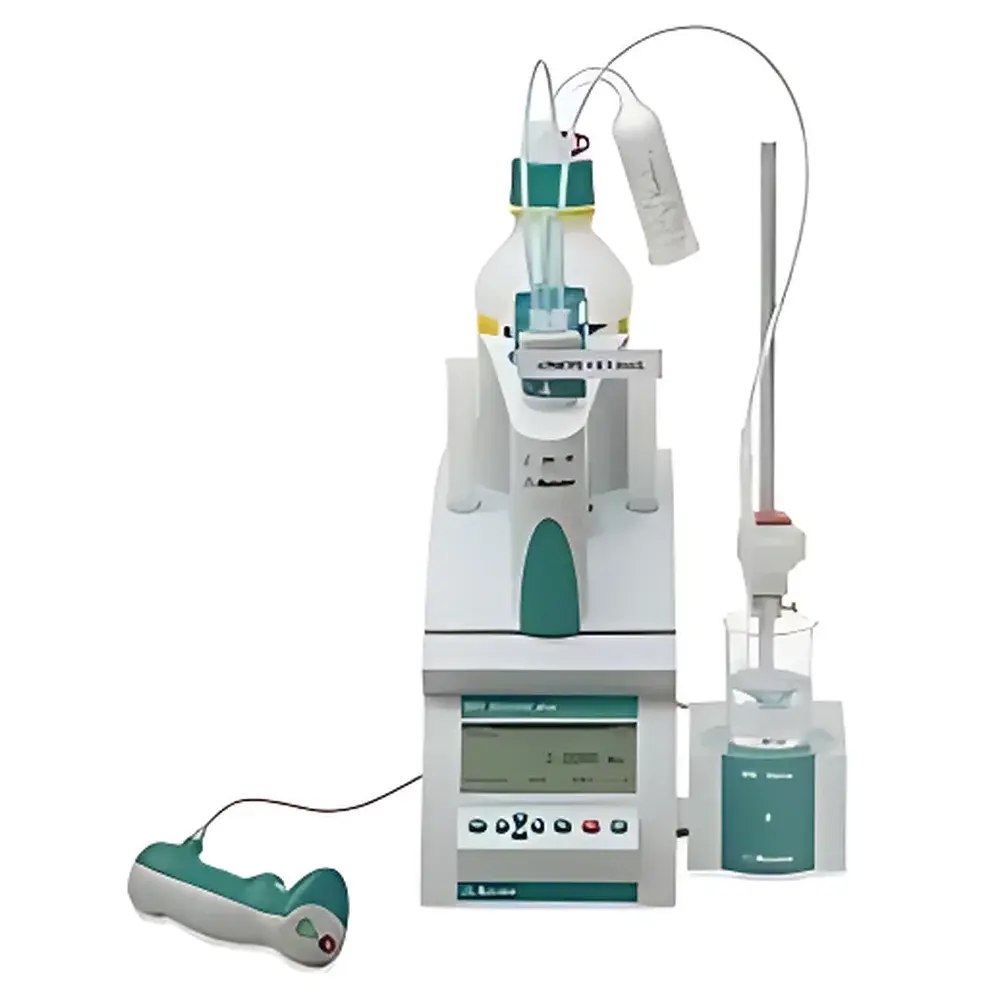
Metrohm 865 Dispenser
| Brand | Metrohm |
|---|---|
| Origin | Switzerland |
| Manufacturer Type | Manufacturer |
| Origin Category | Imported |
| Model | 865 |
| Instrument Type | Electrochemical Sample Processor |
| Dosing Modes | DOS, XDOS, CNTD, LQT |
| Interface | USB (native), RS-232/USB Box (optional) |
| Display | Large graphical LCD |
| Connectivity | Supports USB Hub for concurrent peripherals (keyboard, mouse, printer, USB storage) |
| Compliance | Designed for GLP-compliant workflows |
Overview
The Metrohm 865 Dispenser is a precision-engineered electrochemical sample processor designed to automate and standardize liquid handling tasks in titration, solution preparation, dilution, and content-based dosing workflows. Built upon Metrohm’s decades of expertise in potentiometric and coulometric analysis, the 865 integrates seamlessly into modern electrochemical laboratories where reproducibility, traceability, and method flexibility are critical. Unlike generic pipetting systems, the 865 operates on volumetric dispensing principles governed by calibrated piston-driven burettes and pressure-controlled fluidics—ensuring high accuracy across variable viscosity ranges and low-volatility reagents. Its architecture supports both manual endpoint detection (e.g., colorimetric titrations) and fully automated, parameter-driven protocols—making it suitable for routine QC labs, R&D environments, and regulated pharmaceutical or environmental testing facilities operating under ISO/IEC 17025, USP , or ASTM E2029 guidelines.
Key Features
- Four dedicated dosing modes: DOS (manual titration with real-time volume monitoring), XDOS (programmable fixed-volume, time-controlled, or speed-controlled dispensing), CNTD (concentration-based solution preparation from solids or stock solutions), and LQT (precise liquid transfer for dilution and aliquoting).
- Large graphical LCD display enabling clear visualization of titration curves, method parameters, and real-time status—reducing operator interpretation errors during manual endpoints.
- Native USB 2.0 interface compliant with HID and mass-storage class standards—enabling direct connection to PCs, touchscreens, or Metrohm titrators without proprietary drivers.
- Expandable connectivity via USB hub: simultaneous support for keyboard, optical mouse, USB thermal printer, commercial inkjet/laser printers, and encrypted USB flash drives for raw data export.
- Optional RS-232/USB Box accessory enables bidirectional communication with METTLER TOLEDO, Sartorius, or A&D laboratory balances—automating mass input for CNTD calculations and eliminating transcription errors.
- GLP-ready firmware architecture: timestamps all operations, logs user ID (when integrated with Metrohm OMNIS software), and stores full method metadata—including reagent lot numbers, ambient temperature, and calibration history—in human-readable PDF reports.
Sample Compatibility & Compliance
The 865 Dispenser accommodates aqueous, organic, and mixed-solvent systems within viscosity limits typical of common titrants (e.g., HCl, NaOH, AgNO₃, EDTA, KBr in acetic acid). It interfaces with standard Metrohm 10–50 mL glass or PTFE-coated burettes and accepts interchangeable tips for cross-contamination control. All firmware and report templates comply with FDA 21 CFR Part 11 requirements when deployed with Metrohm OMNIS software (electronic signatures, audit trails, and role-based access control). The device meets IEC 61010-1 safety standards for laboratory equipment and carries CE marking for EMC and low-voltage directive compliance. Routine verification follows Metrohm Application Note AN-865-01, which references ISO 8655-3 for piston burette performance validation.
Software & Data Management
While the 865 operates autonomously via front-panel controls, its full traceability potential is realized through integration with Metrohm OMNIS Titration Software (v3.0+). OMNIS provides method templating, electronic batch records, and automated report generation—including PDFs with embedded QR codes linking to instrument logs and calibration certificates. Raw dispense logs (CSV format) are exportable directly via USB storage for LIMS ingestion. All printed reports include mandatory GLP fields: operator name, date/time stamp, instrument ID, method version, reagent IDs, and calculated uncertainty estimates derived from burette tolerance and balance readability per GUM (JCGM 100:2008).
Applications
- Standardization of titrants (e.g., preparing 0.1 mol/L Na₂S₂O₃ from primary standard KIO₃ using CNTD mode).
- Preparation of multi-level calibration standards for ion chromatography or ICP-MS sample introduction.
- Automated serial dilution of environmental water extracts prior to voltammetric heavy metal analysis.
- Reproducible addition of masking agents (e.g., triethanolamine) in complexometric titrations of Ca²⁺/Mg²⁺ mixtures.
- Documentation-compliant spiking experiments for recovery studies under ISO 17025-accredited testing protocols.
FAQ
Can the 865 Dispenser be used without a computer?
Yes—the device supports fully standalone operation with preloaded methods stored in non-volatile memory. All four dosing modes are accessible via intuitive menu navigation.
Is calibration traceable to national standards?
Burette calibration is performed using gravimetric verification per ISO 8655-3; certified reference weights (class E2 or better) and accredited analytical balances are required. Calibration certificates include uncertainty budgets.
Does the 865 support multi-step sequential dispensing?
Not natively—each dispensing event is executed as a discrete command. However, OMNIS software enables scripting of multi-step sequences with conditional logic and intermediate measurements.
What maintenance is required for long-term accuracy?
Daily rinsing of burette tips and tubing with deionized water; monthly piston lubrication with Metrohm-recommended silicone grease; annual verification of drive motor torque and encoder resolution.
Can third-party reagent bottles be connected?
Yes—provided they use standard GL45 or GL32 threaded necks and compatible bottle adapters (Metrohm part nos. 6.0221.100 and 6.0221.200). Pressure regulation must remain within 0.5–2.5 bar.





