
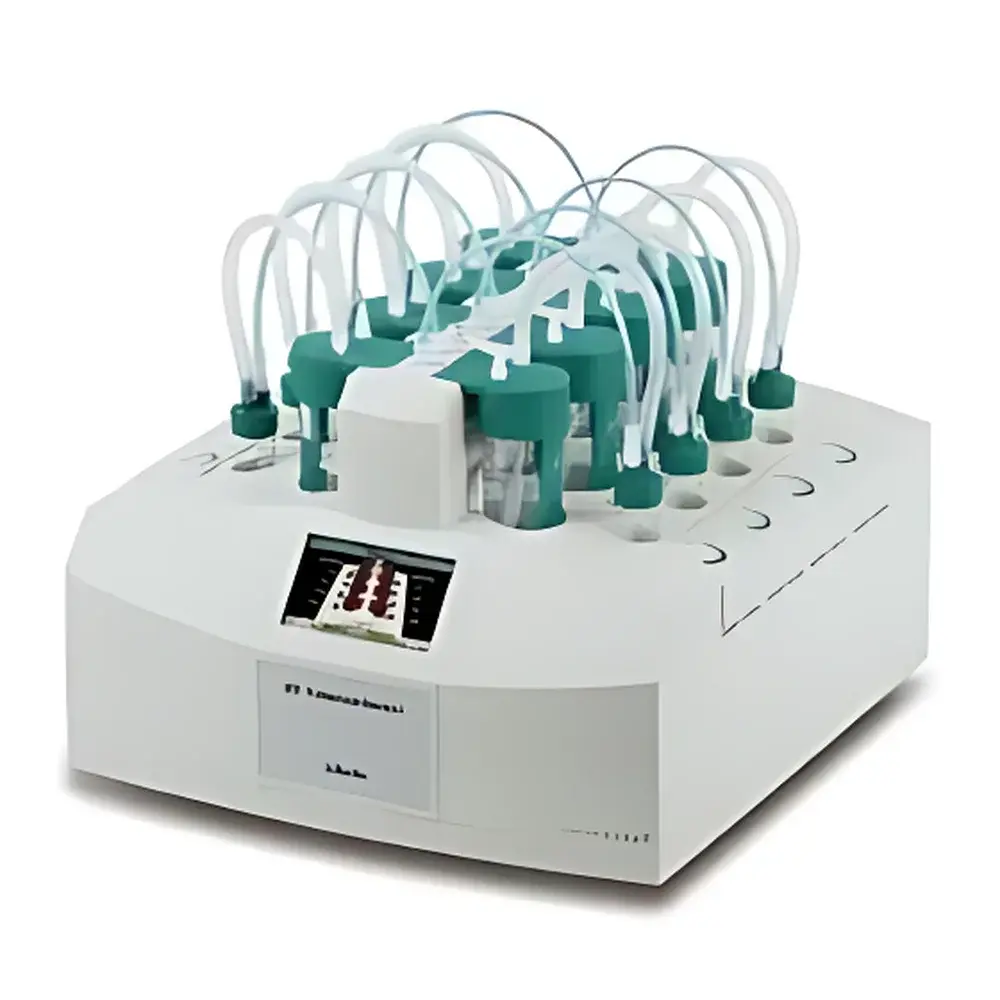
Metrohm 892 Rancimat Oil Oxidation Stability Analyzer
| Brand | Metrohm |
|---|---|
| Origin | Switzerland |
| Model | 892 |
| Heating Range | 50–220 °C (0.1 °C resolution) |
| Sample Capacity | 8 independent reaction vessels |
| Air Flow Control | 1–25 L/h (integrated diaphragm pump, calibrated at 25 °C/1013 hPa) |
| Conductivity Measurement Range | 0–400 µS/cm |
| Temperature Uniformity | <0.3 °C between vessels |
| Temperature Stability | <0.1 °C at setpoint |
| Data Acquisition Interval | 12 s |
| Interface | USB-controlled, PC-based operation |
| Compliance | Fully compliant with FDA 21 CFR Part 11 (via StabNet™ client-server architecture), GLP/GMP-ready audit trail and user role management |
Overview
The Metrohm 892 Rancimat Oil Oxidation Stability Analyzer is an advanced, fully automated instrument engineered for the accelerated oxidative stability assessment of fats, oils, and lipid-containing matrices. It operates on the internationally standardized Rancimat method—a forced-air oxidation technique in which a controlled stream of air is passed through a heated oil sample, accelerating autoxidation. Volatile secondary oxidation products (primarily formic acid) are swept into a conductivity cell, where their accumulation is monitored continuously as an increase in aqueous-phase electrical conductivity. The induction period—the time until a sharp inflection in the conductivity curve—is reported as the Oxidative Stability Index (OSI), a quantitative, reproducible metric directly correlated with shelf life and antioxidant efficacy.
Key Features
- Eight independently controllable reaction vessels, each with dedicated start/stop activation directly on the instrument front panel
- High-resolution color touchscreen displaying real-time status of all eight channels: temperature, airflow rate, conductivity signal, and elapsed time
- Precise thermal control across the full 50–220 °C range, with 0.1 °C setpoint resolution and <0.1 °C short-term stability; inter-vessel temperature deviation maintained below 0.3 °C
- Integrated, maintenance-free diaphragm air pump delivering stable, calibrated airflow from 1 to 25 L/h (referenced to 25 °C and 1013 hPa)
- Low-drift conductivity measurement system (0–400 µS/cm) with automatic baseline compensation and internal electrode temperature correction
- USB interface enabling full remote control, synchronization, and data logging via PC—no standalone embedded controller required
Sample Compatibility & Compliance
The 892 Rancimat accommodates both neat oils and complex lipid matrices. Direct analysis is feasible for low-moisture, high-fat foods such as potato chips, microwave popcorn, nuts, butter cookies, and fried noodles—requiring only mechanical size reduction prior to loading. For samples with elevated water or protein content (e.g., mayonnaise, salad dressings, chocolate, custard creams), lipid extraction is recommended using cold petroleum ether per AOCS Cd 12b-92 or equivalent protocols. All measurement procedures align with ISO 6886:2006, AOCS Cd 12b-92, JIS K 2501 (formerly CDM 2.4.28.2-93), and GB/T 21121–2007. Instrument software and hardware architecture support full compliance with FDA 21 CFR Part 11, including electronic signatures, role-based access control, immutable audit trails, and secure data archiving—making it suitable for regulated QA/QC laboratories operating under GLP or GMP frameworks.
Software & Data Management
StabNet™ software serves as the central analytical and operational platform for the 892 Rancimat. Available in client-server configuration, it enables centralized deployment across laboratory networks while enforcing strict data governance. The interface features intuitive workflow navigation, drag-and-drop method assignment, and real-time multi-channel visualization. All raw conductivity traces, temperature logs, and airflow profiles are timestamped and stored in a relational database with version-controlled method parameters. Built-in reporting tools generate compliant PDF reports—including OSI values, derivative curves, statistical summaries (mean, SD, CV%), and pass/fail evaluation against user-defined specification limits. Data export supports CSV, XML, and LIMS-compatible formats, facilitating integration with enterprise quality systems.
Applications
- Quantitative evaluation of natural and synthetic antioxidant performance (e.g., tocopherols, BHA, BHT, rosemary extract) in refined and crude vegetable oils
- Stability screening of marine oils (fish, krill) and structured lipids subject to rapid peroxidation
- OSI determination for cosmetic emulsions containing triglycerides or squalane (e.g., sunscreens, lip balms, hand creams, shower gels)
- Batch-to-batch consistency monitoring in edible oil refining and margarine production
- Accelerated shelf-life prediction for lipid-rich functional foods and nutraceutical formulations
- Method development and validation studies supporting regulatory submissions (EFSA, FDA, MFDS)
FAQ
What is the minimum and maximum sample mass required for direct analysis?
Typical sample mass ranges from 3 to 5 g (or 3–5 mL for liquid oils). Smaller masses may be used with appropriate calibration verification; larger masses do not improve sensitivity and may compromise thermal homogeneity.
Can the 892 Rancimat perform simultaneous measurements at two different temperatures?
No. All eight vessels operate at a single, user-defined temperature setpoint. Dual-temperature testing requires sequential runs or use of two instruments.
Is lipid extraction mandatory for all food samples?
Extraction is recommended when water content exceeds ~5% w/w or protein content exceeds ~10% w/w, as these components interfere with conductivity detection and may cause foaming or carryover.
How often does the conductivity cell require cleaning or recalibration?
The cell is designed for long-term stability. Routine rinsing with deionized water after each run is sufficient. Full calibration using standard KCl solutions is advised every 50–100 measurements or at the start of each new study series.
Does StabNet™ support automated report generation for regulatory audits?
Yes. Reports include full metadata (operator ID, instrument serial number, method version, environmental conditions), raw data traceability, electronic signature fields, and tamper-evident digital seals—all compliant with 21 CFR Part 11 Subpart B requirements.





