
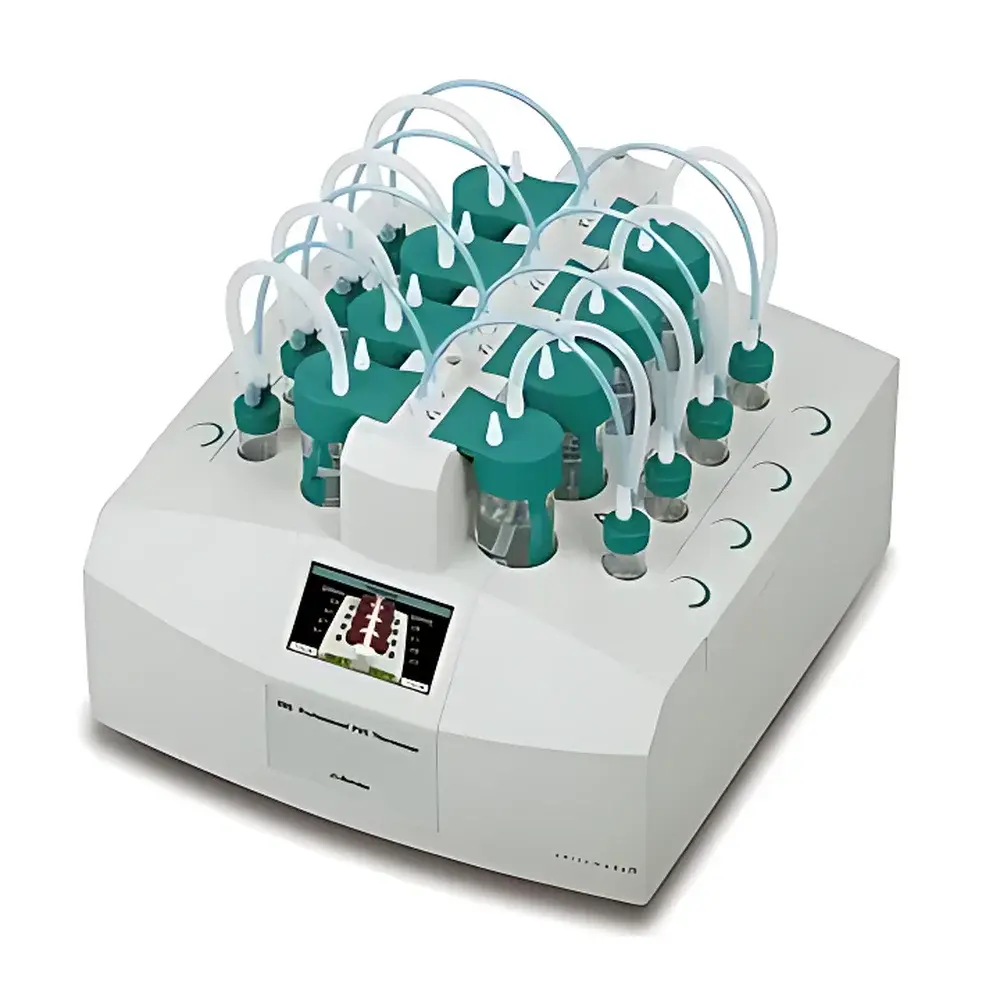
Metrohm 895 Professional PVC Thermal Stability Analyzer
| Brand | Metrohm |
|---|---|
| Origin | Switzerland |
| Manufacturer | Metrohm AG |
| Product Type | Imported Instrument |
| Model | 895 Professional |
| Pricing | Upon Request |
Overview
The Metrohm 895 Professional PVC Thermal Stability Analyzer is a dedicated, automated analytical system engineered for the precise and reproducible assessment of thermal stability in polyvinyl chloride (PVC) and other chlorine-containing polymers. It operates on the dehydrochlorination principle—quantifying the onset and rate of hydrochloric acid (HCl) evolution during controlled thermal degradation. Under standardized conditions (e.g., DIN 53381-1 or ISO 182-3), test specimens are heated in inert nitrogen atmosphere; evolved HCl gas is swept into a deionized water-filled conductivity cell, where real-time changes in solution conductivity (µS/cm) are measured. The time required for conductivity to increase by 50 µS/cm—termed the “stabilization time”—serves as the primary quantitative metric for material thermal resistance. This method is applicable across R&D, formulation optimization, quality control, and regulatory compliance workflows in polymer manufacturing and additive development.
Key Features
- Two independent heating modules, each accommodating four parallel measurement positions (total 8 channels per unit)
- Individual physical start buttons and real-time status feedback via high-contrast color LCD display per channel
- Integrated, robust conductivity measurement cells with sealed, reusable electrode assemblies and optimized flow geometry
- Dedicated disposable borosilicate glass reaction tubes—eliminating cross-contamination and minimizing post-run cleaning effort
- Modular, mechanically stable cup lids with integrated gas-tight sealing and thermal shielding
- Scalable system architecture: up to four 895 units can be synchronized and operated from a single PC workstation
- Hardware-level temperature control with ±0.5 °C accuracy across the operational range (typically 140–200 °C)
Sample Compatibility & Compliance
The 895 analyzer supports solid PVC compounds—including unplasticized (uPVC), flexible, and compound formulations containing heat stabilizers (e.g., Ca/Zn, organotin, lead-based, or newer bio-derived alternatives). It accommodates granules, powders, and milled sheet fragments within standardized mass ranges (typically 0.5–2.0 g). The system complies with internationally recognized test standards including DIN 53381-1 (determination of thermal stability of PVC by conductivity method), ISO 182-3 (plastics — determination of thermal stability of PVC compounds — part 3: conductivity method), and ASTM D4217 (standard test method for thermal stability of PVC compounds by conductivity). Its hardware design and software traceability features meet GLP (Good Laboratory Practice) requirements, supporting audit-ready documentation for regulated environments.
Software & Data Management
StabNet software provides full instrument control, method definition, real-time data acquisition, and post-processing capabilities. Its interface features an intuitive, tab-based layout with drag-and-drop method configuration, multi-channel synchronization, and live conductivity curve visualization. All raw data—including timestamped conductivity values, temperature profiles, method parameters, and user annotations—are stored in a relational SQL database with built-in filtering, sorting, statistical analysis (mean, SD, CV%), and comparative reporting. StabNet implements role-based user management with customizable access rights, electronic signatures, audit trails, and automatic daily backups—fully aligned with FDA 21 CFR Part 11 requirements for electronic records and signatures. Optional client-server deployment enables centralized data management across laboratory networks.
Applications
- Comparative evaluation of heat stabilizer efficiency in PVC formulations
- Quality assurance testing of incoming PVC resin batches
- Accelerated aging studies correlating stabilization time with long-term processing performance
- Development and validation of non-toxic, heavy-metal-free stabilizer systems
- Root-cause analysis of premature discoloration or degradation in extrusion/injection molding trials
- Supporting technical documentation for REACH, RoHS, and food-contact compliance dossiers
FAQ
What is the minimum sample mass required for reliable measurement?
Typical recommended mass is 1.0 g ± 0.1 g for standard PVC compounds; method validation is advised for highly filled or low-density formulations.
Can StabNet export data to LIMS or third-party statistical packages?
Yes—StabNet supports CSV, Excel (.xlsx), and XML exports; API integration is available for validated LIMS interfaces.
Is calibration of the conductivity cell required between runs?
No routine recalibration is needed; the system uses factory-calibrated electrodes with drift monitoring and optional two-point verification using KCl standards.
How is nitrogen flow rate controlled and verified?
Mass flow controllers (MFCs) maintain constant 100 mL/min ± 2% N₂ flow; integrated pressure sensors and flow diagnostics provide continuous verification.
Does the 895 support method transfer between laboratories?
Yes—StabNet methods include all instrument parameters, metadata, and calculation rules, enabling full procedural replication across instruments and sites.





