
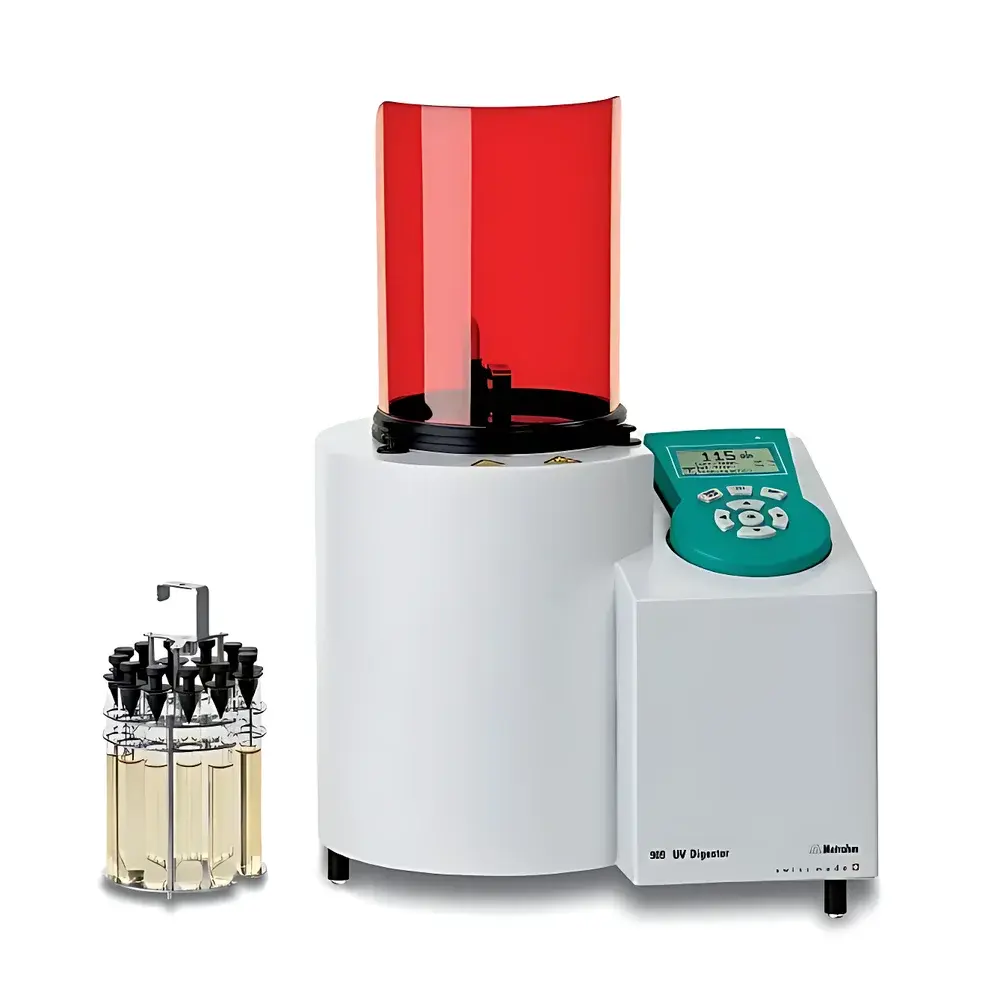
Metrohm 909 UV Digestion Unit
| Brand | Metrohm |
|---|---|
| Origin | Switzerland |
| Manufacturer Type | Original Equipment Manufacturer (OEM) |
| Origin Category | Imported |
| Model | 909 UV |
| Pricing | Upon Request |
Overview
The Metrohm 909 UV Digestion Unit is a dedicated, benchtop ultraviolet (UV) photolysis system engineered for the oxidative decomposition of organic matrix components in aqueous samples prior to trace metal analysis. Unlike thermal or acid-based digestion methods, the 909 UV employs low-pressure mercury vapor lamps emitting at 254 nm—optimal for direct photolytic cleavage of carbon–halogen, carbon–nitrogen, and carbon–sulfur bonds—thereby mineralizing refractory organics without introducing reagent-derived contaminants or altering oxidation states of target analytes. This principle is especially critical for electrochemical techniques such as anodic stripping voltammetry (ASV) and cathodic stripping voltammetry (CSV), where residual organic ligands can suppress electrode response, cause passivation, or induce false negatives in the determination of Zn, Cd, Pb, Cu, Tl, Ni, Co, and U. The unit operates under strictly controlled thermal conditions, with real-time monitoring via Pt1000 resistance temperature detectors and closed-loop microprocessor regulation of both irradiation duration and sample temperature—ensuring method reproducibility across heterogeneous matrices.
Key Features
- Integrated low-pressure UV lamp (254 nm emission) with calibrated intensity output and ≥5,000-hour service life
- Active air-cooling system maintaining ambient lamp housing temperature ≤40 °C during continuous operation
- Pt1000 temperature sensor embedded directly in the quartz digestion chamber for accurate in-situ thermal feedback
- Microprocessor-controlled digestion protocol: programmable time (1–120 min) and temperature setpoint (20–95 °C) with ±0.3 °C stability
- Quartz reaction vessel (standard 50 mL capacity) optimized for UV transmittance and chemical inertness toward strong oxidants
- Automatic safety interlock: UV lamp deactivation upon lid opening and thermal cutoff at 100 °C
- Compliant with CE marking requirements for laboratory electrical equipment (2014/30/EU EMC Directive & 2014/35/EU LVD)
Sample Compatibility & Compliance
The 909 UV is validated for use with environmental water matrices—including raw surface water, groundwater, drinking water, wastewater effluents, and leachates—with total organic carbon (TOC) concentrations up to 50 mg/L. It accommodates samples containing humic substances, surfactants, chelating agents (e.g., EDTA, NTA), and low-molecular-weight organic acids without requiring pre-dilution or acidification. Its performance aligns with DIN 38406-16 (voltammetric determination of Zn, Cd, Pb, Cu, Tl, Ni, Co) and DIN 38406-17 (adsorptive stripping voltammetry for uranium in natural waters). Method validation data confirm >95% organic carbon removal efficiency for standard fulvic acid solutions after 45-min irradiation at 70 °C—meeting the matrix elimination criteria specified in ISO 17294-2 for ICP-MS and EPA Method 200.8 for AAS/ICP-OES workflows.
Software & Data Management
The 909 UV operates as a standalone instrument with local parameter configuration via front-panel keypad and LCD display. All digestion runs are timestamped and logged internally with parameters (set temperature, actual temperature profile, elapsed time, lamp-on status). Exportable CSV logs support audit-ready documentation for GLP-compliant laboratories. While no proprietary software is required, the unit’s digital interface enables optional integration into LIMS environments via RS-232 or USB-to-serial adapter for automated run initiation and metadata capture. Full electronic records satisfy FDA 21 CFR Part 11 requirements when paired with validated third-party data acquisition systems supporting electronic signatures and audit trails.
Applications
- Voltammetric trace metal analysis (ASV/CSV) in compliance with DIN 38406-16 and -17
- Pre-treatment of samples for ICP-OES, ICP-MS, and flame/graphite furnace AAS where organic interference causes spectral overlap or signal suppression
- Removal of complexing agents prior to colorimetric determination of metals (e.g., dithizone, PAR methods)
- Stabilization of labile redox species (e.g., Cr(III)/Cr(VI), As(III)/As(V)) by eliminating competing organic reductants
- Method development for regulatory monitoring programs under EU Water Framework Directive (2000/60/EC) and US Clean Water Act Section 304(a)
FAQ
What types of organic interferences does the 909 UV effectively eliminate?
It degrades humic and fulvic acids, amino acids, peptides, EDTA, citrate, oxalate, and common surfactants—particularly those forming stable complexes with transition metals.
Can the 909 UV be used for solid or suspended particulate samples?
No—it is designed exclusively for clear to slightly turbid aqueous solutions; suspended solids must be removed by filtration (0.45 µm) prior to digestion.
Is lamp calibration required, and how often?
Metrohm recommends annual intensity verification using a NIST-traceable UV radiometer; lamp replacement is indicated when output falls below 85% of initial specification.
Does the 909 UV meet ISO/IEC 17025 requirements for accredited testing labs?
Yes—when operated within validated protocols and supported by documented calibration, preventive maintenance, and uncertainty budgets for digestion efficiency, it satisfies clause 5.5.2 on equipment suitability.
How does UV digestion compare to persulfate UV or acid persulfate methods?
The 909 UV relies solely on photolysis without added oxidants, avoiding sulfate contamination, blank elevation, or nitrate interference—making it ideal for ultra-trace sulfur- or nitrogen-sensitive assays.






