
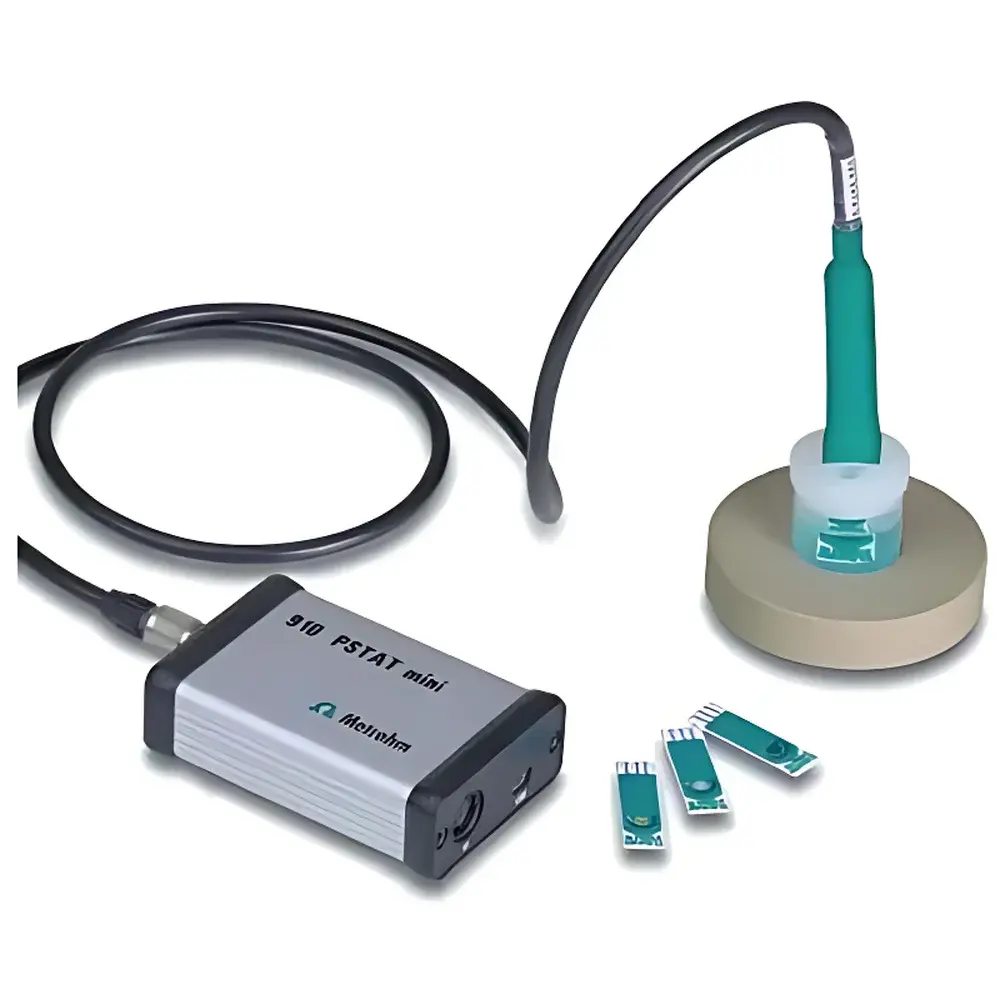
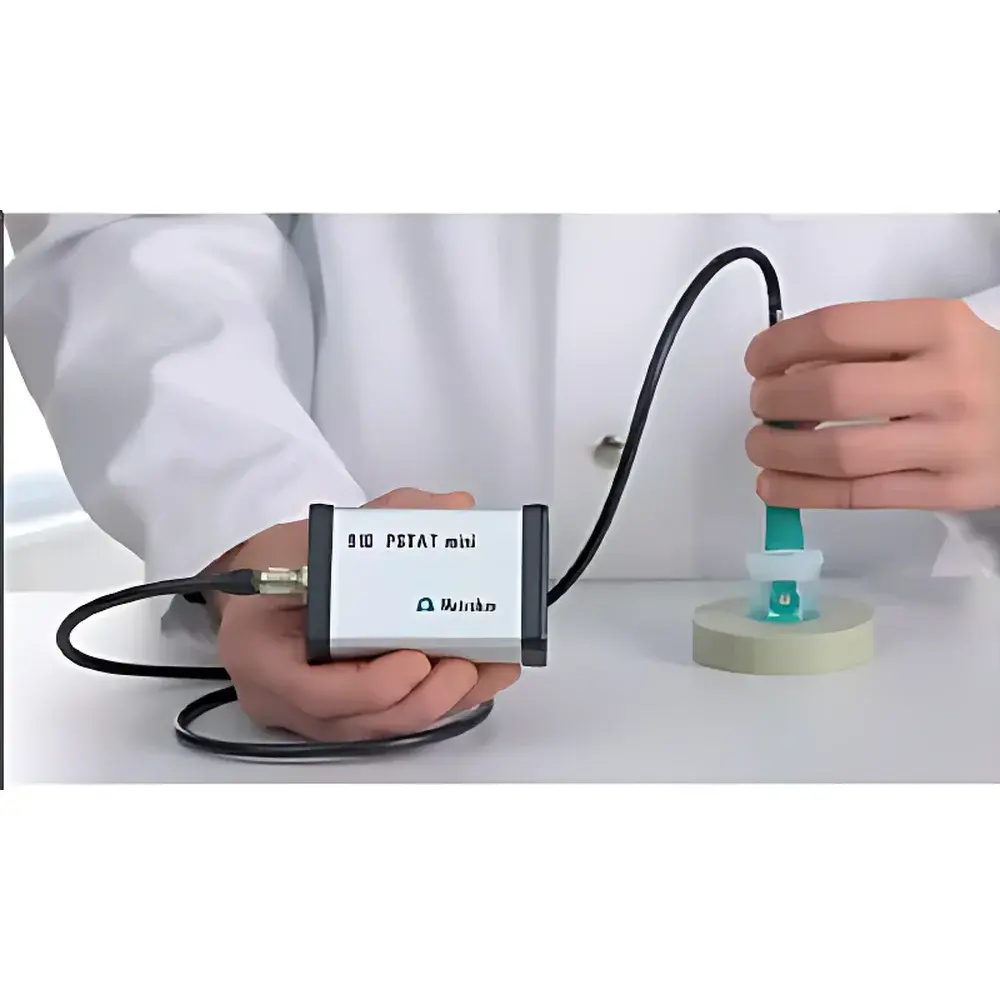
Metrohm 910 PSTAT mini Portable Potentiostat
| Brand | Metrohm |
|---|---|
| Origin | Switzerland |
| Manufacturer Type | Original Equipment Manufacturer (OEM) |
| Product Category | Imported Instrument |
| Model | 910 |
| Instrument Type | Portable Electrochemical Workstation |
| Current Range | ±2 nA to ±200 µA |
| Current Accuracy | ±0.2% of reading |
| Potential Accuracy | ±1 mV |
| Potentiostatic Range | ±2.048 V |
| Impedance Frequency Range | Not supported (DC-only operation) |
| Potential Resolution | 1 mV |
| Current Resolution | 1 pA (at 2 nA range) |
| Dimensions | 80 × 54 × 23 mm |
| Weight | 94 g |
| Power Supply | 5 V DC / ≤45 mA via USB |
| Interface | Mini-USB + 8-pin Mini-DIN (5 digital I/O, 3 analog inputs @ 10-bit ADC, 1 analog output 0–5 V) |
Overview
The Metrohm 910 PSTAT mini is a compact, computer-controlled portable potentiostat engineered for field-deployable and teaching-laboratory electrochemical analysis. Unlike full-featured bipotentiostats or impedance-capable workstations, the 910 PSTAT mini operates exclusively in DC potentiostatic mode—delivering high-fidelity voltammetric and amperometric measurements without AC impedance functionality. Its design follows classical three-electrode electrochemistry principles: precise control of working electrode potential versus a stable Ag pseudo-reference electrode, with current measured through a counter electrode—all implemented on disposable screen-printed electrodes (SPEs). The instrument’s ultra-low power consumption (≤45 mA), USB bus-powered architecture, and sub-100 g mass make it uniquely suited for on-site water quality screening, point-of-care sensor validation, undergraduate electrochemistry labs, and rapid prototyping of electrochemical biosensors. All core electronics—including analog front-end, DAC/ADC, and microcontroller—are integrated into a single PCB housed in a ruggedized aluminum enclosure compliant with IP54-rated environmental protection for non-submerged portable use.
Key Features
- True portable operation: powered solely via standard USB 2.0 port—no external battery pack or AC adapter required.
- High-resolution current measurement: 6 auto-ranging current channels spanning ±2 nA to ±200 µA; minimum resolution of 1 pA at the lowest range.
- Precise potential control: ±2.048 V compliance range with 1 mV step resolution and ±1 mV absolute accuracy (calibrated at factory against NIST-traceable references).
- Plug-and-play SPE compatibility: accepts standardized 3-electrode SPE chips (working: carbon/gold/platinum; reference: Ag; counter: carbon) without manual wiring or polishing.
- Digital I/O expansion: 8-pin Mini-DIN connector enables synchronization with external triggers, peristaltic pumps, or LED indicators—supporting GLP-aligned automated assay sequences.
- FDA 21 CFR Part 11–ready software architecture: PSTAT software includes user access control, electronic signatures, and full audit trail logging for regulated environments.
Sample Compatibility & Compliance
The 910 PSTAT mini is validated for aqueous-phase electrochemical assays using certified screen-printed electrodes (SPEs) meeting ISO 17025-accredited manufacturing protocols. Each SPE batch undergoes lot-specific electrochemical characterization (CV baseline noise < 0.5 nA RMS, peak separation ΔEp < 60 mV for 1 mM K₃Fe(CN)₆ in 0.1 M KCl) prior to release. The system supports EPA Method 7196A (chromium VI), ASTM D3370 (lead in drinking water), and USP –aligned cleaning validation workflows when paired with appropriate SPE modifiers (e.g., bismuth-film carbon SPEs for heavy metal stripping). Non-mercury-based electrode configurations ensure compliance with EU RoHS Directive 2011/65/EU and OSHA PEL standards for laboratory safety. Device firmware and PSTAT software are designed to meet IEC 61326-1:2013 EMC requirements and EN 61010-1:2010 safety specifications for electrical equipment used in laboratory settings.
Software & Data Management
PSTAT software (v4.2+) provides a unified interface for method setup, real-time data acquisition, and post-experiment analysis. It supports all major DC techniques: Linear Sweep Voltammetry (LSV), Cyclic Voltammetry (CV), Square Wave Voltammetry (SWV), Differential Pulse Voltammetry (DPV), Amperometric Detection (AD), and Pulsed Amperometric Detection (PAD). Raw data is saved in vendor-neutral .csv and .txt formats with embedded metadata (timestamp, operator ID, electrode lot number, calibration date). Batch processing tools enable automated peak integration, baseline correction (Rubberband algorithm), and calibration curve generation (linear, quadratic, or Langmuir–Freundlich fit). Audit trails record every parameter change, file export, and user login—fully traceable for GLP/GMP audits. Software updates are delivered via secure HTTPS channel with SHA-256 signature verification.
Applications
- Environmental monitoring: quantification of Pb²⁺, Cd²⁺, As³⁺, and Cu²⁺ in tap water at sub-ppb levels using anodic stripping voltammetry (ASV) on bismuth-film SPEs.
- Clinical diagnostics: uric acid detection in diluted urine samples (LOD: 0.15 µM) via direct oxidation at carbon SPEs.
- Food quality control: ascorbic acid (vitamin C) titration in fruit juices using iodometric endpoint detection coupled with chronoamperometry.
- Pharmaceutical QA: paracetamol (acetaminophen) assay in tablet extracts by DPV—validated per ICH Q2(R2) guidelines.
- Electrode development: kinetic evaluation of electron-transfer rates (k⁰) for redox mediators using CV scan-rate dependence analysis.
- Academic instruction: implementation of foundational experiments from the *Electrochemical Experiment Handbook*, including diffusion-controlled current modeling and Tafel slope determination.
FAQ
Does the 910 PSTAT mini support electrochemical impedance spectroscopy (EIS)?
No. The 910 PSTAT mini is a DC-only potentiostat. EIS capability requires dedicated frequency response analyzers and is available only in Metrohm’s higher-tier Autolab and PGSTAT series instruments.
Can I use custom-made SPEs with non-standard geometries or materials?
Yes—provided the SPE adheres to the standard 3-electrode pinout (working, reference, counter) and fits the mechanical alignment guide of the electrode holder. Metrohm provides technical drawings and contact resistance specifications upon request.
Is calibration required before each measurement?
Factory calibration remains valid for 12 months under normal operating conditions. Users may perform optional two-point current/potential verification using certified dummy cells (included) before critical assays.
What is the maximum sampling rate during CV acquisition?
Up to 1000 data points per second at 200 mV/s scan rate (limited by USB 2.0 bandwidth and internal ADC settling time); optimal resolution achieved at ≤500 mV/s for signal-to-noise ratio > 60 dB.
How is data integrity ensured during long-term field deployments?
PSTAT software writes data directly to the host PC’s local storage with periodic auto-save intervals (configurable from 1 s to 30 min); no onboard memory is used to eliminate risk of data loss during power interruption.
Related Products





