
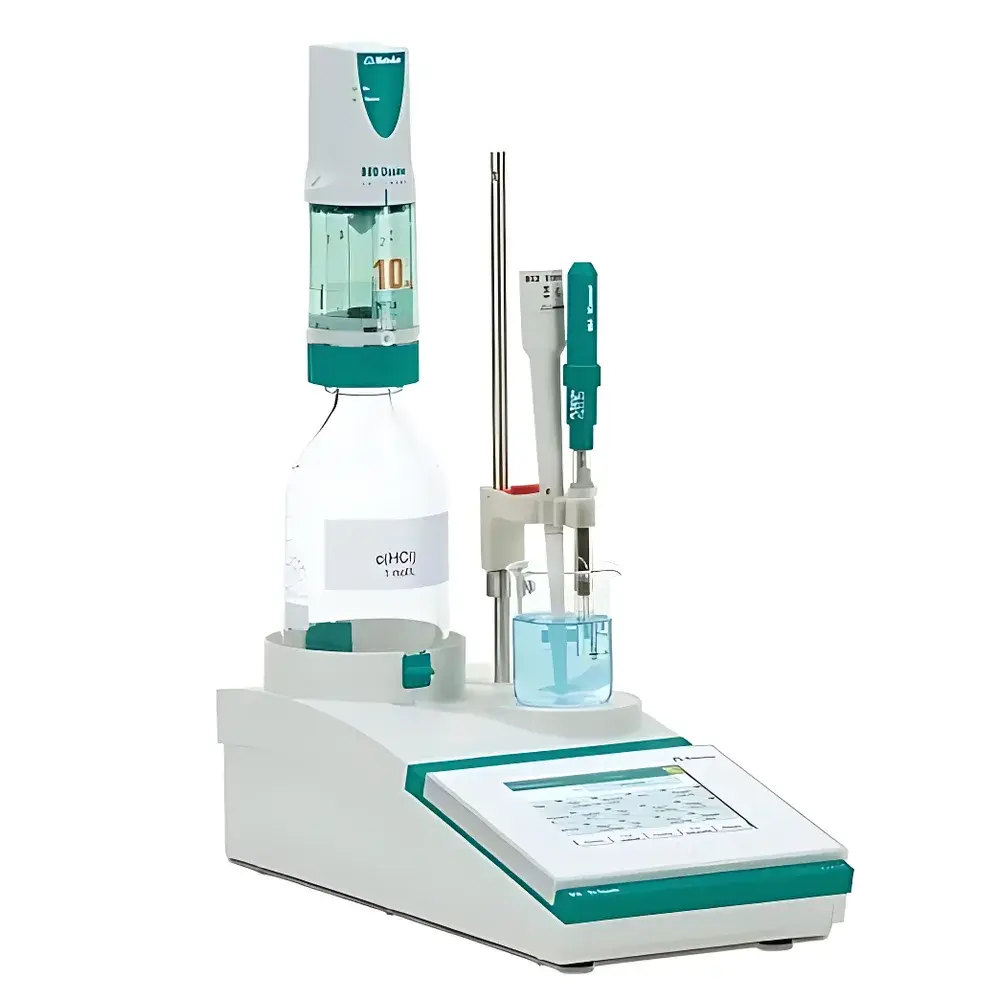
Metrohm 916 Compact Titrator
| Origin | Switzerland |
|---|---|
| Manufacturer Type | Authorized Distributor |
| Origin Category | Imported Instrument |
| Model | 916s |
| Pricing | Available Upon Request |
Overview
The Metrohm 916 Compact Titrator is a fully integrated, benchtop automatic potentiometric titrator engineered for precision micro-titration in regulated and resource-constrained laboratory environments. Based on classical potentiometric endpoint detection—measuring potential change across a high-impedance indicator electrode relative to a stable reference electrode—the system delivers trace-level analytical accuracy with minimal reagent and sample consumption. Introduced in September 2011, the 916s represents Metrohm’s first-generation compact titrator platform designed specifically to address the growing demand for low-volume, high-reproducibility titrimetric analysis in pharmaceutical QC, academic research, and fine chemical synthesis. Its core innovation lies in the integration of Dosino dosing modules—precision piston-driven burettes with zero-dead-volume fluid path design—which enable dispensing accuracy down to 0.5 µL per step and total titrant delivery under 0.5 mL per analysis. This reduces sample volume requirements to as little as 10 mm liquid column height (≈0.3–0.5 mL depending on cell geometry), cutting solvent and analyte consumption by more than one order of magnitude compared to conventional titration systems operating at 5–20 mL titrant volumes.
Key Features
- Integrated Dosino dosing units with ceramic piston technology and pressure-compensated air gap elimination—ensuring drift-free, bubble-free reagent delivery without priming or purging
- Four standardized titration modes: DET (Dynamic Endpoint Titration), MET (Multi-Endpoint Titration), SET (Single or Dual-Endpoint Titration), and MAT (Manual Titration)—all selectable via intuitive touch interface without external software
- Embedded Ethernet port supporting direct LIMS connectivity and network-based method deployment; no PC required for operation, data logging, or report generation
- Onboard PDF report generator with configurable templates—including GLP-compliant audit trails, timestamped operator ID, and instrument calibration history
- Dual-channel capability enabling parallel titration of two independent samples or sequential analysis with automatic rinse and conditioning cycles
- Smart stirring control with adaptive speed regulation based on viscosity and electrode immersion depth—maintaining laminar flow without vortex formation or electrode coating
- Tool-free reagent cartridge exchange system with RFID-tagged consumables—automatically recognized and validated upon insertion
- Plug-and-play compatibility with Metrohm’s micro-electrode series (e.g., 6.0234.100 pH micro-electrode, 6.0351.100 redox micro-electrode) featuring 3 mm diameter sensing tips and optimized junction geometry for low-volume cells
Sample Compatibility & Compliance
The 916s supports aqueous and non-aqueous matrices across pH 0–14, redox potentials from −1500 to +1500 mV, and ion-selective applications (e.g., Cl⁻, Ag⁺, F⁻) when paired with compatible micro-sensors. Its hardware architecture complies with IEC 61000-4 electromagnetic immunity standards and meets CE marking requirements for laboratory instrumentation. For regulated environments, the system supports 21 CFR Part 11-compliant user access control (role-based permissions), electronic signature workflows, and tamper-evident data storage. All measurement records—including raw potential vs. volume curves, derivative plots, and endpoint calculations—are stored in encrypted internal memory with optional external USB backup. Method validation documentation aligns with ISO/IEC 17025 and ASTM E2028 guidelines for titrimetric assay verification.
Software & Data Management
Operation is managed entirely through the built-in tiBase firmware (v3.5+), which provides real-time titration curve visualization, dynamic endpoint interpolation using second-derivative algorithms, and customizable pass/fail criteria for automated result classification. Data export options include CSV (for Excel or statistical packages), XML (for LIMS ingestion), and native PDF with embedded digital signatures. The system logs all critical events—including electrode calibration status, dosing module maintenance intervals, and environmental sensor readings (temperature, humidity)—in a time-stamped, immutable audit trail. Firmware updates are delivered via secure HTTPS and verified using SHA-256 checksums prior to installation.
Applications
- Pharmaceutical active ingredient assay (e.g., USP acid-base titration of amine salts)
- Trace chloride quantification in ultrapure water (ASTM D4582)
- Oxidation-reduction titration of ascorbic acid in nutraceutical extracts
- Micro-determination of free fatty acids in biodiesel (ASTM D664)
- Endpoint detection in Karl Fischer coulometric moisture analysis (when interfaced with 851 KF Coulometer)
- Quality control of catalyst precursors requiring sub-milligram sample loads
FAQ
Does the 916s require a computer for routine operation?
No—full titration control, data acquisition, PDF reporting, and LIMS communication are handled autonomously by the onboard processor.
Can the 916s be used with non-Metrohm electrodes?
Yes, provided the electrode has BNC or DIN connectors and operates within standard potentiometric input impedance ranges (≥10¹² Ω); however, micro-electrode performance optimization is guaranteed only with Metrohm-certified sensors.
Is method transfer from older Metrohm titrators supported?
Yes—tiBase firmware includes backward-compatible import filters for methods created on 785/795/848 Titrino platforms, preserving titration parameters, endpoint logic, and report formatting.
What is the minimum detectable volume increment?
The Dosino module achieves 0.5 µL resolution per dispensing step, with volumetric accuracy certified to ±0.1% RSD at 100 µL and above.
How is calibration traceability maintained?
Each Dosino module ships with a factory calibration certificate traceable to NIST SRM 912a; users may perform in-house verification using certified volumetric standards (e.g., ISO 4787 Class A).






