
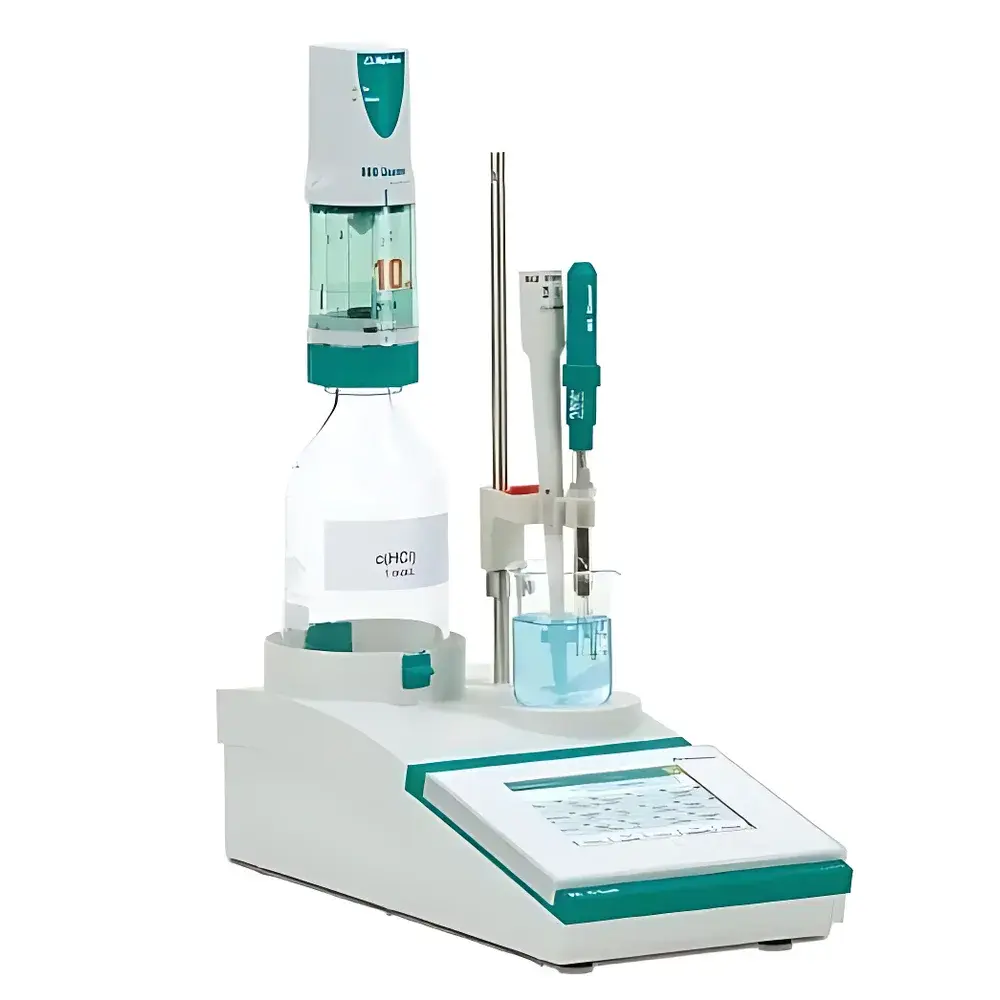
Metrohm 916 Ti-Touch All-in-One Potentiometric Titrator
| Brand | Metrohm |
|---|---|
| Origin | Switzerland |
| Manufacturer | Metrohm AG |
| Type | Imported Instrument |
| Model | 916 Ti-Touch |
| Instrument Category | General-Purpose Potentiometric Titrator |
| Application Scope | Universal |
| Measurement Range | −2000 mV to +2000 mV |
| Potential Resolution | 0.1 mV |
| Titration Mode Support | DET, MET, SET (single or dual endpoint), MAT |
Overview
The Metrohm 916 Ti-Touch is an all-in-one potentiometric titrator engineered for precision, safety, and operational autonomy in modern analytical laboratories. Based on the fundamental principle of potentiometric endpoint detection—measuring the potential difference between a reference and an indicator electrode as a function of titrant addition—the system delivers high reproducibility in acid-base, redox, precipitation, and complexometric titrations. Its integrated architecture eliminates external PCs for core operation: method execution, real-time titration curve visualization, data logging, report generation, and network interfacing are all managed via its 7-inch capacitive touchscreen interface. Designed and manufactured in Herisau, Switzerland, the instrument complies with ISO/IEC 17025 requirements for testing laboratories and supports GLP/GMP workflows through audit-trail-capable data handling and electronic signature readiness.
Key Features
- Self-contained operation: No PC required for method execution, data acquisition, or report export—enabling standalone deployment in QC labs, production environments, or field mobile units.
- Four validated titration modes: DET (Dynamic Equivalence Point Detection), MET (Constant Volume Increment with Endpoint Search), SET (Single or Dual Fixed-Endpoint Titration), and MAT (Manual Titration with real-time potential monitoring).
- Patented Dosino dosing technology: A mechanically isolated, stepper-motor-driven reagent delivery system enabling rapid, tool-free reagent exchange without exposure to hazardous chemicals—certified per IEC 61000-4-3 for electromagnetic immunity.
- Dual MSB (Metrohm Serial Bus) ports: Support simultaneous connection of two Dosino units, two 805 Dosimat burettes, or mixed configurations—enabling true dual-channel titration for parallel analysis or back-titration workflows.
- Smart Stirring System: Auto-adjusting magnetic or spiral stirrer speed based on sample viscosity and electrode response dynamics—ensuring optimal mixing without foaming or splashing.
- Intelligent electrode compatibility: Full plug-and-play recognition of Metrohm’s “IntelliSens” and “IntelliCAL” electrode families—including pH, redox, ion-selective, and photometric sensors—with automatic calibration parameter transfer and lifetime tracking.
- Secure data integrity: On-device generation of digitally signed, tamper-evident PDF reports compliant with FDA 21 CFR Part 11 Annex 11 requirements when used with tiBase software and appropriate user access controls.
Sample Compatibility & Compliance
The 916 Ti-Touch accommodates liquid, semi-solid, and homogenized solid samples across diverse matrices—including aqueous solutions, hydrocarbon-based oils, food extracts, pharmaceutical suspensions, and environmental leachates. It meets ASTM D664 (acid number in petroleum products), ISO 8587 (sensory analysis—ranking methods), USP (titrimetric assays), and EN 14104 (fatty acid methyl ester content in biodiesel). All hardware components—including electrodes, dosing units, and stirrers—are CE-marked and RoHS-compliant. The system supports IQ/OQ documentation packages for regulated industries and integrates seamlessly with LIMS platforms via standard TCP/IP protocols and HL7-compatible result export.
Software & Data Management
Data capture, processing, and archival are handled by the embedded firmware and optional tiBase software suite. Raw titration curves, equivalence point calculations, derivative plots, and metadata (user ID, timestamp, electrode ID, reagent lot) are stored locally on internal flash memory or externally via USB mass storage devices. Reports are exported as PDF files containing cryptographic hash signatures to prevent post-acquisition modification. When connected to Ethernet, the instrument registers directly with enterprise networks—allowing remote method deployment, centralized result archiving, and automated backup to NAS or cloud-based repositories. tiBase enables advanced statistical evaluation (e.g., ANOVA, trend analysis), multi-method comparison, and compliance-ready audit trail review—including full change history for methods, parameters, and calibration records.
Applications
The 916 Ti-Touch serves as a universal platform for routine and regulated titrimetric analysis. Common applications include chloride determination in water (Mohr method), total acidity in edible oils (AOCS Cd 3d-63), free fatty acid quantification in biodiesel (EN 14104), sulfur dioxide in wine (Ripper method), peroxide value in fats (AOCS Cd 8-53), and calcium/magnesium hardness in industrial cooling water (EDTA complexometry). Preconfigured application packages—such as the Salt Analysis Kit, Oil Analysis Kit, and Food Analysis Kit—include validated methods, certified reference materials, optimized electrodes, and dedicated dosing sequences aligned with respective ISO, AOCS, and AOAC guidelines.
FAQ
Does the 916 Ti-Touch require a computer for daily operation?
No. All titration control, real-time curve display, data storage, and PDF report generation occur natively on the instrument’s embedded system.
Can it connect to laboratory information management systems (LIMS)?
Yes—via Ethernet using standard TCP/IP communication; supports direct upload of results and methods without intermediary software.
What electrode technologies are supported?
All Metrohm IntelliSens and IntelliCAL electrodes with digital identification chips—including pH, redox, Ag, Cu, F, Cl, Br, CN, S²⁻, and photometric sensors—with automatic configuration and calibration history synchronization.
Is dual-channel titration possible?
Yes—using both MSB ports to operate two independent dosing units simultaneously, enabling back-titration, sequential reagent addition, or parallel sample analysis.
How is data integrity ensured for regulatory submissions?
Through encrypted PDF reports with embedded digital signatures, time-stamped audit trails in tiBase, and full traceability of users, methods, reagents, and hardware states—meeting FDA 21 CFR Part 11 and EU Annex 11 expectations.





