
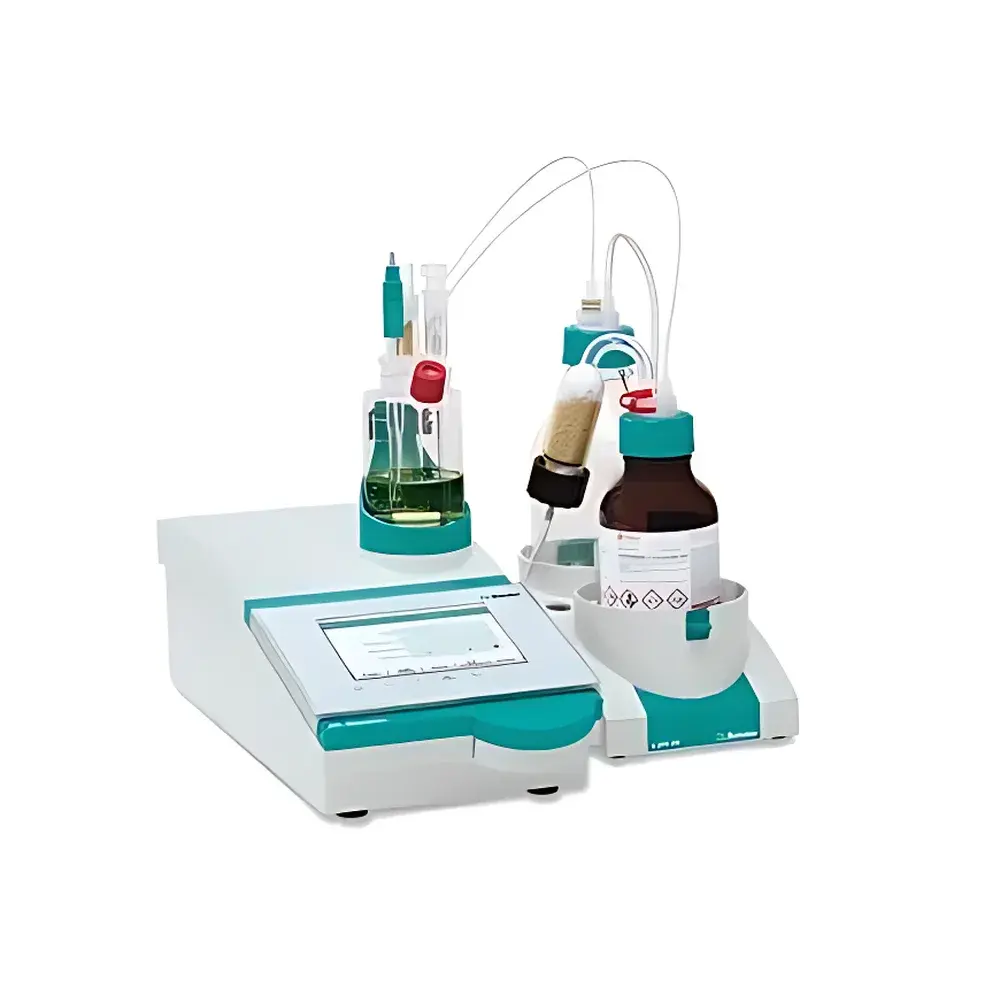
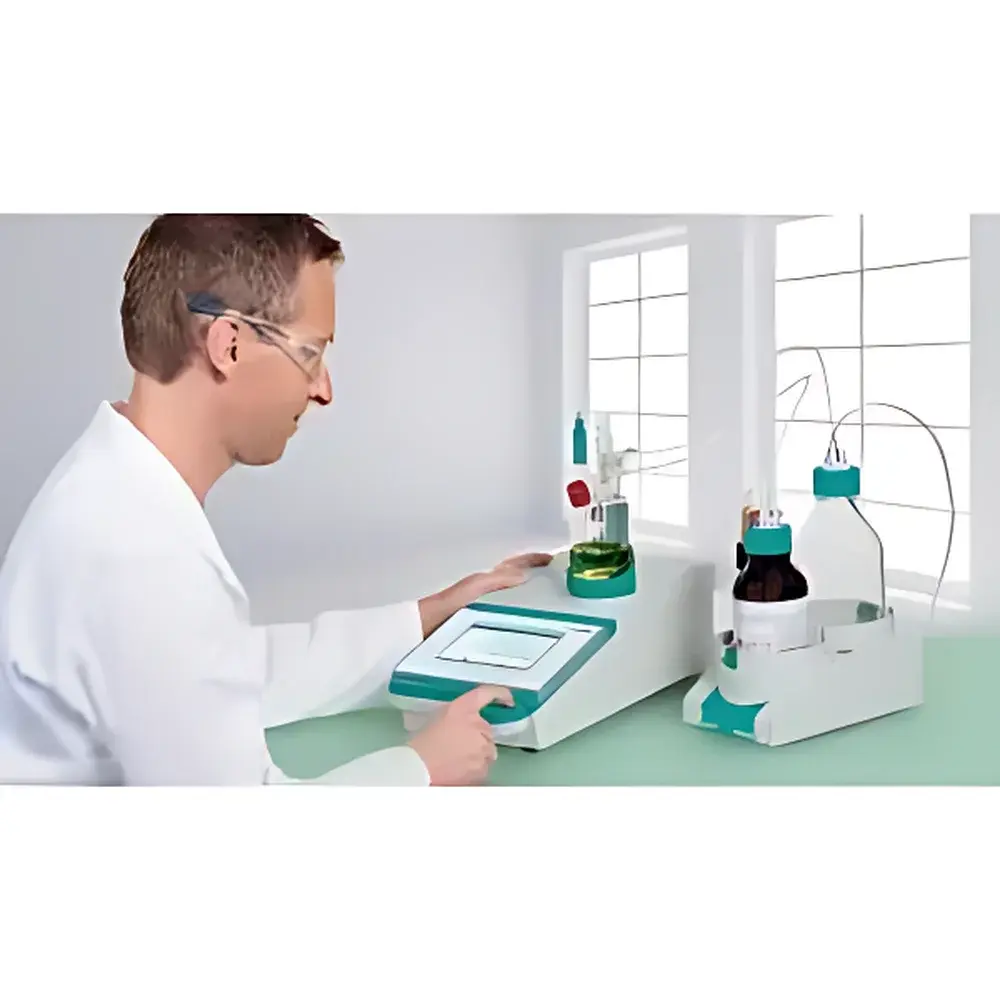
Metrohm 917 Coulometric Karl Fischer Titrator
| Brand | Metrohm |
|---|---|
| Origin | Switzerland |
| Model | 917 |
| Measurement Range | 10 µg – 200 mg H₂O (up to 1000 mg max) |
| Accuracy | ±0.3% (for H₂O ≥ 1000 µg) |
| Resolution | 3 µg |
| Titration Precision | ±0.3 mV over 3 h |
| Generator Electrode Max. Electrolysis Rate | 2241 µg H₂O/min |
| Generator Current Settings | 100, 200, 400 mA and auto |
| Indicator Electrode Polarization Current | AC: 5, 10, 20, 30 µA |
| DC | –125 to +125 µA |
| Indicator Electrode Potential Resolution | 0.1 mV |
| Integrated Membrane Pump | Yes |
| USB Storage & Network Interface | Yes |
| Touchscreen | 90 mm × 120 mm color display with real-time titration curve |
| Compliance | ASTM D6304, ISO 760, USP <921>, EP 2.5.12, GLP/GMP-ready audit trail support |
Overview
The Metrohm 917 Coulometric Karl Fischer Titrator is a fully integrated, benchtop coulometric moisture analyzer engineered for high-precision, routine water content determination in laboratories adhering to strict regulatory and quality control standards. Based on the electrochemical principle of coulometric Karl Fischer titration, the system quantifies trace water by electrolytically generating iodine at the anode in a sealed, reagent-filled cell — where iodine stoichiometrically reacts with water (1 mol I₂ ≡ 1 mol H₂O). This method delivers superior sensitivity and reproducibility for samples containing ≤1000 µg water per measurement, eliminating volumetric reagent calibration drift and enabling absolute quantification without standardization. Designed as a dedicated coulometric platform, the 917 supports dual operational modes: standard coulometric moisture analysis and bromine number/bromine index determination via controlled-potential coulometry — both governed by Faraday’s law and validated against ASTM D2710, D1159, and IP 124.
Key Features
- Integrated architecture: Combines generator/indicator electrodes, magnetic stirrer, sealed titration cell, membrane pump, and capacitive touchscreen (90 × 120 mm) into a single compact unit — minimizing footprint and cross-contamination risk.
- Automated sample initiation: Capacitive sensing detects vial insertion or syringe actuation, triggering pre-titration stabilization and subsequent coulometric water quantification without manual start commands.
- Reagent lifecycle management: Real-time tracking of cumulative sample injections, total water consumed, and reagent exhaustion thresholds; alerts users when predefined limits are reached to ensure metrological integrity.
- Touch-actuated fluid handling: One-button evacuation of spent electrolyte and replenishment of fresh KF reagent — no manual cell opening required, reducing operator exposure and contamination.
- Dynamic electrode control: Adjustable generator current (100/200/400 mA or auto-mode) and selectable indicator polarization (AC/DC), optimized for diverse sample matrices and moisture release kinetics.
- Embedded security and traceability: Digital signature-enabled PDF reports stored locally on USB or remotely via Ethernet; full audit trail compliant with FDA 21 CFR Part 11 requirements when paired with LIMS or validated network infrastructure.
Sample Compatibility & Compliance
The 917 accommodates a broad spectrum of solid, liquid, and viscous samples — including pharmaceutical actives (e.g., lyophilized APIs), petrochemicals (transformer oils, jet fuels), polymers (PE, PA, PVC), food ingredients (milk powder, coffee extracts), and cosmetics (lipsticks, sunscreens). For samples incompatible with direct coulometric injection — such as those exhibiting slow water release, side reactions with KF reagents (e.g., aldehydes/ketones), or physical insolubility (polyester chips, bone implants) — the system seamlessly interfaces with optional Metrohm 860 (single-position) or 885 (18-position automated) KF ovens. These ovens employ headspace heating under inert carrier gas (N₂ or dry air), thermally liberating bound moisture and transferring it quantitatively to the titration cell — ensuring complete extraction and compliance with ISO 15512 and ASTM E203 methodologies. All workflows support GLP/GMP documentation, with electronic signatures, user-level access control (operator/expert modes), and configurable calculation formulas meeting pharmacopeial validation criteria.
Software & Data Management
The embedded operating system features a multilingual GUI (English, German, French, Spanish, Chinese) and supports up to 14 customizable method shortcuts on the home screen for rapid assay deployment. Method parameters — including drift correction strategy (manual/auto/off), endpoint detection algorithm (fixed potential, dynamic slope), and post-measurement recalculation rules — are stored in a relational database with timestamped metadata. Raw data (potential vs. time curves), intermediate values (drift, background current), and final results are exportable in CSV or encrypted PDF formats. The dual USB ports enable direct connection to balances, barcode scanners, printers, or PCs; the Ethernet port permits centralized data archiving, remote diagnostics, and native integration with LIMS via TCP/IP or OPC UA protocols. All report generation follows NIST SP 800-53 guidelines for cryptographic integrity and non-repudiation.
Applications
- Petrochemical QA/QC: Moisture in aviation turbine fuel (ASTM D6304), bromine index in naphtha (ASTM D1159), and water in lubricating oils.
- Pharmaceutical manufacturing: Residual solvent water in freeze-dried injectables (USP <921>), excipient moisture profiling (EP 2.5.12), and stability-indicating assays.
- Food & beverage R&D: Water activity correlation in dairy powders, moisture in roasted coffee beans, and glycerin/water ratios in confectionery.
- Materials science: Hydration state analysis in catalysts, polymer resin drying verification (ISO 15512), and moisture ingress testing in encapsulated electronics.
- Electrolyte formulation: Trace water quantification in Li-ion battery solvents (e.g., ethylene carbonate, dimethyl carbonate) where sub-10 ppm levels impact SEI formation.
FAQ
What is the lower detection limit for water using the 917?
The system achieves reliable quantification down to 10 µg absolute water mass, with optimal precision (±0.3%) attained at ≥1000 µg.
Can the 917 perform bromine number analysis without hardware modification?
Yes — bromine number and bromine index determination are firmware-enabled coulometric modes requiring only electrode polarity reversal and appropriate electrolyte (e.g., LiBr in acetic acid), no additional hardware.
Is method validation support included?
The instrument provides built-in tools for repeatability assessment, spike recovery testing, and system suitability checks aligned with ICH Q2(R2); full validation documentation templates are available from Metrohm upon request.
How does the 917 handle high-viscosity or particulate-laden samples?
For such matrices, coupling with the 885 KF oven is recommended — its heated headspace transfer eliminates clogging risks while maintaining quantitative recovery across heterogeneous solids.
Does the system comply with 21 CFR Part 11 for electronic records?
When deployed with network authentication, role-based access, and digital signature modules enabled, the 917 meets predicate rule requirements for electronic signatures and audit trails.




