
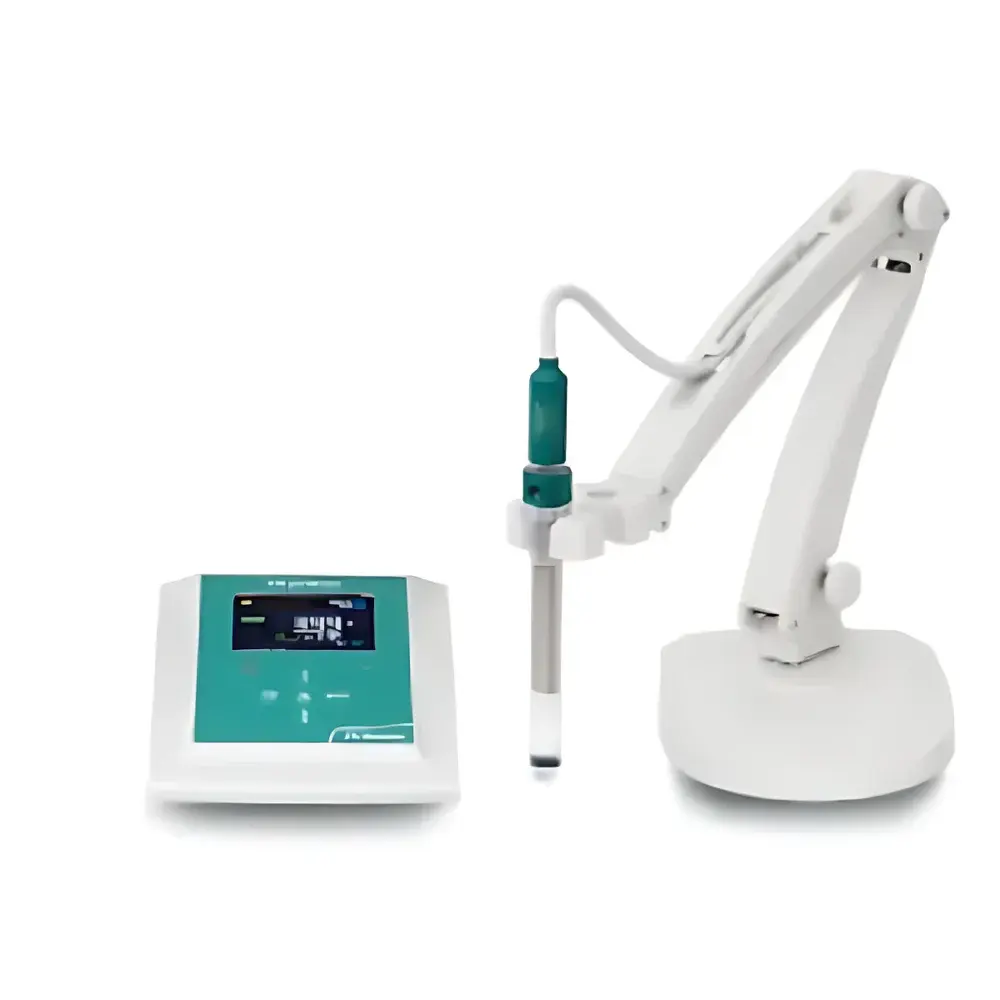

Metrohm 949 pH Meter
| Brand | Metrohm |
|---|---|
| Origin | Switzerland |
| Manufacturer | Metrohm AG |
| Product Type | Benchtop pH Meter |
| Model | 949 |
| Measurement Modes | pH, mV, ORP, Temperature |
| pH Range | −2.00 to 16.00 (resolution: 0.01 pH) |
| mV/ORP Range | −1000.0 to +1999.9 mV (resolution: 0.1 mV) |
| Temperature Range | −10.0 to +110.0 °C (resolution: 0.1 °C) |
| Calibration | Automatic buffer recognition (built-in IUPAC/NIST/USP/DIN buffer tables), up to 5-point calibration |
| Temperature Compensation | Automatic (ATC) and manual |
| Data Storage | Up to 1,000 measurement records with timestamp (date/time stamping) |
| Interface | RS232 serial port for printer or PC connection |
| Compliance | GLP-compliant reporting, audit-ready data logging, electrode calibration reminder |
Overview
The Metrohm 949 pH Meter is a benchtop electrochemical instrument engineered for precision, reliability, and regulatory compliance in routine laboratory environments. Designed according to fundamental potentiometric principles—measuring the potential difference between a pH-sensitive glass electrode and a stable reference electrode—the 949 delivers traceable, reproducible measurements across the full operational pH range of −2.00 to 16.00. Its architecture integrates thermistor-based temperature sensing and automatic temperature compensation (ATC) to correct for thermal effects on electrode response, ensuring Nernstian accuracy under variable ambient and sample conditions. As an entry-level yet fully featured system, the 949 supports not only standard pH quantification but also direct mV and redox (ORP) potential measurement, making it suitable for applications ranging from quality control in pharmaceutical manufacturing to environmental water analysis and educational laboratories.
Key Features
- Built-in buffer recognition with preloaded calibration tables compliant with IUPAC, NIST, USP, and DIN standards—enabling rapid, error-resistant 2- to 5-point calibration without manual buffer entry.
- GLP-compliant data handling: all measurements are automatically time- and date-stamped; calibration events are logged with buffer IDs, slope, offset, and asymmetry potential values.
- High-contrast color display with dynamic stability indicator—visually distinguishes stable vs. drifting readings using real-time signal variance assessment.
- RS232 interface supporting direct printing of measurement reports (including calibration parameters) or bidirectional communication with LIMS or custom data acquisition software.
- Electrode calibration reminder function—configurable by user-defined intervals—to proactively maintain measurement integrity and support internal QA/QC protocols.
- Internal memory capacity of 1,000 data points with full metadata (pH/mV/ORP value, temperature, timestamp, electrode ID if encoded, calibration status).
Sample Compatibility & Compliance
The 949 is compatible with the complete portfolio of Metrohm pH electrodes—including refillable, gel-filled, and solid-state variants—as well as ORP electrodes and Pt1000 temperature probes. This interoperability ensures optimal performance across diverse sample matrices: aqueous buffers, non-aqueous solvents (with appropriate electrode selection), viscous biological fluids, aggressive acids or alkalis (pH −2 to 16), and low-conductivity ultrapure water (when used with low-resistance electrodes and guarded measurement mode). The instrument meets essential regulatory expectations for analytical instrumentation: data immutability (no post-hoc editing of stored records), audit-trail-capable calibration history, and adherence to ISO/IEC 17025 documentation requirements. While not inherently 21 CFR Part 11–compliant out-of-the-box, its structured data export (via RS232) enables integration into validated systems that enforce electronic signature and access control policies.
Software & Data Management
No proprietary software is required for basic operation; however, the RS232 interface permits seamless integration with third-party platforms including Excel-based templates, LabVIEW applications, or enterprise-grade LIMS via ASCII protocol. All exported data retain native formatting: timestamp (YYYY-MM-DD HH:MM:SS), measured parameter, unit, electrode identifier (if encoded), temperature, and calibration metadata. Internal storage follows first-in-first-out (FIFO) logic with overwrite protection enabled only after explicit user confirmation—ensuring raw data integrity during routine use. Calibration logs include slope (%), zero point (mV), and asymmetry potential (mV), enabling trend analysis of electrode aging per ASTM D1293 and ISO 10523 guidelines.
Applications
- Pharmaceutical QC testing: dissolution media pH verification, excipient compatibility studies, and cleaning validation rinse water monitoring.
- Environmental labs: surface water, wastewater, and soil leachate pH/ORP profiling per EPA Method 9040C and ISO 10523.
- Food & beverage production: fermentation process control, titratable acidity correlation, and shelf-life stability testing.
- Academic teaching labs: Nernst equation validation, buffer capacity experiments, and electrode selectivity demonstrations.
- Chemical R&D: reaction mixture pH tracking in catalytic synthesis and corrosion inhibitor evaluation.
FAQ
Does the 949 support automatic calibration with non-Metrohm electrodes?
Yes—it accepts any pH or ORP electrode with standard BNC or DIN connectors and compatible reference junctions; however, automatic buffer recognition and electrode-specific diagnostics require Metrohm Smart Electrodes with integrated memory chips.
Can measurement data be exported in CSV format?
Yes—via RS232 connection using terminal emulation software (e.g., Tera Term) or custom scripts; the instrument outputs ASCII-delimited records ready for spreadsheet import.
Is temperature compensation mandatory during pH measurement?
No—ATC can be disabled for manual temperature input or fixed-temperature studies, though ISO 7888 and ASTM E70 recommend ATC for routine accuracy.
What is the maximum allowable sample conductivity for stable readings?
The 949 operates reliably down to ~5 µS/cm; for ultrapure water (<1 µS/cm), use a low-conductivity electrode (e.g., Metrohm 6.0234.100) and minimize ground loops.
How often should the instrument be verified with certified reference solutions?
Per ISO/IEC 17025, daily verification is recommended before critical measurements; documented verification against traceable standards (e.g., NIST SRM 186) satisfies GLP audit requirements.
Related Products




