
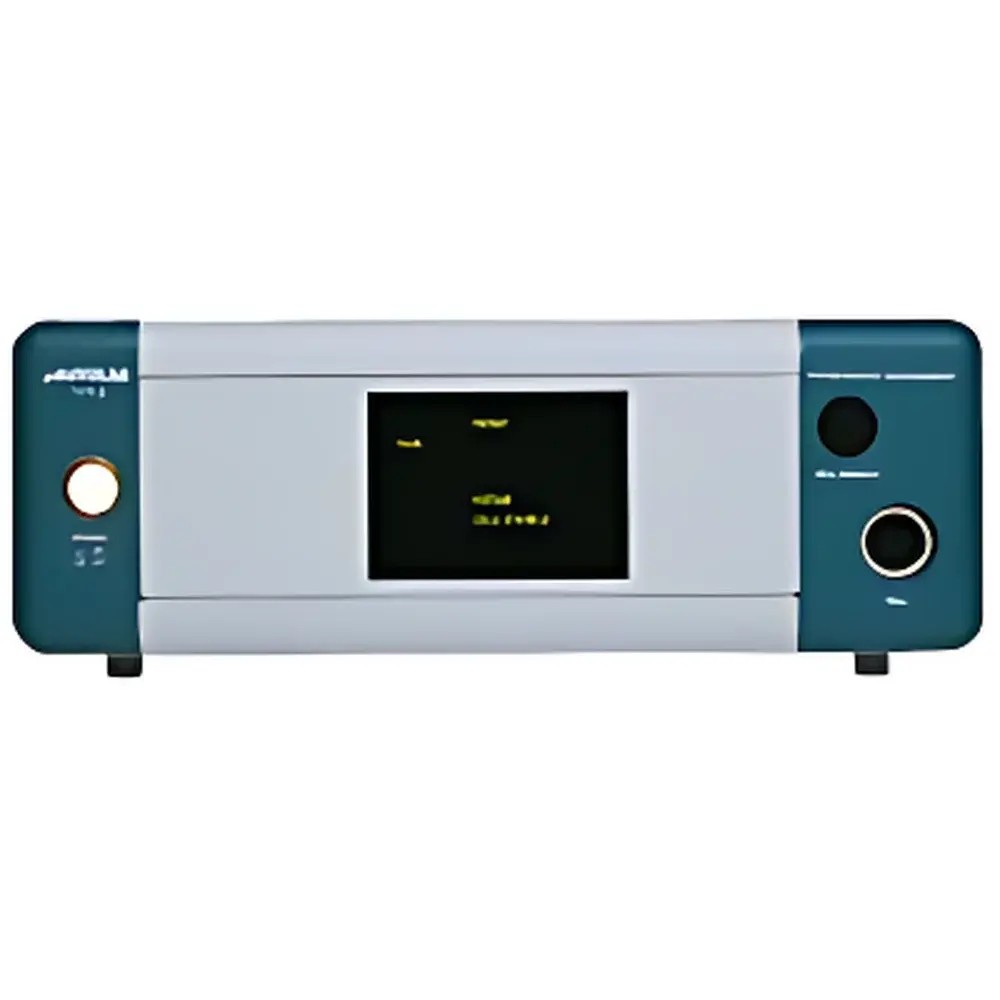
Metrohm Autolab μAUTOLAB III Electrochemical Workstation
| Brand | Metrohm Autolab |
|---|---|
| Model | μAUTOLAB III |
| Max Output Current | ±250 mA |
| Max Output Voltage | ±100 V |
| Potential Range | ±10 V |
| Applied Potential Accuracy | ±2 mV ± 0.2% of set value |
| Applied Potential Resolution | 150 µV |
| Measured Potential Resolution | 30 µV (high-res mode) or 300 µV |
| Current Range | 10 nA to 100 mA (8 decades) |
| Current Accuracy | ±0.2% of reading ± 0.2% of range |
| Applied Current Resolution | 0.03% of range |
| Measured Current Resolution | 0.0003% of range (30 fA at 10 nA range) |
| Potentiostat Bandwidth | >400 kHz |
| Rise/Fall Time (1 V step, 10–90%) | <500 ns |
| Electrometer Input Impedance | >100 GΩ |
| Input Bias Current (@25°C) | <1 pA |
| Electrometer Bandwidth | >4 MHz |
| EIS Frequency Range | 10 µHz to 1 MHz |
| Sampling Rate | up to 750 kHz (with ADC750 module) |
| iR Compensation Range | 0–200 MΩ, resolution 0.025% |
| Electrode Configurations | 2-, 3-, or 4-electrode modes |
| Analog I/O | Dual-channel DAC/ADC for external control and synchronization |
Overview
The Metrohm Autolab μAUTOLAB III is a high-performance, modular potentiostat/galvanostat designed for demanding electrochemical research and industrial applications involving high-impedance electrolytes and low-conductivity media. Engineered on a precision analog front-end architecture with ultra-low noise design, it supports both potentiostatic and galvanostatic operation across an extended voltage range (±100 V) and current range (±250 mA), making it uniquely suited for corrosion studies in soils, organic solvents, petroleum products, ceramics, and reinforced concrete. Its core measurement principle relies on real-time feedback-controlled current/voltage sourcing with sub-picampere current detection capability—enabling quantitative analysis of slow charge-transfer kinetics, interfacial capacitance, and faradaic processes in systems where solution resistance exceeds several megaohms. The instrument’s analog bandwidth (>400 kHz) and nanosecond-scale transient response (<500 ns rise time) ensure fidelity in fast-scan voltammetry, pulse techniques, and time-resolved impedance measurements.
Key Features
- Modular, PC-controlled architecture enabling field-upgradable functionality via plug-in modules (e.g., FRA2, BOOSTER 10A, ADC750, SCANGEN, ECD)
- Ultra-low input bias current (100 GΩ || <8 pF) for accurate measurement in insulating media
- Current resolution down to 30 fA (at 10 nA range), supporting trace-level redox detection and double-layer capacitance quantification
- Programmable iR compensation (0–200 MΩ, 0.025% resolution) for precise potential control in high-Rs environments
- Dual-channel analog I/O for synchronized external triggering, waveform generation, or integration with auxiliary equipment (e.g., temperature controllers, flow cells)
- Sampling rates up to 750 kHz (1.5 µs interval) with ADC750 module—essential for transient analysis and high-speed chronoamperometry
- Flexible electrode configuration support: 2-, 3-, and 4-electrode modes—including floating-ground operation for in-situ pipeline, tank, or bridge corrosion monitoring
Sample Compatibility & Compliance
The μAUTOLAB III is routinely deployed in heterogeneous, non-aqueous, and highly resistive matrices where conventional potentiostats fail due to insufficient voltage headroom or excessive noise floor. It meets functional requirements outlined in ASTM G59 (standard practice for conducting potentiodynamic polarization resistance measurements), ASTM G102 (calculation of corrosion rates), and ISO 16774 (electrochemical impedance spectroscopy for coated metals). Its hardware design conforms to IEC 61010-1 safety standards for laboratory electrical equipment. When operated with GLP/GMP-compliant software configurations (e.g., GPES v5.0+ with audit trail enabled), the system supports regulatory submissions under FDA 21 CFR Part 11 for pharmaceutical and biomedical electroanalysis. All analog signal paths are shielded and isolated to minimize ground-loop interference during field-deployed measurements.
Software & Data Management
The workstation ships with GPES (General Purpose Electrochemical Software), a validated platform offering over 30 built-in electrochemical methods—including cyclic, differential pulse, square wave, and AC voltammetry; chronoamperometry, chronopotentiometry, and coulometry; stripping analysis; and multi-step potential/current protocols. For impedance characterization, the optional FRA (Frequency Response Analyzer) software provides full EIS acquisition from 10 µHz to 1 MHz in single-sweep mode, with configurable amplitude per frequency point and support for multi-sine (5- or 15-tone) excitation. Both GPES and FRA include advanced curve-fitting engines (e.g., equivalent circuit modeling using ZView-compatible formats), statistical data export (CSV, TXT, XLSX), and batch processing for reproducibility assessment. Raw data files store metadata (timestamp, instrument ID, calibration history) to satisfy traceability requirements in regulated laboratories.
Applications
- Corrosion monitoring of steel reinforcement in concrete and cementitious systems
- In-situ electrochemical testing of buried pipelines, storage tanks, and structural bridges using floating-ground configuration
- Electrochemical characterization of battery materials in low-conductivity organic electrolytes (e.g., Li-ion, solid-state)
- Interfacial studies at liquid|liquid or semiconductor|electrolyte junctions requiring 4-electrode control
- High-voltage electrosynthesis and industrial electroplating under constant-current conditions (up to ±250 mA)
- AC impedance mapping of coatings, membranes, and porous electrodes for fuel cell and sensor development
- Fundamental kinetics analysis in molten salts, ionic liquids, and ceramic sintering environments
FAQ
Can the μAUTOLAB III perform EIS measurements on samples with solution resistance exceeding 100 MΩ?
Yes—the instrument’s ±100 V compliance voltage, programmable iR compensation (up to 200 MΩ), and ultra-low bias current enable stable EIS acquisition in extremely resistive media such as dry soils or polymer electrolytes.
Is the floating-ground version compatible with standard three-electrode setups?
Yes—floating operation does not restrict electrode configuration; users may select 2-, 3-, or 4-electrode modes regardless of grounding mode.
What level of software validation is available for regulated industries?
GPES v5.0 and later support 21 CFR Part 11 compliance when deployed on validated Windows OS platforms with user access controls, electronic signatures, and immutable audit trails.
How is synchronization achieved with external devices like potentiostat-controlled reactors or spectroelectrochemical cells?
Via its dual-channel analog I/O interface, which supports TTL-triggered start/stop, analog voltage output for reference potential offset, and real-time current/voltage feedback input.
Does the system support automated long-term corrosion monitoring (e.g., weekly scans over 6 months)?
Yes—GPES includes script-based scheduling, auto-save routines, and error-recovery protocols suitable for unattended multi-week experiments with periodic data backup to network drives.
Related Products





