
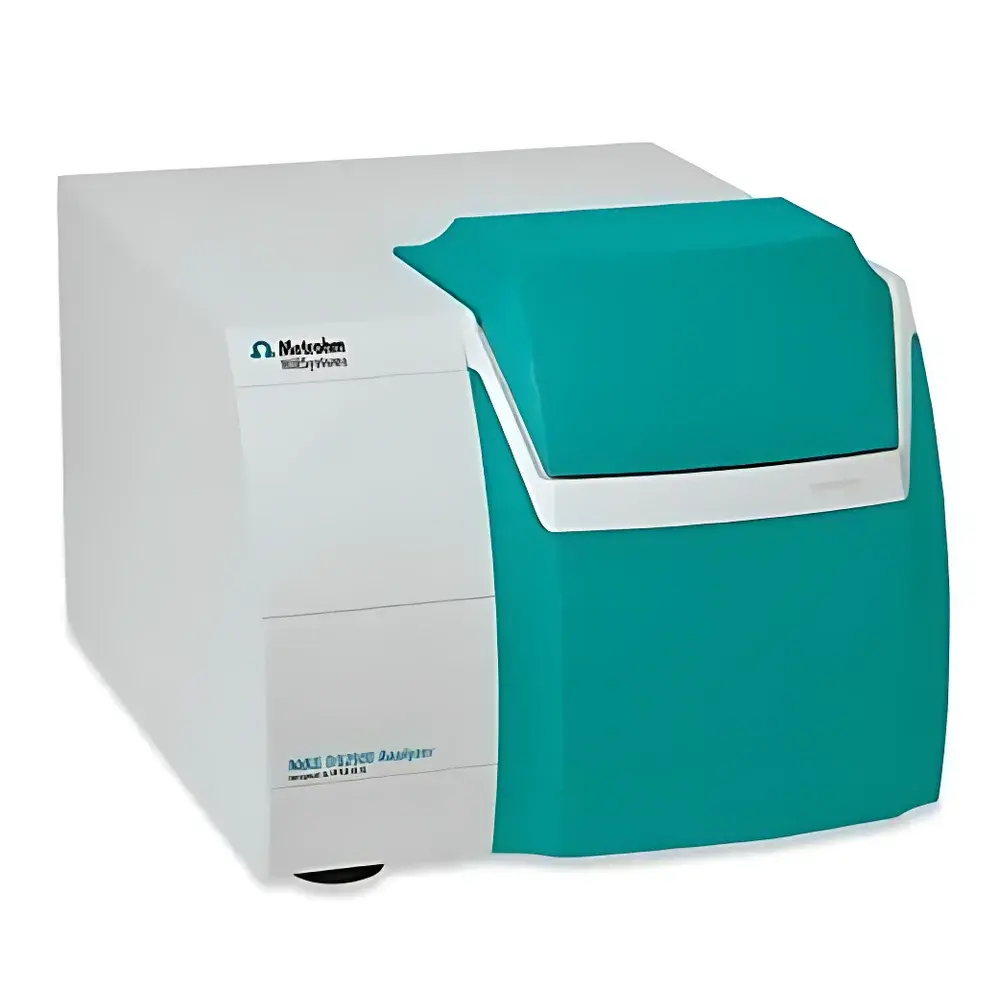
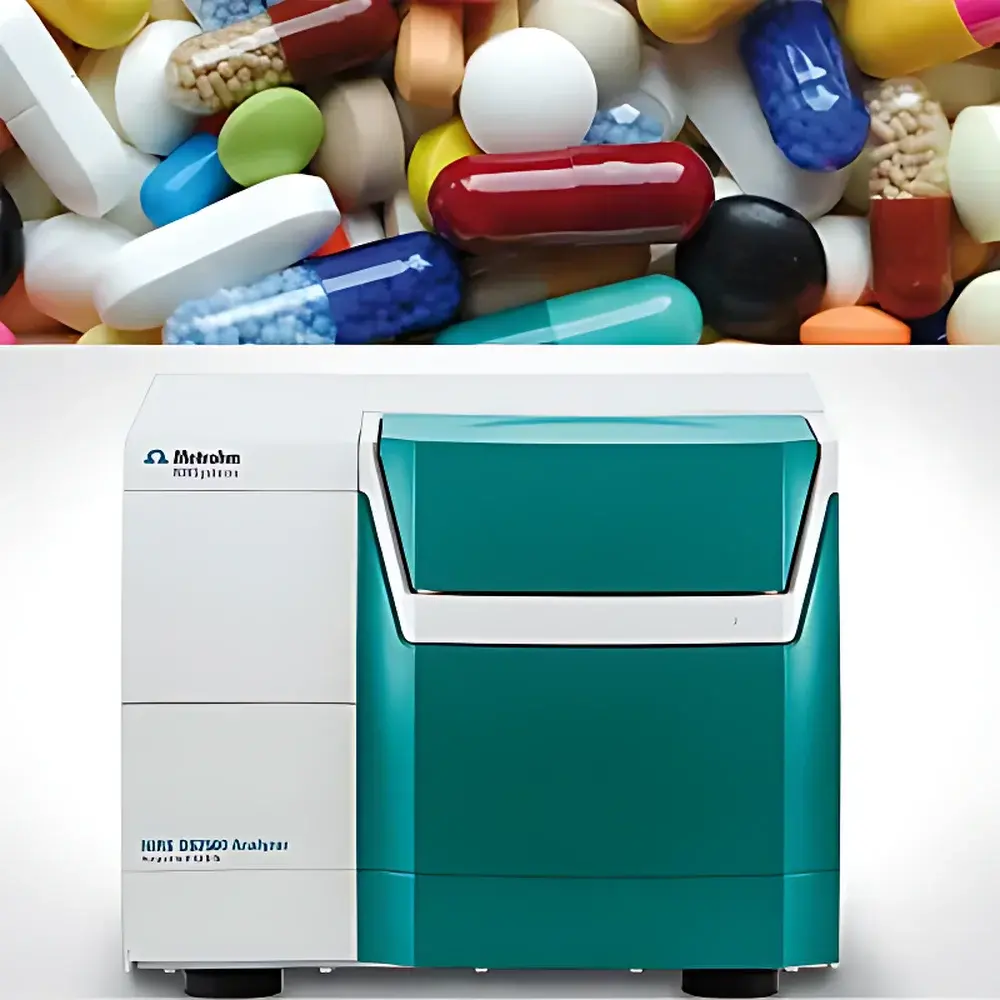
Metrohm DS2500 Near-Infrared Spectrometer
| Brand | Metrohm |
|---|---|
| Origin | Sweden |
| Manufacturer Type | Manufacturer |
| Origin Category | Imported |
| Model | DS 2500 |
| Instrument Type | Laboratory |
| Principle | Grating Scanning |
| Wavelength Range | 400–2500 nm |
| Scan Speed | 2 scans/sec |
| Data Sampling Interval | 0.5 nm |
| Measurement Modes | Diffuse Reflectance / Transflectance |
| Chemometrics Software | Vision |
Overview
The Metrohm DS2500 Near-Infrared Spectrometer is a high-performance, laboratory-grade grating-scanning NIR instrument engineered for robust, traceable, and regulatory-compliant quantitative and qualitative analysis across pharmaceutical, nutraceutical, and fine chemical manufacturing environments. Operating on the principle of dispersive grating-based spectroscopy, the DS2500 captures high-fidelity spectral data across the full near-infrared and visible-NIR transition region (400–2500 nm), enabling comprehensive molecular fingerprinting of organic functional groups—including O–H, N–H, and C–H overtones and combinations. Its front-mounted monochromator architecture delivers exceptional optical stability, minimal wavelength drift ( 10,000:1 at 1500 nm), allowing reliable detection of low-concentration analytes (e.g., moisture < 0.1%, active pharmaceutical ingredient [API] content ±0.2% w/w) within sub-minute measurement cycles. Designed to meet the operational rigor of GMP-regulated facilities, the DS2500 integrates seamlessly into quality control workflows—from raw material identity verification (ID) and assay to in-process monitoring and final product release testing.
Key Features
- Front-mounted scanning monochromator with thermally stabilized optics for long-term wavelength accuracy and minimal recalibration frequency
- IP65-rated enclosure—certified for operation in high-humidity, dusty, or vibration-prone production environments
- Dual-mode optical interface supporting both diffuse reflectance (for powders, tablets, granules) and transflectance (for liquids, suspensions, films)
- Real-time spectral acquisition at 2 scans per second with 0.5 nm data sampling interval, ensuring high-resolution spectral fidelity
- Internal reference standards for automatic intensity, bandwidth, and wavelength validation prior to each measurement sequence
- LAN-enabled remote operation and integration with centralized process control systems (e.g., DCS, SCADA)
- Modular accessory compatibility—including fiber-optic probes, integrating spheres, temperature-controlled sample holders, and automated tablet samplers
Sample Compatibility & Compliance
The DS2500 accommodates solid, semi-solid, and liquid samples without destructive preparation: intact tablets, bulk powders, capsules, syrups, emulsions, and lyophilized formulations are all amenable to direct, non-contact analysis. Its optical design eliminates baseline distortion from particle size variation or surface heterogeneity, enabling reproducible quantification even in unprocessed feedstock. From a regulatory standpoint, the DS2500 supports full auditability under FDA 21 CFR Part 11, EU Annex 11, and ISO/IEC 17025 requirements. Built-in electronic signatures, user-access controls, and immutable audit trails for calibration, method execution, and result reporting ensure compliance with GLP and GMP documentation standards. All firmware and Vision software versions undergo formal change control and validation support documentation per ICH Q2(R2) and USP .
Software & Data Management
Controlled exclusively by Metrohm Vision software—a validated, 21 CFR Part 11-compliant chemometrics platform—the DS2500 enables end-to-end method lifecycle management. Vision supports PLS and MLR regression modeling, outlier detection via Hotelling’s T² and Q-residuals, and automated model transfer between DS2500, XDS, and legacy System II instruments without performance loss. Spectral databases are stored in encrypted, timestamped SQL format with configurable retention policies. Real-time trend visualization, limit-based pass/fail logic, and automated report generation (PDF/CSV/XML) facilitate rapid decision-making. LIMS integration is achieved via ASTM E1384-compliant messaging or direct ODBC connectivity. Remote diagnostics, secure cloud-assisted calibration updates, and version-controlled method libraries ensure consistent cross-site deployment.
Applications
- Raw material identification (RMI) and assay verification per USP and Ph. Eur. 2.2.40
- In-line moisture content monitoring in fluid-bed dryers and roller compactors
- Blend uniformity assessment of multi-component powder mixtures (ASTM E2893-23)
- Coating thickness and dissolution profile prediction for film-coated tablets
- Quantitative determination of excipients (lactose, microcrystalline cellulose, PVP) and APIs in finished dosage forms
- Stability-indicating assays tracking degradation products (e.g., oxidation, hydrolysis) without chromatography
- Nutrient profiling in dietary supplements (vitamin A, D, E, omega-3 fatty acids) per AOAC 2012.01
FAQ
Does the DS2500 require routine wavelength recalibration?
No—its thermally stabilized front-mounted monochromator and internal wavelength reference standard maintain calibration stability for ≥12 months under normal use. Annual verification against NIST-traceable standards is recommended for GMP audits.
Can Vision models developed on older Metrohm NIR platforms be deployed directly on the DS2500?
Yes—Vision ensures full backward compatibility with System II and XDS models. Spectral preprocessing, regression coefficients, and validation metrics transfer without retraining or rescaling.
Is the DS2500 suitable for use inside a cleanroom environment?
Yes—when equipped with optional stainless-steel housing and HEPA-filtered purge ports, the DS2500 meets ISO Class 5 cleanroom requirements (ISO 14644-1) and supports Grade A/B operations when integrated with isolator interfaces.
What level of technical support is included post-installation?
Metrohm provides comprehensive support including preventive maintenance visits, certified spare parts logistics, Vision software update subscriptions, on-site method development assistance, and operator qualification training aligned with Annex 15 and ASTM E2500-22.





