
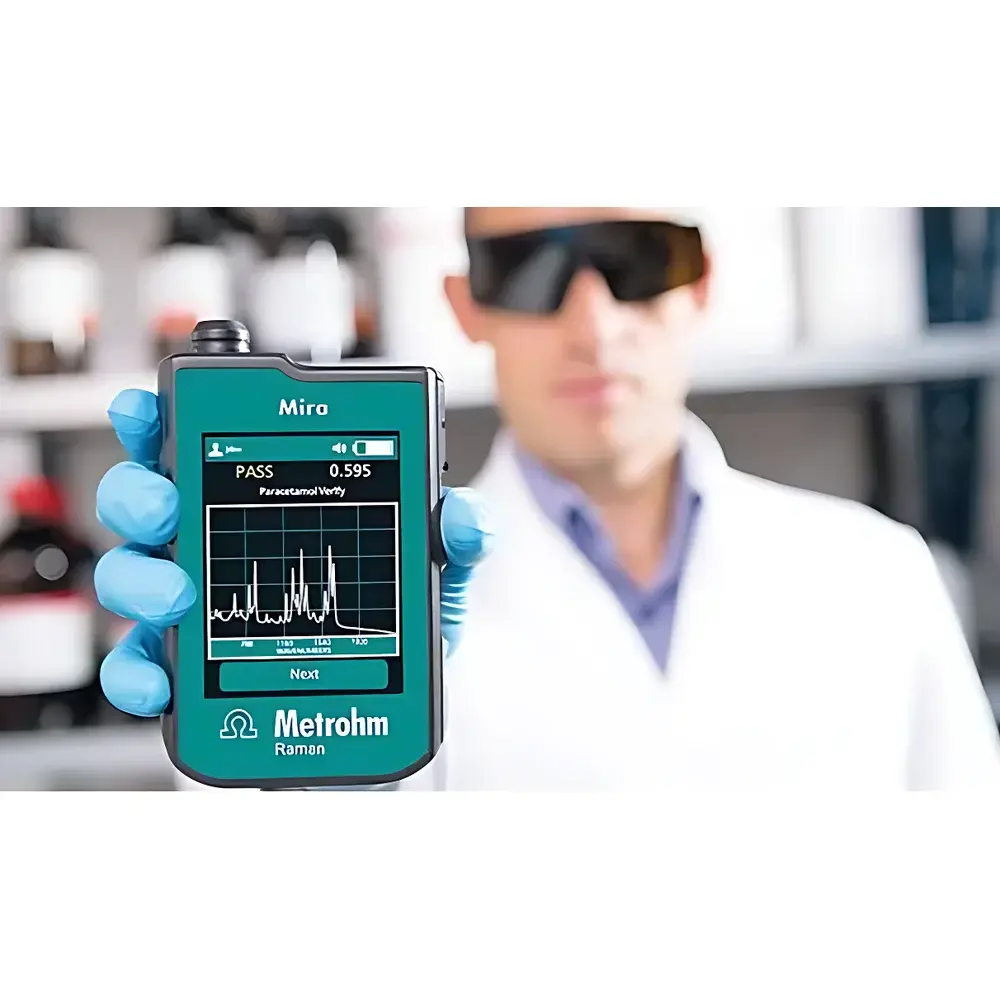
Metrohm Mira P Handheld Raman Spectrometer
| Brand | Metrohm |
|---|---|
| Origin | USA |
| Manufacturer | Metrohm AG |
| Product Type | Handheld Raman Spectrometer |
| Model | Mira P |
| Spectral Range | 400–2300 cm⁻¹ |
| Spectral Resolution | 12–14 cm⁻¹ (FWHM) |
| Minimum Wavenumber | 400 cm⁻¹ |
| Spectral Reproducibility | ≤0.15 cm⁻¹ |
Overview
The Metrohm Mira P Handheld Raman Spectrometer is an FDA 21 CFR Part 11-compliant, palm-sized analytical instrument engineered for rapid, non-destructive identification and verification of raw materials at point-of-use. Based on dispersive Raman spectroscopy with a stabilized 785 nm laser excitation source, the Mira P delivers high-fidelity spectral data optimized for pharmaceutical, chemical, and manufacturing quality control environments. Its compact form factor—comparable in size to a modern smartphone—enables seamless integration into warehouse receiving bays, production line checkpoints, and field-based supply chain audits. Unlike benchtop or fiber-coupled systems, the Mira P employs an integrated optical path with fixed alignment and thermally stabilized detector, eliminating routine recalibration while maintaining long-term wavenumber stability across ambient temperature fluctuations (15–30 °C). The system is designed for regulatory-grade material verification, supporting identity testing per USP , EP 2.2.48, and ICH Q5C guidelines.
Key Features
- ORS™ (Orbital Raster Scanning) Technology: Replaces static single-point laser illumination with controlled circular raster motion over a defined sample area (~1 mm diameter), generating spatially averaged spectra that mitigate heterogeneity effects—critical for powders, granules, and blended APIs.
- FDA 21 CFR Part 11 Compliance: Embedded Mira Cal P software provides full audit trail, electronic signatures, role-based access control, and immutable data storage—validated for GMP/GLP environments without third-party configuration.
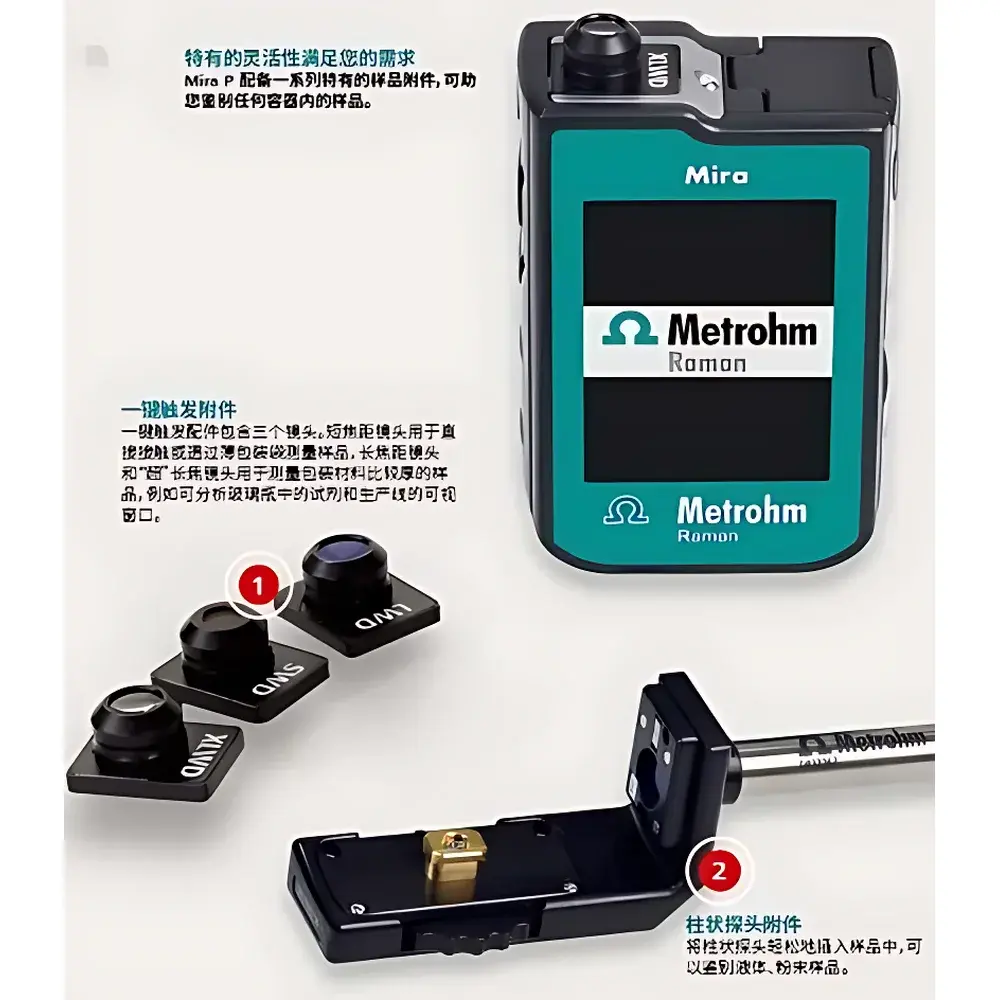
- Multi-Mode Sample Interfacing: Supports direct contact measurement via trigger-activated focusing adapters (dual focal lengths: 0.5 mm and 5 mm working distance), non-invasive analysis through transparent barriers (PET, HDPE, glass vials, blister packs), and dedicated accessories for tablets, liquids, and loose powders.
- Robust Optical Architecture: Sealed, vibration-damped spectrometer core with back-illuminated CCD detector ensures consistent signal-to-noise ratio (>600:1 at 1000 cm⁻¹) and thermal drift compensation across repeated measurements.
- Real-Time Decision Logic: On-device spectral matching against user-defined libraries enables pass/fail determination within 15–20 seconds—no external PC required for routine screening.
Sample Compatibility & Compliance
The Mira P is validated for direct and through-barrier analysis of solid dosage forms (tablets, capsules), bulk powders, liquid solutions, and packaged intermediates. It meets ASTM E1840-22 for Raman instrument performance verification and supports compliance with ISO/IEC 17025:2017 requirements for test method validation. All hardware and firmware components are manufactured under ISO 13485-certified processes. The device carries CE marking for EMC and safety (EN 61326-1, EN 61010-1), and its optical output class complies with IEC 60825-1:2014 Class 1M laser safety standards. No sample preparation—grinding, dilution, or solvent extraction—is required for standard identity checks.
Software & Data Management
Mira Cal P is a purpose-built, embedded application running on the device’s Linux-based OS. It features encrypted local database storage, configurable spectral libraries (with peak assignment, tolerance thresholds, and reference metadata), and export options compliant with ALCOA+ principles (Attributable, Legible, Contemporaneous, Original, Accurate). Audit trails record operator ID, timestamp, spectral acquisition parameters, library match scores, and pass/fail decisions—including any manual overrides. Data export formats include .csv, .spc, and .jdx; all files retain embedded hash signatures for integrity verification. Remote fleet management and centralized library synchronization are supported via Metrohm’s optional Mira Connect cloud service (GxP-compliant deployment available).
Applications
- Raw material identity verification per FDA Guidance for Industry: Container Closure Systems for Packaging Human Drugs and Biologics
- In-process checks of active pharmaceutical ingredients (APIs) and excipients during blending and compression
- Counterfeit detection of commercial pharmaceuticals through spectral fingerprinting
- Warehouse receipt inspection of solvents, catalysts, and reagents in chemical manufacturing
- Field-based forensic screening of unknown white powders in law enforcement and customs settings
- Stability-indicating monitoring of degradation products in accelerated storage studies (when paired with reference libraries)
FAQ
Does the Mira P require annual calibration by a certified service provider?
No. The Mira P uses a permanently aligned optical train with internal wavelength reference (silicon peak at 520.7 cm⁻¹) and requires only user-performed performance verification using supplied NIST-traceable polystyrene standard before each shift.
Can Mira P spectra be imported into third-party chemometric platforms such as MATLAB or Unscrambler?
Yes. Exported .spc and .jdx files are fully compatible with industry-standard spectral processing tools and support PCA, PLS-DA, and SIMCA modeling workflows.
Is the device suitable for analyzing dark or fluorescent samples?
The 785 nm excitation wavelength minimizes fluorescence interference in most organic matrices; however, highly pigmented or carbon-black-containing samples may require optimization of integration time and laser power—refer to Metrohm Application Note AN-RAM-023 for protocol guidance.
What cybersecurity measures are implemented in Mira Cal P?
The device enforces TLS 1.2+ encrypted communication, disables unused network services by default, and supports integration with enterprise Active Directory for centralized authentication.
How is data integrity ensured during power loss or unexpected shutdown?
All spectral acquisitions and audit trail entries are written to non-volatile flash memory with journaling file system (ext4), guaranteeing atomic write operations and preventing partial or corrupted record storage.
Related Products



