
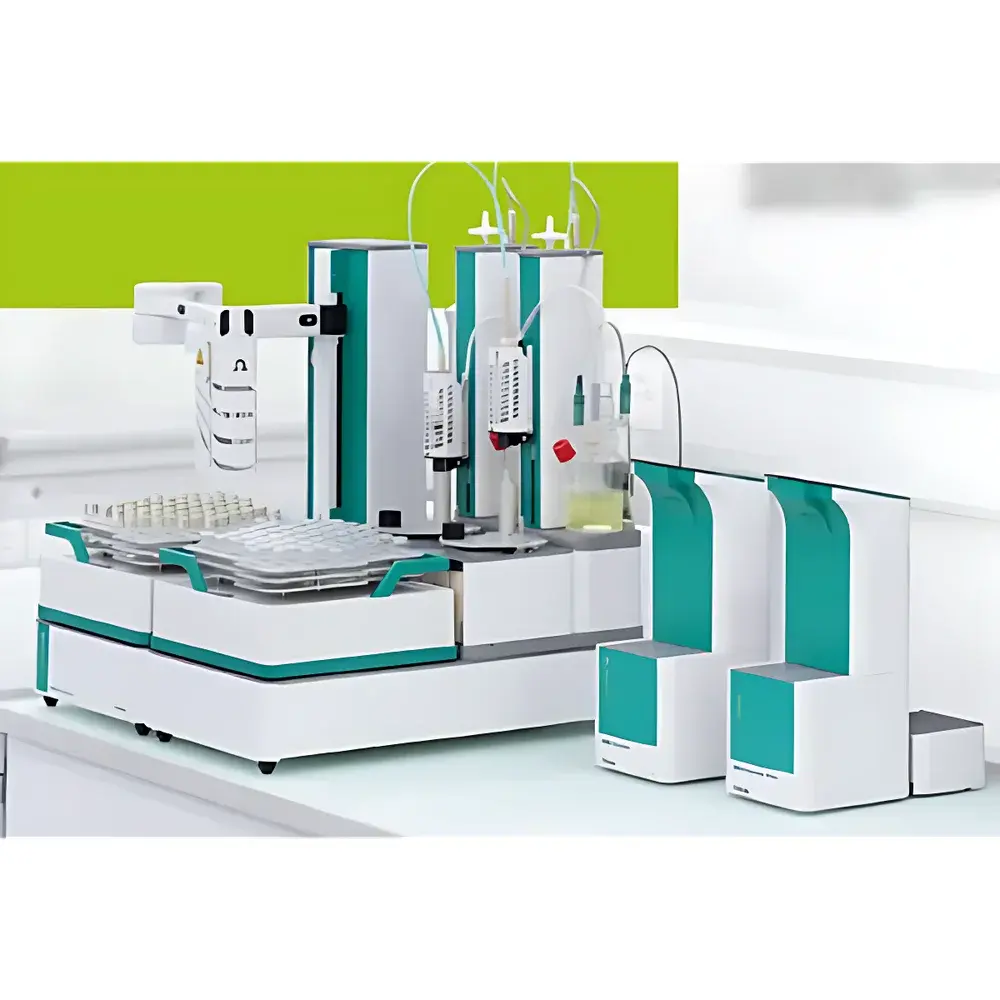
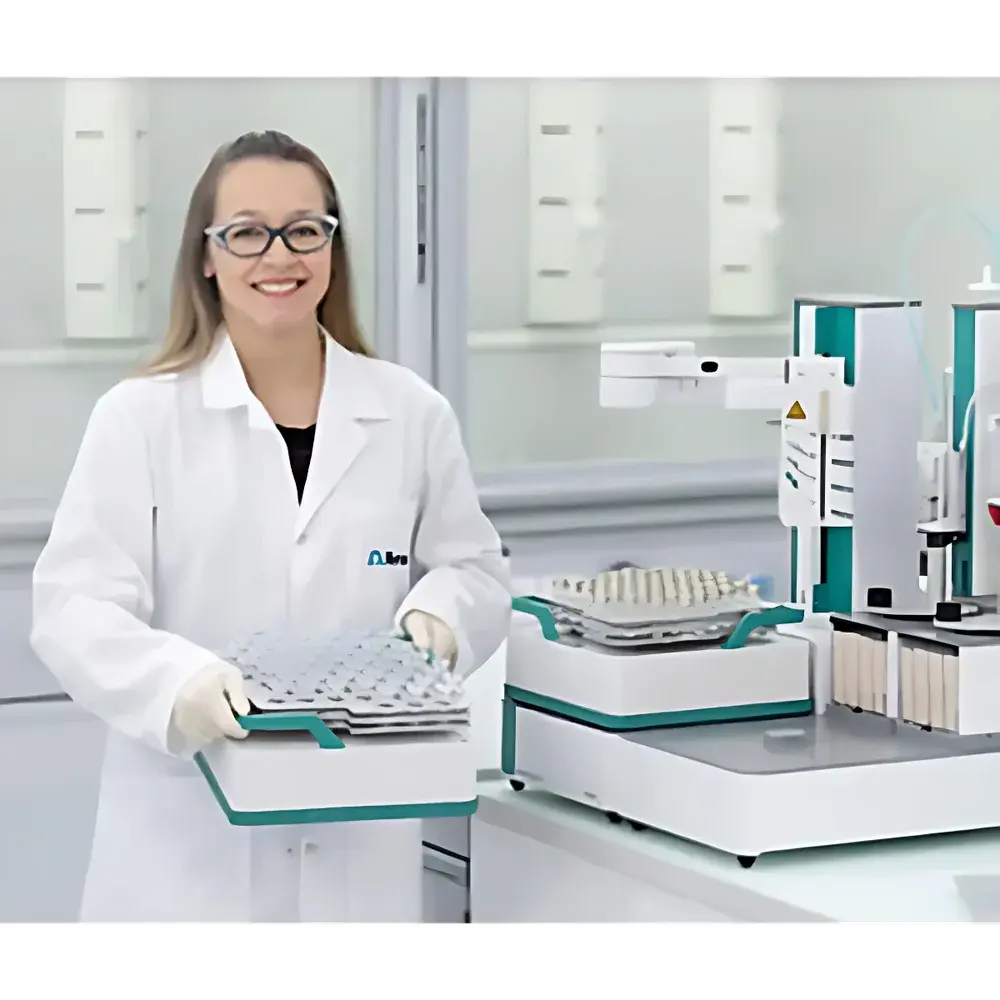
Metrohm OMNIS KF Oven – Automated Sample Heating Module for Coulometric Karl Fischer Water Determination
| Brand | Metrohm |
|---|---|
| Origin | Switzerland |
| Manufacturer | Metrohm AG |
| Import Category | Imported Instrument |
| Model | OMNIS KF Oven |
| Instrument Type | Automated Sample Processor for Electrochemical Moisture Analysis |
| Maximum Heating Temperature | 300 °C |
| Sample Capacity | Up to 100 × 6 mL vials (unattended) |
| Compatible Vial Standards | ISO 8362 (2R–30R), plus standard 6 mL crimp-top and 8 mL screw-cap vials |
| Heating Modules | Configurable with 1 or 2 independent oven modules |
| Carrier Gas Options | Dry ambient air or nitrogen, with integrated large-capacity molecular sieve dryer |
| Needle Depth Adjustment | Motorized, programmable syringe needle extension for optimal vial penetration |
| Optional Integration | OMNIS Liquid Handling Module for automatic reagent replenishment (KF reagent and methanol) |
Overview
The Metrohm OMNIS KF Oven is a fully automated, temperature-controlled sample heating module engineered exclusively for integration with the OMNIS platform’s coulometric Karl Fischer titration system. It enables precise, reproducible moisture determination in solid, viscous, or thermally labile matrices that cannot be directly introduced into the coulometric titration cell—such as polymers, pharmaceutical excipients, metal powders, catalysts, and hygroscopic salts. The principle of operation relies on quantitative thermal desorption: samples are sealed in inert vials, heated under controlled conditions, and the liberated water vapor is swept by a dry carrier gas (air or nitrogen) into the coulometric titration cell, where electrochemical quantification occurs according to Faraday’s law. This method eliminates manual handling, minimizes atmospheric moisture ingress, and ensures trace-level accuracy (<10 µg H₂O) in compliance with ASTM E203, ISO 760, and USP . Designed as a modular component of the OMNIS ecosystem, the KF Oven operates under full platform-level method control, enabling seamless scheduling, parameter synchronization, and audit-trail generation.
Key Features
- Programmable dual-zone heating up to 300 °C with ±0.5 °C stability, supporting both isothermal and gradient ramp protocols to optimize water release kinetics without decomposition.
- Modular architecture: field-upgradeable from single- to dual-oven configuration—enabling parallel processing of heterogeneous sample sets while preserving footprint and minimizing capital expenditure.
- Motorized, software-adjustable inlet needle with real-time depth calibration—ensures consistent septum penetration across vial formats (2R–30R per ISO 8362, plus 6 mL crimp and 8 mL screw-cap vials) and variable fill levels.
- Integrated carrier gas conditioning: high-capacity molecular sieve dryer (≥1000 L dry air capacity) coupled with pressure-regulated flow control (10–150 mL/min) to maintain dew point < −40 °C throughout extended unattended runs.
- Full interoperability with OMNIS Liquid Handling Module (optional): automatic detection and replenishment of coulometric reagent and anhydrous methanol during prolonged sequences—eliminating operator intervention and ensuring stoichiometric integrity.
Sample Compatibility & Compliance
The OMNIS KF Oven accommodates a broad spectrum of non-volatile, non-reactive solids and semi-solids—including but not limited to cellulose derivatives, lithium battery cathode materials, silica gels, zeolites, and API intermediates. Its vial agnostic design supports ISO 8362-compliant glass containers (2R to 30R), allowing direct transfer from stability chambers or GMP manufacturing lines. All operational parameters—including temperature profiles, carrier gas flow, needle insertion depth, and vial positioning—are stored within encrypted method files, satisfying FDA 21 CFR Part 11 requirements for electronic records and signatures. System validation documentation (IQ/OQ/PQ templates), traceable calibration certificates, and GLP/GMP-aligned audit trails are natively generated via OMNIS Software.
Software & Data Management
Controlled entirely through OMNIS Software v3.0+, the KF Oven integrates into unified method workflows alongside titration, dosing, and sample handling modules. Users define multi-step heating protocols—including hold times, ramp rates, and conditional triggers (e.g., “proceed only if baseline current stabilizes below 0.1 µA”). Raw sensor data (temperature, pressure, current) and processed results (µg H₂O, % w/w, RSD) are time-stamped, digitally signed, and exported in ASTM E1382-compliant .csv or .pdf formats. Role-based access control, electronic signature enforcement, and configurable retention policies ensure alignment with ISO/IEC 17025 and pharmaceutical quality systems.
Applications
- Pharmaceutical: Quantification of residual solvents and hydrate water in active pharmaceutical ingredients (APIs) per ICH Q5C guidelines.
- Materials Science: Moisture content verification in ceramic precursors, carbon black, and metal-organic frameworks (MOFs) prior to sintering or activation.
- Electronics: Trace water analysis in solder pastes, encapsulation resins, and battery electrolyte additives—critical for electrochemical stability.
- Food & Agriculture: Rapid screening of moisture in freeze-dried herbs, dairy powders, and grain storage samples without solvent extraction artifacts.
- Research: Method development for novel hygroscopic materials using gradient heating to identify optimal desorption thresholds.
FAQ
Can the OMNIS KF Oven be used with volumetric Karl Fischer titrators?
No—it is engineered exclusively for coulometric detection due to its low water mass transfer rate and sub-10 µg detection capability.
Is calibration of the oven temperature traceable to NIST standards?
Yes—each unit ships with a factory-calibrated PT100 sensor certified to ISO/IEC 17025-accredited standards; optional on-site calibration services are available.
What happens if a vial seal fails during heating?
The system monitors carrier gas backpressure and titration cell current anomalies; upon detection of abnormal moisture influx, it pauses the sequence, logs the event, and alerts the user via OMNIS notification engine.
Does the dual-oven configuration require additional software licensing?
No—OMNIS Software natively supports multi-module orchestration without add-on licenses; both ovens share synchronized method logic and reporting.
How is carryover prevented between high-moisture and low-moisture samples?
The system executes automated purge cycles (≥5 min dry gas flush) between vials and includes programmable blank correction routines based on sequential empty-vial measurements.
Related Products





