
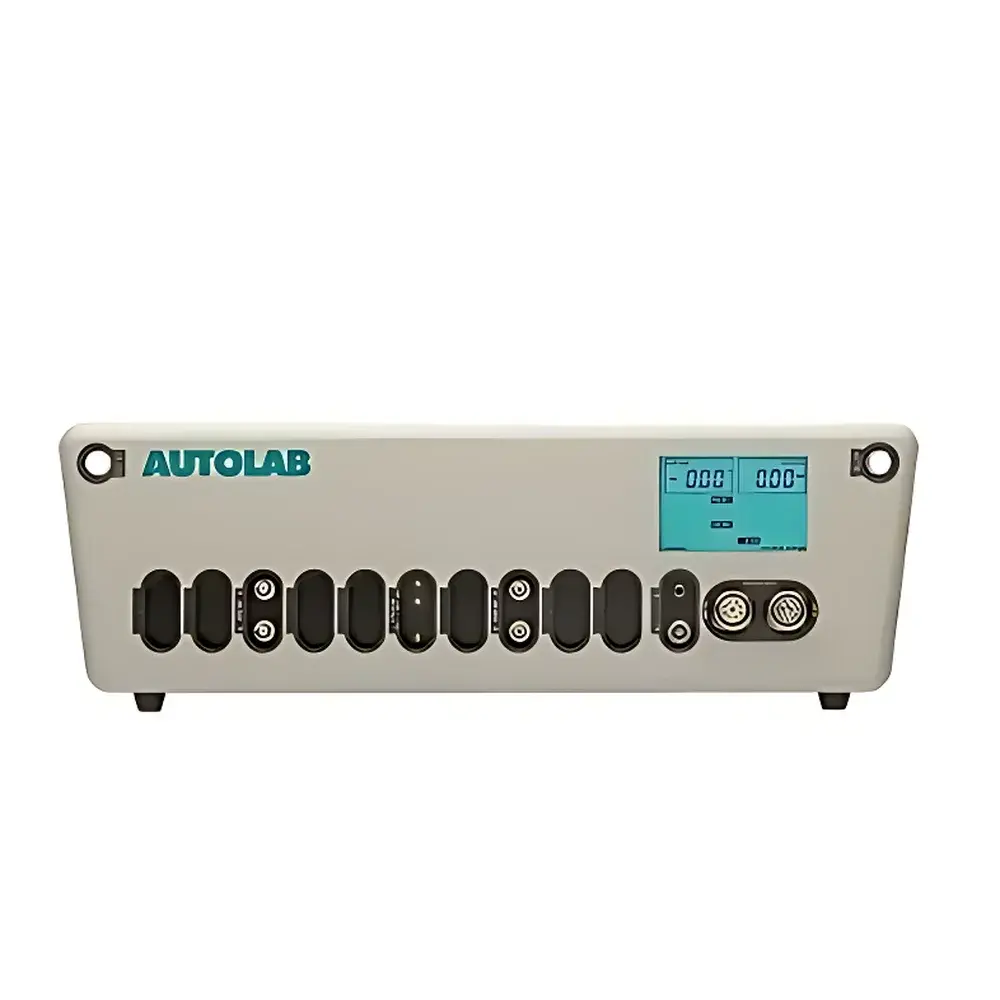
Metrohm PGSTAT 302F Electrochemical Workstation
| Brand | Metrohm |
|---|---|
| Origin | Netherlands |
| Manufacturer Type | Original Equipment Manufacturer (OEM) |
| Origin Category | Imported Instrument |
| Model | PGSTAT 302F |
| Instrument Type | Electrochemical Workstation |
| Channel Configuration | Multi-Channel Workstation |
| Current Range | 10 nA – 1 A |
| Current Accuracy | ±0.2% of reading or range |
| Potential Accuracy | ±0.2% of reading |
| Potentiostatic Range | ±10 V |
| Electrochemical Impedance Spectroscopy (EIS) Frequency Range | 10 µHz – 1 MHz |
| Floating Mode Capability | Yes (dual-mode operation: grounded and floating) |
| Input Bias Current (25°C) | <1 pA |
| Potential Resolution | 300 nV |
| Current Resolution (at 10 nA range) | 30 fA |
| Compatible FRA Module | FRA32M (±2 A max output, ±30 V max output, 9 current ranges) |
Overview
The Metrohm PGSTAT 302F is a high-precision, dual-mode electrochemical workstation engineered for advanced potentiostatic, galvanostatic, and electrochemical impedance spectroscopy (EIS) measurements in both grounded and electrically isolated (floating) configurations. Unlike conventional potentiostats, the PGSTAT 302F features a unique hardware architecture that enables seamless switching between standard grounded operation and true floating mode—where the working electrode reference is decoupled from earth ground. This capability is essential for experiments involving inherently grounded systems, such as pressurized autoclaves, buried metallic infrastructure, or electrochemical cells integrated into industrial process lines. Built upon Metrohm’s proven PGSTAT platform, the 302F retains full functional parity with the PGSTAT 302N in grounded mode while extending experimental flexibility through its isolated ground loop design. Its analog front-end employs low-noise, high-stability circuitry optimized for sub-picoampere current detection and microvolt-level potential control—critical for corrosion kinetics, hydrogen permeation studies, and low-conductivity electrolyte characterization.
Key Features
- Dual operational modes: selectable grounded mode (identical to PGSTAT 302N functionality) and floating mode for grounded working electrode configurations
- Wide dynamic current range spanning nine decades: 10 nA to 1 A, with auto-ranging and manual range selection
- High-resolution potential control: 300 nV resolution over ±10 V range; accuracy ±0.2% of reading
- Ultra-low input bias current (<1 pA at 25°C), enabling reliable measurement of ultra-low Faradaic currents
- Full EIS support from 10 µHz to 1 MHz with phase accuracy <0.3° and magnitude accuracy <0.1 dB
- Modular expandability via optional FRA32M frequency response analyzer module (±2 A/±30 V, 9 programmable current ranges)
- Integrated analog inputs for simultaneous external signal acquisition (e.g., temperature, pressure, pH)
- Rugged, shielded chassis with EMI/RFI filtering compliant with IEC 61326-1 for laboratory and industrial environments
Sample Compatibility & Compliance
The PGSTAT 302F supports a broad spectrum of electrochemical cell geometries—including three-electrode, two-electrode, and zero-resistance ammeter (ZRA) configurations—and interfaces seamlessly with rotating disk electrodes (RDE), scanning electrochemical microscopy (SECM) probes, and custom-built corrosion cells. Its floating capability makes it uniquely suited for ASTM G102-compliant corrosion rate determination in soil-embedded structures, ISO 15156-2 evaluation of materials in sour service environments, and NACE TM0177 hydrogen-induced cracking (HIC) testing. The instrument complies with IEC 61010-1 for electrical safety and meets electromagnetic compatibility requirements per EN 61326-1. Data integrity and audit readiness are ensured through optional GLP/GMP-compliant software modules supporting 21 CFR Part 11 electronic signatures and full audit trail logging.
Software & Data Management
Controlled via NOVA 2.5 software (Windows-based), the PGSTAT 302F provides intuitive experiment setup, real-time data visualization, and post-acquisition analysis tools including Kramers–Kronig validation, equivalent circuit modeling (ECM), and Tafel extrapolation. Raw data are stored in open-format .txt and .csv files, ensuring long-term archival compatibility and third-party analysis interoperability (e.g., MATLAB, Python SciPy). The software supports automated sequence programming for unattended multi-step protocols—such as potentiodynamic polarization followed by EIS at fixed DC bias—and includes built-in calibration wizards for current and potential verification traceable to NIST standards. Optional NOVA Security Pack enforces role-based access control, electronic signature workflows, and immutable audit trails required under FDA-regulated quality systems.
Applications
- Corrosion science: In-situ monitoring of pipeline steels, reinforced concrete rebars, and offshore platform alloys in simulated soil or marine electrolytes
- Hydrogen permeation studies: Quantitative assessment of H-diffusion through membranes and protective coatings using Devanathan–Stachurski dual-cell configuration
- Electrocatalysis research: Kinetic analysis of oxygen reduction reaction (ORR) and CO₂ reduction on nanostructured catalysts
- Battery R&D: Half-cell and full-cell cycling stability, SEI formation analysis, and impedance evolution during aging
- Industrial process electrochemistry: Real-time control of electrowinning, electrorefining, and electroplating baths with grounded reactor vessels
- Fuel cell diagnostics: Membrane hydration state mapping via low-frequency EIS and high-resolution polarization curve acquisition
FAQ
What distinguishes the PGSTAT 302F from the PGSTAT 302N?
The PGSTAT 302F offers identical performance specifications to the 302N but adds hardware-enabled floating mode operation—allowing direct connection to grounded working electrodes without compromising measurement fidelity.
Can the PGSTAT 302F perform EIS on grounded electrochemical systems?
Yes—its floating architecture eliminates ground-loop interference, enabling accurate low-noise EIS down to 10 µHz on systems such as autoclaves, buried pipelines, or electrochemical reactors bonded to structural steel.
Is the FRA32M module required for EIS measurements?
No—the base PGSTAT 302F includes full EIS capability up to 1 MHz; the FRA32M extends current output capacity and adds auxiliary voltage/current channels for complex multi-signal experiments.
How is current resolution achieved at the 10 nA range?
Through a dedicated low-current amplifier stage and 24-bit ADC sampling, delivering 30 fA effective resolution—validated per ASTM E2138 for ultra-low-current electrochemical sensing.
Does the system support automated compliance with GLP or GMP requirements?
When configured with NOVA Security Pack and validated installation qualification (IQ)/operational qualification (OQ) documentation, the PGSTAT 302F meets core elements of 21 CFR Part 11 and EU Annex 11 for regulated laboratories.
Related Products






