
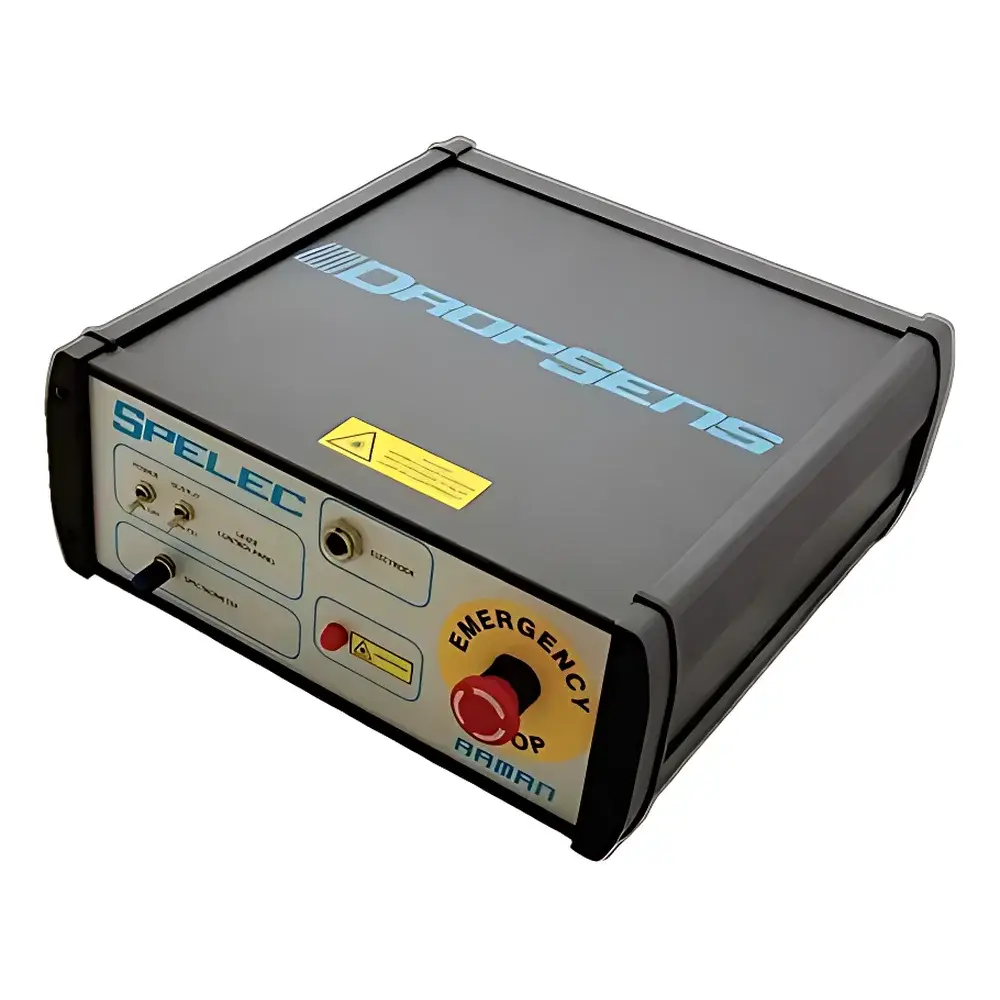
Metrohm SPELEC RAMAN Electrochemical Raman Spectrometer
| Brand | Metrohm |
|---|---|
| Origin | Switzerland |
| Manufacturer Type | Original Equipment Manufacturer (OEM) |
| Origin Category | Imported Instrument |
| Model | SPELEC RAMAN |
| Instrument Type | Electrochemical Workstation |
| Channel Count | Single-Channel |
| Current Range | ±40 mA |
| Current Accuracy | ≤0.5% of full scale |
| Potential Accuracy | ±0.2% of full scale |
| Potentiostatic Range | ±4 V |
| AC Impedance Frequency Range | Not specified |
| Optical Detection Range | 350–1050 nm (UV/VIS spectrometer integrated) |
Overview
The Metrohm SPELEC RAMAN Electrochemical Raman Spectrometer is an integrated analytical platform engineered for in situ and operando electrochemical spectroscopy. It combines a high-stability dual potentiostat/galvanostat, a fiber-coupled UV/VIS spectrometer (350–1050 nm), and a precision Raman excitation module within a single, compact benchtop enclosure. Unlike conventional sequential measurement setups, the SPELEC RAMAN enables true time-synchronized acquisition of electrochemical signals (e.g., cyclic voltammetry, chronoamperometry, impedance steps) and Raman spectral data—capturing molecular vibrational fingerprints with millisecond-level temporal correlation to applied potentials or current transients. This synchronization is critical for resolving short-lived intermediates, tracking redox-state-dependent conformational changes, and validating reaction mechanisms in real time. The system operates on the principle of surface-enhanced Raman scattering (SERS) when used with nanostructured electrodes (e.g., Au or Ag colloids, roughened metal films), significantly amplifying Raman cross-sections by up to 6–8 orders of magnitude and enabling detection of sub-monolayer adsorbates under electrochemical control.
Key Features
- Fully integrated architecture: Co-located potentiostat, spectrometer, and Raman optical path minimize signal latency and spatial misalignment between electrochemical and optical probes.
- Single-channel dual-mode operation: Functions as either a high-fidelity electrochemical workstation (±40 mA current range, ±4 V potential window, ≤0.5% current accuracy, ±0.2% potential accuracy) or a standalone Raman/UV-VIS spectrometer.
- Synchronized trigger logic: Hardware-level TTL triggering ensures sub-millisecond alignment between potential step initiation and spectral acquisition start—essential for kinetic studies.
- Modular electrode compatibility: Supports standard three-electrode configurations (WE/RE/CE) and accommodates SERS-active working electrodes including Au nanodisk arrays, Ag island films, and carbon-based plasmonic substrates.
- Thermally stabilized optical bench: Minimizes spectral drift during extended in situ experiments (>2 h), preserving wavenumber reproducibility (<0.2 cm⁻¹ RMS shift).
Sample Compatibility & Compliance
The SPELEC RAMAN is compatible with aqueous and non-aqueous electrolytes (e.g., LiPF₆ in EC/DMC, H₂SO₄, KOH, TBAPF₆ in acetonitrile), thin-film electrodes (ITO, FTO, Pt mesh), and gas-diffusion layers in PEMFC or CO₂RR configurations. All electrochemical modules comply with IEC 61010-1 safety standards for laboratory equipment. Data integrity meets GLP/GMP-aligned requirements: DROPVIEW SPELEC software supports user access control, electronic signatures, and audit trails compliant with FDA 21 CFR Part 11. No proprietary consumables are required; standard spectroscopic cuvettes (quartz or CaF₂), screen-printed electrodes, and commercial reference electrodes (Ag/AgCl, SCE) are fully supported.
Software & Data Management
DROPVIEW SPELEC is a native Windows application built on a modular, scriptable framework (Python API available). It provides synchronized visualization of voltammograms overlaid with time-resolved Raman intensity maps (e.g., peak evolution at 1600 cm⁻¹ vs. potential), automated baseline correction using asymmetric least squares (ALS), and multivariate analysis (PCA, MCR-ALS) for component resolution. Raw data are stored in HDF5 format with embedded metadata (timestamp, applied potential, integration time, laser power), ensuring FAIR (Findable, Accessible, Interoperable, Reusable) compliance. Export options include ASCII, CSV, and JCAMP-DX for third-party chemometrics tools (e.g., MATLAB, OriginPro, Pirouette).
Applications
- Battery research: In situ monitoring of SEI formation on Si anodes, oxidation state mapping of Ni-rich NMC cathodes during charge/discharge, and Li⁺ solvation structure evolution in solid polymer electrolytes.
- Electrocatalysis: Identification of *COOH vs. *CO adsorption on Cu surfaces during CO₂ reduction; tracking O–O bond cleavage intermediates in IrOₓ oxygen evolution catalysts.
- Corrosion science: Real-time observation of passive film composition (Cr₂O₃ vs. FeOOH) on stainless steel in chloride media; quantification of inhibitor adsorption kinetics via phenyl ring breathing modes.
- New materials development: Screening conductive MOFs for pseudocapacitance; characterizing doping-induced phonon shifts in PEDOT:PSS films under potential control.
FAQ
Can the SPELEC RAMAN perform electrochemical impedance spectroscopy (EIS)?
No—the system does not include built-in frequency response analysis hardware or software modules for EIS. Its core strength lies in time-resolved Raman–electrochemistry coupling, not broadband impedance characterization.
Is external laser excitation supported?
No—Raman excitation is provided by an integrated 785 nm diode laser (Class 3B); external laser coupling is not designed or validated.
What electrode geometries are recommended for optimal SERS enhancement?
Nanostructured Au or Ag electrodes with feature sizes <100 nm and interparticle gaps <10 nm yield strongest enhancement; planar polycrystalline electrodes provide baseline spectra but lack SERS sensitivity.
Does DROPVIEW SPELEC support batch processing of time-series Raman datasets?
Yes—via scripting interface or built-in “Sequence Analysis” workflow, users can apply identical preprocessing (cosmic ray removal, normalization, peak fitting) across hundreds of spectra acquired during a potential ramp.
Is the UV/VIS spectrometer cooled?
Yes—the CCD detector is thermoelectrically cooled to –10 °C, reducing dark current noise and enabling integration times up to 60 s without saturation.
Related Products




