
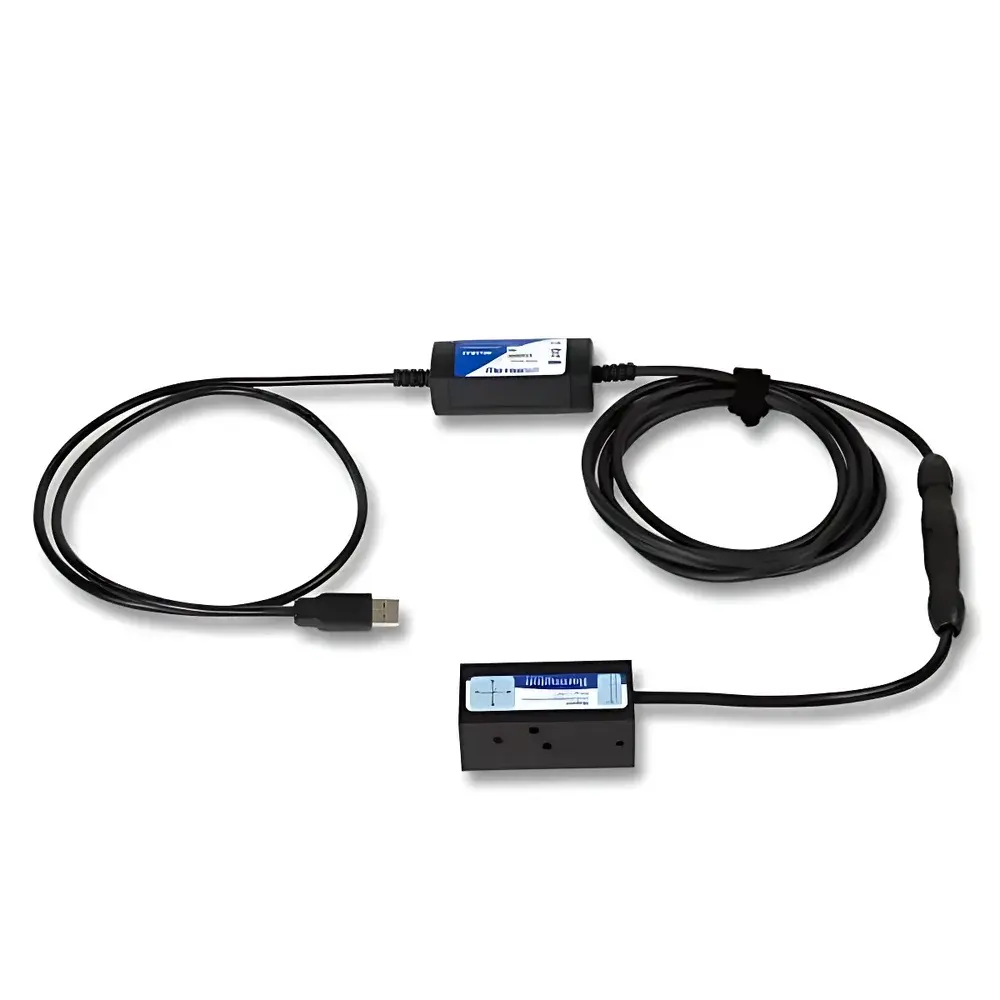
Metrolab TFM1186 Triaxial Fluxgate Magnetometer
| Brand | Auniontech |
|---|---|
| Origin | Shanghai, China |
| Manufacturer Type | Authorized Distributor |
| Regional Classification | Domestic (China) |
| Model | TFM1186 |
| Pricing | Upon Request |
Overview
The Metrolab TFM1186 Triaxial Fluxgate Magnetometer is a high-stability, low-noise magnetic field sensor engineered for precision measurement of static and quasi-static DC/AC magnetic fields in laboratory, industrial, and field-deployable environments. Based on the well-established fluxgate principle—where a periodically saturated high-permeability core generates harmonics proportional to ambient field strength—the TFM1186 delivers vector-resolved magnetic field data along orthogonal X, Y, and Z axes simultaneously. Its ±100 µT full-scale range and 4 nT resolution enable detection of subtle field perturbations caused by ferromagnetic objects, power-line harmonics (50/60 Hz and harmonics), or magnetic shielding inefficiencies. Designed as a direct evolution of the THM1176 series, the TFM1186 integrates advanced temperature compensation algorithms and factory-calibrated nonlinearity correction, ensuring long-term stability without recalibration under typical ambient conditions (15–35 °C). The instrument operates with minimal power draw (<150 mW), making it suitable for battery-powered portable operation or continuous USB bus-powered acquisition.
Key Features
- Triaxial vector measurement: Simultaneous real-time acquisition of Bx, By, and Bz components with inherent orthogonality calibration
- High-resolution sensing: 4 nT RMS noise floor (typical, 1 Hz bandwidth), enabling sub-nanotesla-level interference detection
- Wide dynamic range: ±100 µT full-scale, with automatic ranging and auto-zeroing functionality
- Integrated thermal compensation: Onboard temperature sensor and firmware-based drift correction minimize thermal coefficient effects (<0.1 nT/°C residual after compensation)
- USB-native interface: Compliant with USBTMC-USB488, SCPI, VISA, and DFU protocols; fully compatible with Windows, macOS, and Linux without proprietary drivers
- Ruggedized mechanical design: Compact probe head (Ø12 mm × 45 mm) with reinforced coaxial cable optimized to suppress triboelectric and inductive pickup
Sample Compatibility & Compliance
The TFM1186 is designed for non-contact, non-invasive measurement of magnetic fields in air, vacuum, or non-magnetic enclosures. It is not intended for immersion in liquids or exposure to strong RF fields (>10 V/m, 10 kHz–1 GHz). Probe materials are RoHS-compliant and chemically inert (stainless-steel housing, PTFE-insulated cable). While not certified to IEC 61000-4-x immunity standards, its differential fluxgate architecture provides inherent common-mode rejection of electromagnetic interference. For regulated environments, raw data output supports traceable post-processing compliant with ISO/IEC 17025 requirements when used with documented calibration certificates (NIST-traceable calibration optional upon request). Firmware logging includes timestamped metadata required for GLP/GMP-aligned documentation workflows.
Software & Data Management
The included cross-platform software suite provides real-time visualization of total field magnitude (|B|), Cartesian components, and 3D vector orientation via an interactive OpenGL-rendered pointer. Signal processing capabilities include configurable sampling rates (1–100 Hz default; up to 1 kHz with reduced resolution), programmable trigger modes (edge, level, external TTL sync), moving-average filtering, RMS/peak-to-peak/FFT spectral analysis (up to 512-point), and user-defined alarm thresholds. All measurements are saved in ASCII CSV format with header metadata (timestamp, units, sensor ID, firmware version). Full source code (C++ and Python APIs) is provided under a royalty-free license, enabling integration into custom DAQ systems, LabVIEW VIs, or MATLAB-based analysis pipelines. Software supports audit-trail logging per FDA 21 CFR Part 11 requirements when deployed with validated system configurations.
Applications
- Magnetic field mapping of MRI fringe fields, particle accelerator dipoles, and synchrotron beamlines
- Quality assurance of magnetic shielding enclosures (e.g., mu-metal rooms, Helmholtz coil nulling verification)
- Geophysical survey support: Detection of buried ferrous objects, UXO screening, and paleomagnetic sample characterization
- Electromagnetic compatibility (EMC) pre-compliance testing: Localization of stray fields from PCBs, power converters, and motor drives
- Research-grade magnetometry in condensed matter physics labs, including studies of spintronic devices and superconducting vortices
- Education: Undergraduate and graduate labs requiring vector field visualization and quantitative field gradient analysis
FAQ
Is the TFM1186 calibrated traceable to national standards?
Yes—factory calibration is performed against reference fields generated by precision Helmholtz coils calibrated using NIST-traceable fluxgate standards. Optional annual recalibration services include full uncertainty budget reporting.
Can the probe be used in vacuum or high-humidity environments?
The standard probe is rated for operation at ambient pressure and humidity ≤90% RH non-condensing. Vacuum-compatible variants (with ceramic feedthroughs and outgassing-tested materials) are available upon special order.
Does the software support automated scripting for unattended data collection?
Yes—the open-source Python API enables scheduled acquisition, conditional triggering, and remote control via SSH or serial-over-USB, supporting 24/7 monitoring deployments.
What is the maximum cable length supported without signal degradation?
For optimal noise performance, the standard 2.5 m shielded USB cable is recommended. Extension beyond 3 m requires active USB repeaters or fiber-optic USB extenders to maintain signal integrity and timing accuracy.
How is temperature drift corrected during extended measurements?
Real-time temperature monitoring and polynomial-based compensation are applied in firmware. Residual drift remains below ±10 nT over a 10 °C ambient shift when operated within the specified temperature range.



