
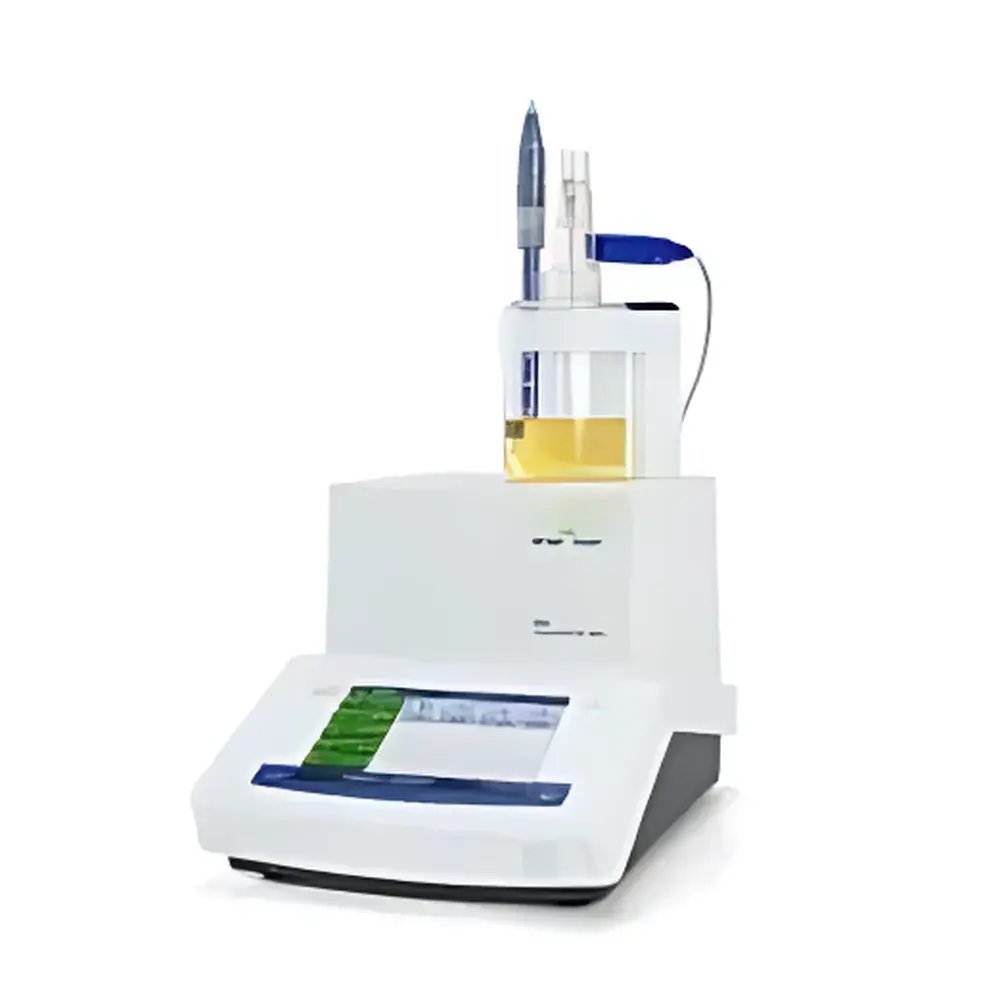
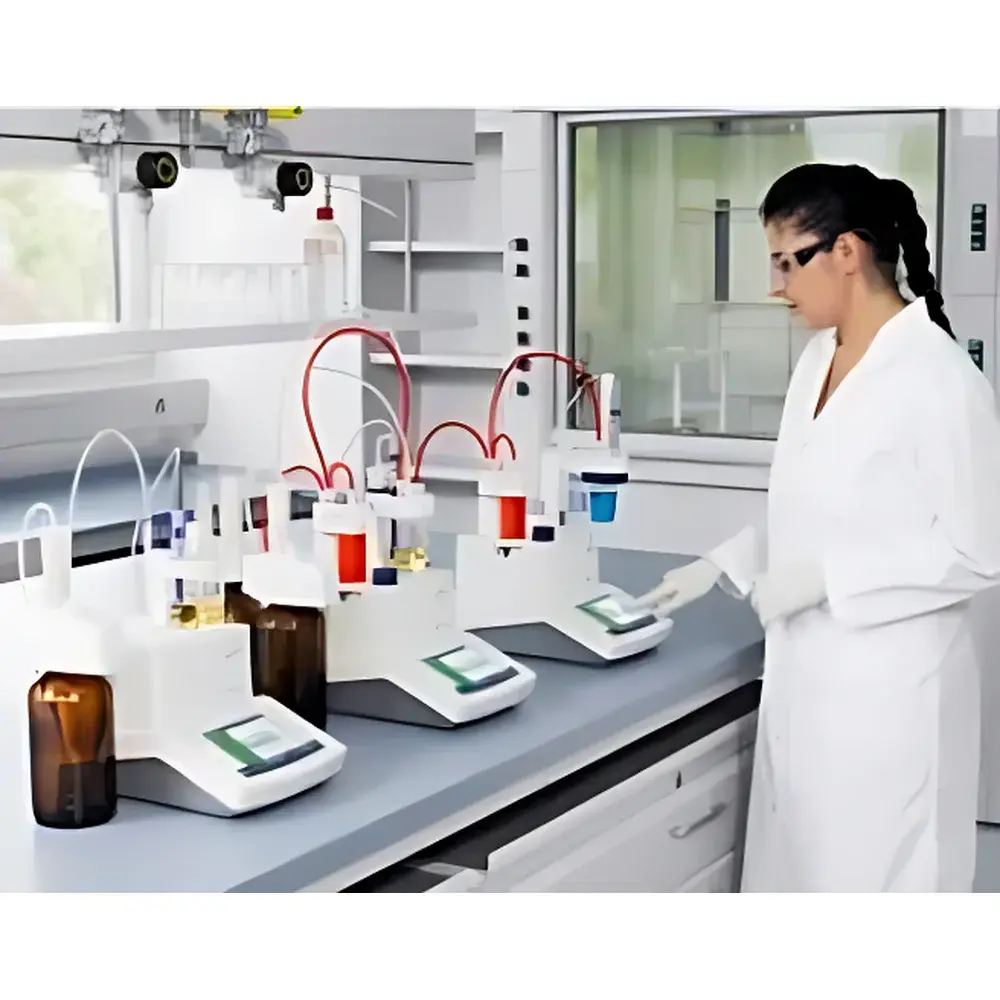
METTLER TOLEDO C20S/C30S Compact Coulometric Karl Fischer Moisture Analyzer
| Brand | METTLER TOLEDO |
|---|---|
| Origin | Switzerland |
| Instrument Type | Coulometric Karl Fischer Titrator |
| Model | C20S / C30S |
| Titration Mode | Fully Automatic |
| Measurement Resolution | 0.1 mV |
| Water Content Range | 10 µg – 200 mg H₂O |
| Accuracy | ±0.3% (for samples containing >1 mg H₂O) |
| Minimum Charge Delivery | 0.1 mC |
| Titration Control Precision | 0.1 mC |
Overview
The METTLER TOLEDO C20S and C30S Compact Coulometric Karl Fischer Moisture Analyzers are precision-engineered instruments designed for trace-level water quantification in pharmaceutical, chemical, polymer, and petrochemical laboratories. Based on the electrochemical coulometric principle—where iodine is generated *in situ* via controlled electrolysis of iodide ions—the system delivers high reproducibility and sensitivity without manual reagent standardization. This eliminates volumetric calibration drift and ensures compliance with pharmacopoeial requirements (USP , EP 2.5.12, JP 2.05) for moisture determination across solid, liquid, and viscous matrices. The analyzers operate within a validated detection range of 10 µg to 200 mg absolute water mass, supporting quantitation down to sub-ppm levels when normalized to sample mass—making them suitable for low-moisture APIs, lyophilized powders, solvents, and hygroscopic excipients.
Key Features
- One Click® intuitive color touchscreen interface with customizable home screens—each user receives dedicated shortcut keys for routine tasks (e.g., blank determination, sample titration, electrode conditioning)
- Dual-platform language support: English, German, French, Italian, Spanish, Chinese, Russian, Polish, Korean, and Portuguese—fully embedded in firmware with no runtime localization dependencies
- Intelligent reagent management: real-time monitoring of three critical parameters (electrolyte conductivity, anolyte level, catholyte saturation); automated alerts and guided replacement workflows via One Click
- Integrated solvent manager enables safe, closed-loop reagent transfer—minimizing operator exposure to toxic pyridine-free or pyridine-containing KF reagents
- Automatic burette recognition and method validation: preloaded METTLER TOLEDO methods (11 for C30S; core library for C20S) include built-in system suitability checks, endpoint stability criteria, and drift compensation algorithms
- C20S supports up to 5 user-defined methods and 12 shortcuts per user; C30S expands capacity to 100 user methods and 10 concurrent task queue entries
Sample Compatibility & Compliance
The C20S/C30S platforms accommodate diverse sample types—including crystalline solids, oils, resins, gels, and heat-sensitive compounds—via direct injection, oven coupling (DO308 manual dryer), or fully automated Stromboli heating oven (C30S only). Stromboli provides programmable temperature ramping (up to 300 °C), inert gas purging, and precise vapor transfer to the titration cell—enabling reliable analysis of bound water in polymers or residual solvents in active pharmaceutical ingredients. All hardware and software components comply with ISO/IEC 17025:2017 laboratory accreditation requirements. When paired with LabX Titration Server PC software in Remote Mode, the system meets FDA 21 CFR Part 11 electronic record and signature mandates—including audit trails, role-based access control, electronic signatures, and data integrity safeguards aligned with ALCOA+ principles.
Software & Data Management
LabX Titration Server integrates seamlessly via TCP/IP or USB, enabling centralized method deployment, instrument monitoring, and raw data archiving. All titration curves, endpoint calculations, blank corrections, and statistical summaries (e.g., RSD%, confidence intervals across replicate series) are stored in encrypted, timestamped database records. GLP-compliant reporting includes automatic inclusion of instrument ID, operator ID, environmental conditions (optional external sensor input), reagent lot numbers, and full traceability of every parameter change. USB-connected printers (generic PCL or METTLER TOLEDO P25 thermal) generate tamper-evident reports with digital watermarking and checksum verification.
Applications
- Pharmaceutical QC: water content in APIs, excipients, and final dosage forms per ICH Q5C stability guidelines
- Electronics manufacturing: moisture in solder pastes, encapsulants, and PCB substrates affecting delamination risk
- Polymer industry: residual monomer hydration in polyamide or polyimide precursors impacting polymerization kinetics
- Fuel and lubricant testing: trace water in jet fuels (ASTM D6304) and transformer oils (IEC 60814)
- Food science: water activity correlation studies in freeze-dried foods and hydrocolloid systems
- Research labs: kinetic studies of hydrolysis reactions using time-resolved coulometric titration
FAQ
What distinguishes coulometric from volumetric Karl Fischer titration?
Coulometric KF generates iodine electrochemically at the anode, offering superior precision for samples containing ≤100 µg water. It eliminates burette calibration errors and reagent stability concerns inherent in volumetric methods.
Can the C20S/C30S analyze samples with interfering side reactions?
Yes—via integrated external extraction protocols. The instrument automatically measures solvent blank contribution and corrects sample results in real time, supporting ketones, aldehydes, and strong reducing agents.
Is method validation support included?
Each preconfigured METTLER TOLEDO method contains documented system suitability tests (SST), including repeatability of blank titration, linearity across water mass range, and robustness against ambient humidity fluctuations.
How is data integrity ensured during networked operation?
LabX Remote Mode enforces cryptographic hashing of all data objects, immutable audit logs with operator attribution, and dual-factor authentication for administrative functions—fully auditable for GMP and ISO 13485 inspections.
What maintenance is required for long-term electrode stability?
The dual-compartment cell design (with or without diaphragm) minimizes cross-contamination. Routine cleaning with methanol and periodic reference check using certified 1.00 mg water standards are recommended every 50–100 analyses.



