
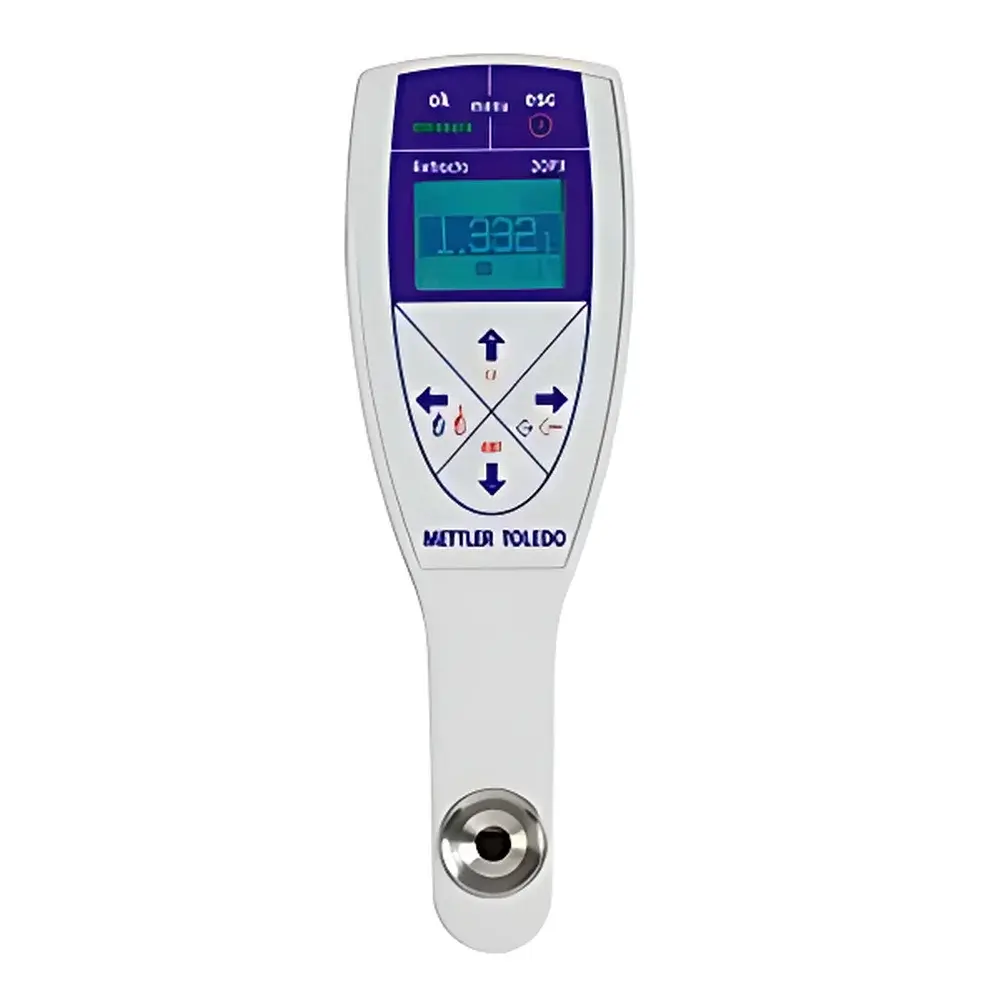
METTLER TOLEDO Densito 30PX Portable Density Meter
| Brand | METTLER TOLEDO |
|---|---|
| Origin | Switzerland |
| Model | Densito 30PX |
| Product Type | Handheld Density Meter |
| Temperature Control | Yes |
| Digital Display | Yes |
| Measurement Range | 0 to 2 g/cm³ |
| Resolution | 0.0001 g/cm³ |
| Accuracy | ±0.001 g/cm³ |
| Temperature Range | 5–35 °C |
| Temperature Resolution | ±0.1 °C |
| Units Supported | Density, Specific Gravity (SG), Alcohol % v/v, Brix %, API Gravity, Baumé, Plato, H₂SO₄ (w/w%), and User-Defined Units |
Overview
The METTLER TOLEDO Densito 30PX is a high-precision, portable density meter engineered for field and at-line applications where laboratory-grade accuracy must be maintained outside controlled environments. Unlike traditional refractometers—which measure refractive index to infer concentration—the Densito 30PX employs oscillating U-tube densitometry, a primary measurement principle traceable to SI units via calibrated reference standards. This method determines density by measuring the resonant frequency of a filled, vibrating U-shaped glass tube; density is calculated inversely proportional to the square of the oscillation period. The instrument automatically applies temperature compensation using an integrated Pt1000 sensor with ±0.1 °C resolution, ensuring compliance with ISO 12185 (petroleum products), ASTM D4052 (density of liquids), and USP (density and specific gravity). Designed for operational robustness, the Densito 30PX features IP65-rated housing, shock-absorbing elastomer grips, and a sealed optical path—making it suitable for use in production floors, storage tanks, fermentation vessels, and quality control checkpoints across food & beverage, pharmaceuticals, chemical, and petrochemical industries.
Key Features
- Oscillating U-tube measurement principle delivering direct, SI-traceable density determination without calibration curves or empirical correlations
- Real-time temperature compensation with automatic selection of material-specific thermal expansion coefficients (e.g., ethanol, sucrose solutions, sulfuric acid)
- Adjustable aspiration speed: slow mode minimizes bubble formation in viscous samples (e.g., syrups, glycerol, resins); fast mode enables rapid cleaning cycles between measurements
- External sampling compatibility via Luer-lock fitting—enables connection to syringes or peristaltic pumps for degassing-prone or high-viscosity fluids
- Optically transparent measurement cell with side-view window—allows immediate visual verification of sample homogeneity, bubble presence, and contamination before analysis
- Multi-parameter output: simultaneous display of density (g/cm³), specific gravity (SG), and up to eight user-configurable derived units (e.g., % alcohol v/v, °Brix, API gravity, °Plato, w/w% H₂SO₄)
- Onboard data logging with time-stamped results, operator ID fields, and configurable pass/fail limits aligned with internal QC protocols
Sample Compatibility & Compliance
The Densito 30PX accommodates aqueous, organic, and corrosive liquid samples within a viscosity range of up to 20,000 mPa·s (tested with glycerol at 20 °C). It supports direct measurement of aggressive media—including diluted mineral acids and alkaline solutions—when used with optional PTFE-coated capillary tubing. All measurement algorithms adhere to internationally recognized standard methodologies: ISO 12185 for crude oil and petroleum derivatives, ASTM D4052 for precision density determination, and ISO 21527-1 for yeast viability assessment via density-based separation. The device meets GLP/GMP documentation requirements through audit-trail-enabled firmware (optional), supporting 21 CFR Part 11-compliant electronic records when paired with METTLER TOLEDO LabX software.
Software & Data Management
While fully functional as a standalone instrument, the Densito 30PX integrates seamlessly with METTLER TOLEDO LabX™ PC-based software for centralized method management, automated report generation, and secure data archiving. LabX enforces role-based access control, electronic signatures, and full metadata capture—including environmental conditions, calibration history, and user actions. Raw oscillation frequency data and temperature logs are exportable in CSV or PDF format for external statistical process control (SPC) analysis. Firmware updates preserve metrological integrity through cryptographic signature verification and version-controlled parameter validation.
Applications
- Alcoholic beverage production: real-time alcohol content verification during distillation, blending, and bottling
- Pharmaceutical manufacturing: density-based assay of excipients, active ingredient suspensions, and final dosage form consistency checks
- Fermentation monitoring: tracking sugar depletion and ethanol accumulation in beer, wine, and bioethanol processes
- Chemical quality assurance: incoming raw material verification (e.g., sulfuric acid concentration, ethylene glycol purity)
- Food processing: Brix validation in fruit juices, syrup concentration control, and dairy product standardization
- Environmental testing: salinity and total dissolved solids (TDS) estimation in wastewater streams
FAQ
Does the Densito 30PX require periodic recalibration with certified density standards?
Yes. While factory-calibrated using NIST-traceable water and air standards, routine verification against secondary reference materials (e.g., certified density kits) is recommended before each analytical session or per internal SOPs.
Can the instrument measure samples below 5 °C or above 35 °C?
No. Operation outside the specified 5–35 °C ambient and sample temperature range may compromise thermal equilibrium and introduce systematic error in oscillation frequency detection.
Is the measurement cell resistant to sodium hydroxide or nitric acid?
The standard borosilicate glass cell is compatible with ≤10% w/w NaOH and ≤30% w/w HNO₃. For stronger concentrations, PTFE-lined flow cells and chemically resistant tubing accessories are available.
How does the Densito 30PX handle particulate-laden samples?
Samples must be filtered to ≤5 µm particle size prior to analysis. Undissolved solids can obstruct the capillary inlet or dampen U-tube resonance, leading to invalid readings or mechanical damage.
What is the typical measurement cycle time for a single determination?
From sample aspiration to stabilized result display: 20–45 seconds, depending on viscosity, temperature equilibration, and selected aspiration speed.





