
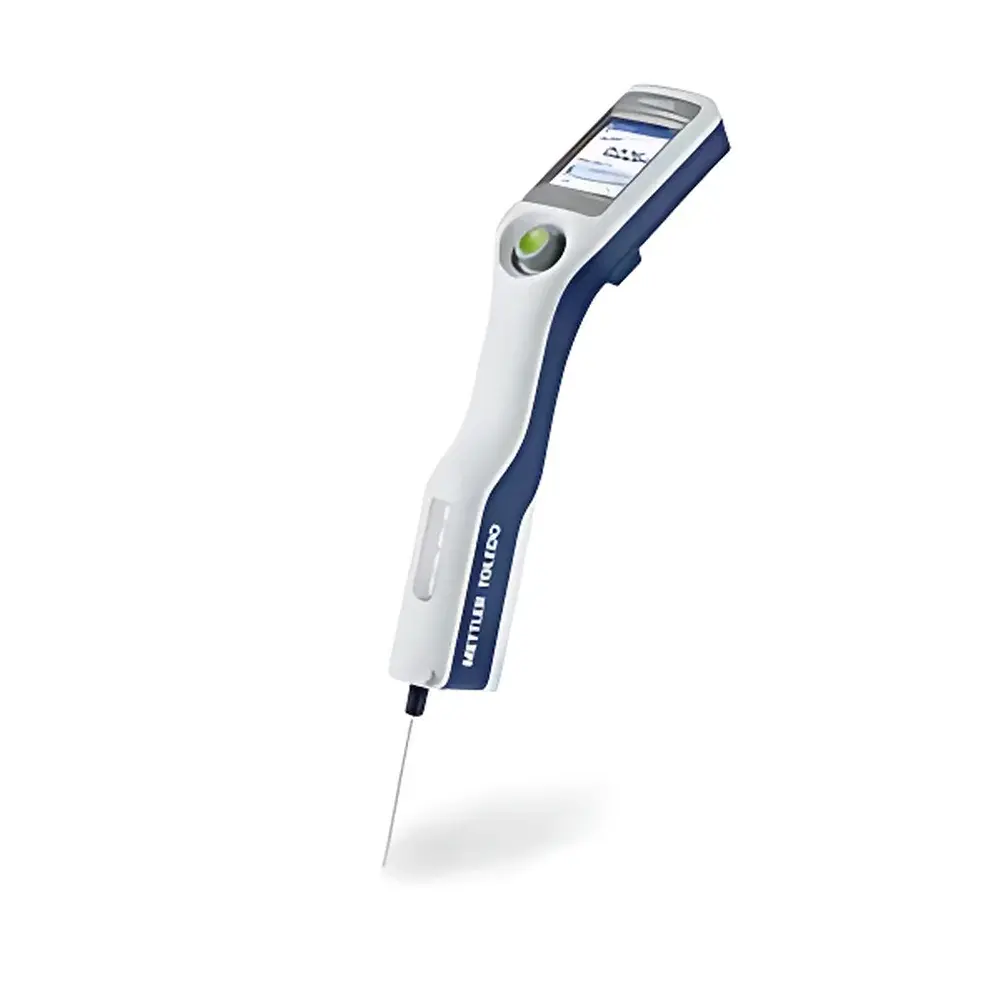
METTLER TOLEDO Densito and Densito Pro Portable Digital Density Meters
| Brand | METTLER TOLEDO |
|---|---|
| Origin | Switzerland |
| Model | Densito / Densito Pro |
| Density Measurement Range | 0–3 g/cm³ |
| Density Accuracy | ±0.001 g/cm³ |
| Temperature Range | 0–50.0 °C |
| Minimum Sample Volume | 2 mL |
| Instrument Type | Portable Digital Density Meter (Oscillating U-tube Principle) |
| Application Scope | Liquid Density Measurement for QC/QA in Lab, Field, and Production Environments |
| Compliance | Designed to support GLP/GMP workflows with audit-trail-capable data management |
Overview
The METTLER TOLEDO Densito and Densito Pro are handheld digital density meters engineered for high-precision liquid density measurement across diverse operational environments—from laboratory benches and production floors to field-based quality control checkpoints. These instruments operate on the well-established oscillating U-tube principle: a precisely manufactured borosilicate glass tube is electromagnetically excited to vibrate at its natural resonant frequency. When filled with sample liquid, the mass-dependent shift in oscillation frequency is measured with sub-Hz resolution and converted into density (g/cm³) using factory-calibrated algorithms traceable to NIST-certified standards. This physical principle ensures inherent linearity, minimal drift, and immunity to sample color, turbidity, or suspended solids—making it fundamentally distinct from hydrometer- or buoyancy-based methods. Both models deliver certified accuracy of ±0.001 g/cm³ across the full 0–3 g/cm³ range, with temperature-controlled measurement enabled by an integrated Peltier-assisted sensor that monitors sample temperature in real time (0–50.0 °C). Temperature compensation is applied automatically using user-selectable coefficients (e.g., ASTM D1298, ISO 12185), ensuring metrological validity regardless of ambient or process conditions.
Key Features
- True portable architecture: Battery-powered operation (up to 10 hours per charge), IP54-rated enclosure, and ergonomic handheld form factor enable reliable use in non-laboratory settings—including warehouses, tank farms, and mobile QC units.
- Automated sampling system: Integrated electric peristaltic pump enables one-button filling, draining, and rinsing of the measurement cell—eliminating manual pipetting errors and cross-contamination risks.
- Adaptive sampling control: Flow rate and aspiration volume are programmable to accommodate viscous, volatile, or foaming liquids without bubble entrapment or over-pressurization.
- Densito Pro exclusive capabilities: Integrated RFID reader and 2D barcode scanner for seamless sample identification; supports direct association of measurement records with LIMS or ERP identifiers without manual entry.
- On-device workflow guidance: Step-by-step visual prompts prevent procedural deviations; configurable pass/fail limits trigger immediate visual and audible alerts upon out-of-spec results.
- Robust data integrity framework: All measurements include timestamp, operator ID (optional), temperature, density value, and instrument serial number—structured for regulatory compliance.
Sample Compatibility & Compliance
The Densito series is validated for aqueous solutions, organic solvents, acids, bases, oils, syrups, and low-viscosity suspensions (≤500 mPa·s). Samples requiring >2 mL volume are compatible with standard operation; for highly valuable or hazardous materials, optional micro-cell accessories reduce minimum volume to 0.5 mL. The instruments conform to international metrological requirements outlined in ISO 12185 (petroleum products), ASTM D4052 (liquid petroleum), and USP (pharmaceutical density testing). Data export and storage protocols support FDA 21 CFR Part 11 compliance when used with validated EasyDirect software configurations—including electronic signatures, audit trails, and role-based access control. Calibration verification is performed using certified reference standards (e.g., air/water, sodium chloride solutions), with calibration history retained on-device and exportable.
Software & Data Management
Up to 1,100 measurement records—including raw frequency data, compensated density, temperature, and metadata—are stored locally with timestamped retention. Data export is supported via USB-C or Bluetooth to Windows/macOS systems running EasyDirect software. This desktop application enables advanced filtering by date, operator, batch ID, or specification limits; generates time-series plots for trend analysis; and exports PDF/CSV reports compliant with internal QA templates or external regulatory submissions. Direct printing via Bluetooth or USB-connected thermal printers is available for real-time documentation. All data transfers are encrypted, and software installations undergo version-controlled validation per GxP requirements.
Applications
- Raw material acceptance testing: Rapid verification of incoming solvents, acids, or monomers against supplier certificates.
- In-process monitoring: Real-time density checks during blending, dilution, or reaction steps in chemical, food, and pharmaceutical manufacturing.
- Finished product release: Final density certification for beverages, fuels, electrolytes, and cleaning formulations per customer or regulatory specifications.
- Field service diagnostics: On-site verification of coolant concentration, battery acid strength, or antifreeze glycol content.
- Educational laboratories: Teaching fundamental fluid property relationships and metrology principles with traceable, repeatable instrumentation.
FAQ
What is the difference between Densito and Densito Pro?
The Densito Pro adds integrated RFID and 2D barcode scanning, enhanced workflow automation (e.g., auto-population of sample IDs), and expanded connectivity options—including configurable Ethernet output for plant-wide SCADA integration.
Can the instrument measure slurries or particulate-containing liquids?
Yes—provided particles remain fully suspended during measurement and do not settle within the U-tube during the 3–6 second acquisition cycle. For abrasive or high-solids samples, optional sapphire-coated tubes are available.
Is temperature control active or passive?
The instrument features active temperature sensing but not active regulation; however, rapid thermal equilibration (<60 s) is achieved via low-thermal-mass design and Peltier-based stabilization of the sensor element.
How is calibration verified in routine use?
Users perform daily verification using two-point checks (e.g., air and water at 20 °C); calibration constants are locked unless modified by authorized personnel with supervisor credentials.
Does the device support custom density units or derived calculations?
Yes—users can define custom units (e.g., °Brix, API gravity, % w/w) via polynomial or linear conversion tables linked to measured density and temperature values.



