
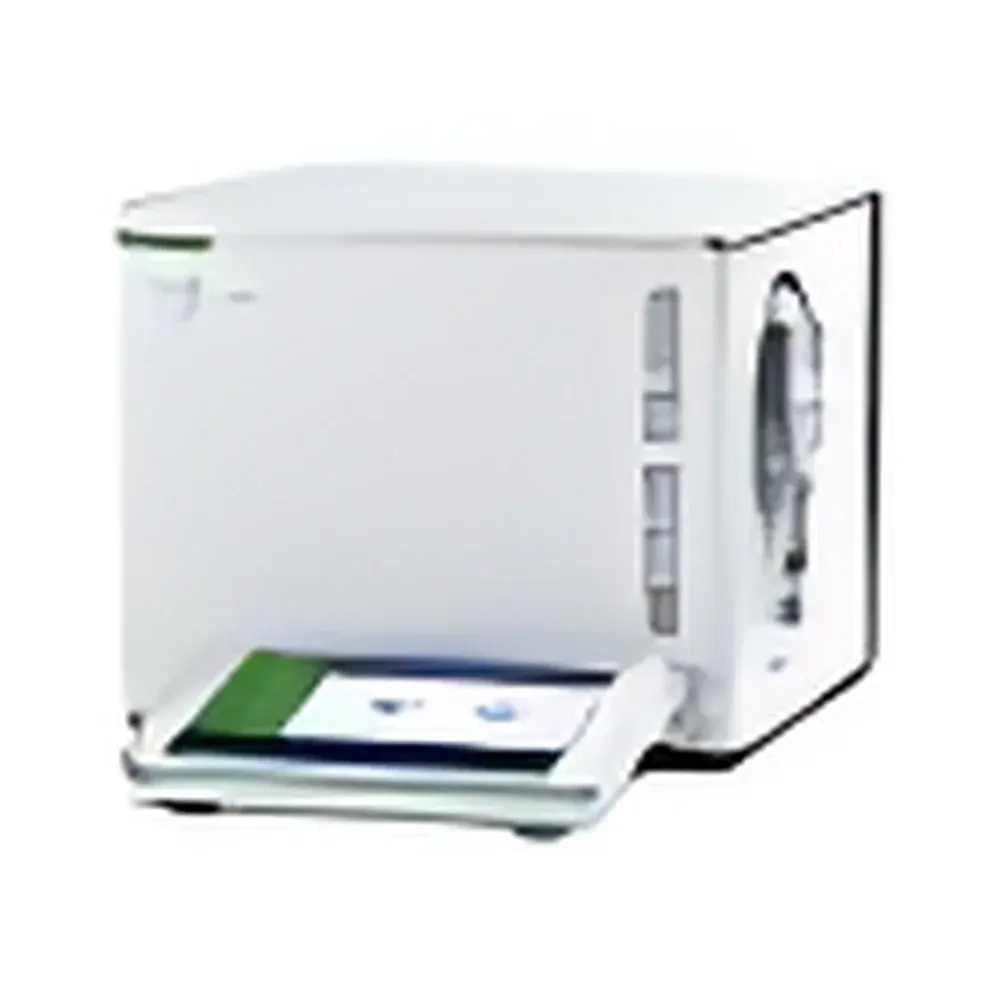
METTLER TOLEDO Density Meter Excellence Series D4 / D5 / D6
| Brand | METTLER TOLEDO |
|---|---|
| Origin | Switzerland |
| Model | D4 / D5 / D6 |
| Instrument Type | Benchtop Laboratory Density Meter |
| Sample Type | Solid and Liquid |
| Temperature Range | 0–95 °C (32–203 °F) |
| Repeatability | ±0.00005 g/cm³ |
| Resolution | 0.0001 g/cm³ |
| Density Range | 0.000–3.000 g/cm³ |
| Accuracy | ±0.0001 / ±0.00005 / ±0.000005 g/cm³ (model-dependent) |
| Temperature Accuracy | ±0.03 / ±0.02 / ±0.01 °C (model-dependent) |
Overview
The METTLER TOLEDO Density Meter Excellence Series D4, D5, and D6 are high-precision benchtop oscillating U-tube density meters engineered for traceable, ISO/IEC 17025-aligned density determination in regulated and research laboratories. Based on the fundamental principle of oscillating U-tube metrology—where the resonant frequency of a precisely temperature-controlled sample-filled glass tube correlates directly with its density—the Excellence Series delivers exceptional accuracy across liquid and solid samples (via immersion or sink-float methods). Each model is calibrated against NIST-traceable standards and supports dual-parameter workflows when integrated with optional refractometry modules. Designed for compliance-critical environments, the system meets the physical measurement requirements of ASTM D4052, ISO 12185, USP , and OIML R 22, ensuring data integrity from first measurement to final report.
Key Features
- Oscillating U-tube technology with Peltier-controlled thermal regulation (0–95 °C), enabling rapid equilibration and minimal thermal drift
- Three-tier precision architecture: D4 (±0.0001 g/cm³), D5 (±0.00005 g/cm³), and D6 (±0.000005 g/cm³) models—each validated per ISO 17025 calibration protocols
- One Click™ touchscreen interface with status-indicating LED ring (Ready / Busy / Intervention Required) minimizes operator dependency and training time
- BubbleCheck™ real-time video-assisted bubble detection and automatic viscosity correction algorithm eliminate manual intervention and subjective interpretation
- Integrated temperature sensor with ±0.03 °C (D4), ±0.02 °C (D5), or ±0.01 °C (D6) accuracy ensures thermodynamic consistency across all density calculations
- Modular expandability: seamless coupling with RM40 or RM50 refractometer modules, pH/conductivity sensors, and colorimetry units via standardized optical and electrical interfaces
Sample Compatibility & Compliance
The Excellence Series accommodates a broad spectrum of sample types—including volatile solvents, viscous polymers, suspensions, slurries, and low-volume solids—without requiring dilution or phase separation. Its robust U-tube design resists clogging and enables direct measurement of samples with viscosities up to 20,000 mPa·s (with optional auto-sampler). All models comply with FDA 21 CFR Part 11 requirements when operated with LabX software, supporting full electronic audit trails, user access control, digital signatures, and secure data archiving. Instrument qualification documentation (IQ/OQ/PQ) templates and GxP-ready validation support kits are provided as standard. Regulatory alignment extends to ISO/IEC 17025 accreditation scopes, GLP study execution, and pharmaceutical QC workflows per ICH Q5C and Q7 guidelines.
Software & Data Management
LabX laboratory software serves as the central platform for method development, instrument control, and data governance. It enables creation of SOP-driven workflows with configurable pass/fail criteria, automated report generation (PDF/CSV/XLSX), and bidirectional LIMS integration via ASTM E1384 or HL7 protocols. All density measurements include embedded metadata: timestamp, operator ID, calibration history, temperature log, and raw oscillation signal traces. Audit trail functionality records every parameter change, result modification, or user login event with immutable timestamps—fully compliant with ALCOA+ principles. Optional cloud-based data backup and remote monitoring via LabX Remote Access further enhance operational continuity and oversight.
Applications
These density meters are routinely deployed across quality control, R&D, and regulatory submission contexts: alcohol content quantification (OIML, AOAC, Gay-Lussac), sugar concentration analysis (Plato, Brix, KMW, Oechsle), petroleum product grading (API gravity, distillate density), battery electrolyte verification, polymer solution characterization, and pharmaceutical excipient density profiling. In food & beverage labs, they support routine compliance with EU Regulation (EC) No 1234/2007 and FDA juice HACCP plans. In chemical manufacturing, they verify batch consistency for surfactants, glycols, and organic solvents under ISO 8217 and ASTM D1298 specifications.
FAQ
What is the difference between D4, D5, and D6 models in terms of metrological performance?
The D4 offers baseline high-precision density measurement (±0.0001 g/cm³); D5 adds enhanced stability for demanding QC applications (±0.00005 g/cm³); D6 delivers ultra-high-resolution capability for reference material certification and metrology labs (±0.000005 g/cm³), with correspondingly tighter temperature control and extended warm-up stabilization protocols.
Can the instrument measure density of solids?
Yes—using the sink-float or immersion method with certified reference spheres or pycnometer inserts; solid density accuracy is traceable to SI units via buoyancy correction algorithms compliant with ISO 1183-1.
Is external calibration required after installation?
No—each unit ships with factory-applied, NIST-traceable calibration certificates. Users may perform verification using certified density standards (e.g., air, water, argon, or binary mixtures) without recalibration unless hardware maintenance occurs.
How does BubbleCheck™ improve measurement reliability?
It captures real-time video of the U-tube during oscillation and applies edge-detection algorithms to identify microbubbles >50 µm in diameter; if detected, the system pauses measurement and alerts the operator before invalid data is recorded.
Does the system support custom concentration tables for proprietary formulations?
Yes—up to 30 user-defined concentration functions can be imported as polynomial equations or tabulated values, with interpolation logic applied during real-time density-to-concentration conversion.



