
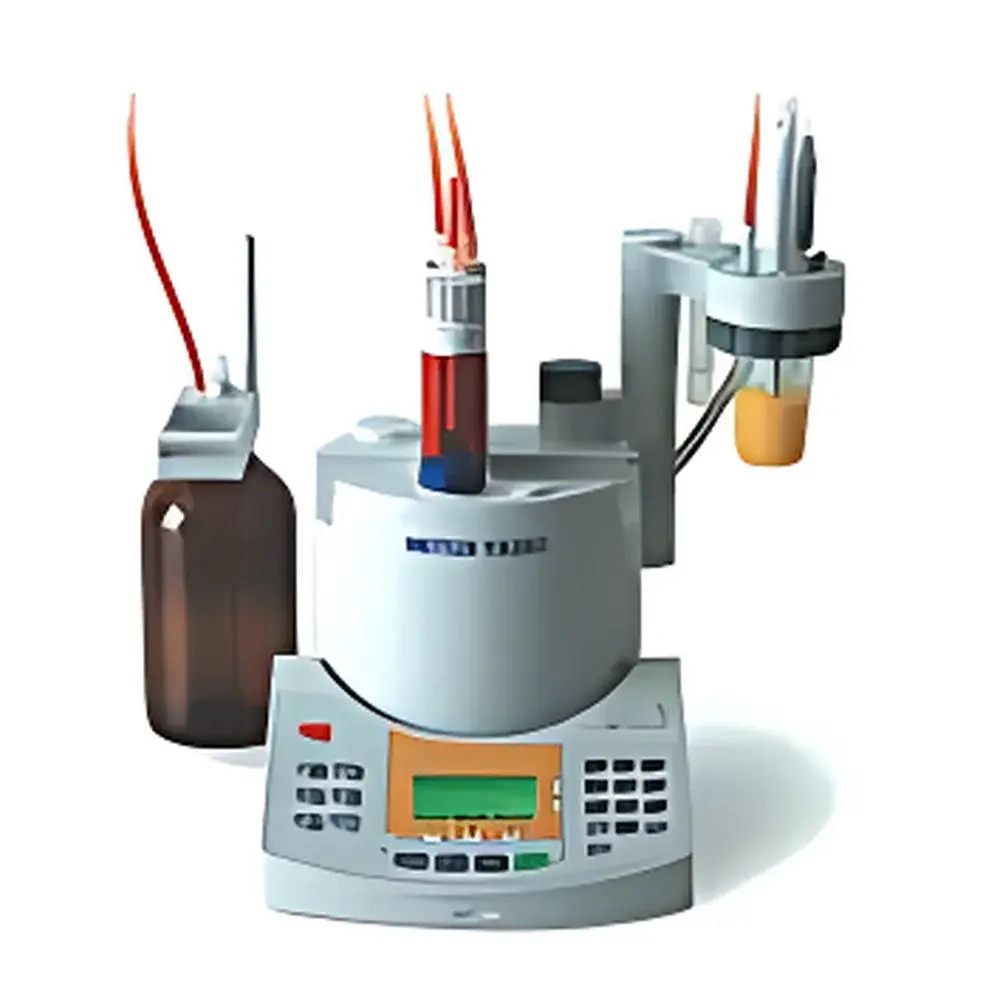
METTLER TOLEDO DL22 Food Analysis Titrator
| Brand | METTLER TOLEDO |
|---|---|
| Model | DL22 |
| Application Scope | Chloride, Ascorbic Acid, Iodine Value, Peroxide Value, Total Hardness, Free SO₂, Glucose, Kjeldahl Nitrogen, Reducing Sugars, Ca²⁺/Mg²⁺/K⁺, Organic Acids |
| Titration Modes | Endpoint & Equivalence Point Detection |
| Dispensing Modes | Dynamic & Fixed-Volume |
| Burette Resolution | 1/10,000 |
| Potential Resolution | 0.1 mV |
| Data Storage | 100 Sample Results |
| Stirring Options | Magnetic & Propeller |
| Burette Volumes | 1 mL, 5 mL, 10 mL, 20 mL |
| Compliance | GLP/GMP/FDA 21 CFR Part 11–Ready Reporting |
Overview
The METTLER TOLEDO DL22 Food Analysis Titrator is a dedicated automatic potentiometric titrator engineered for routine quality control and regulatory testing in food and beverage laboratories. It operates on the fundamental principle of potentiometric endpoint detection—measuring the potential difference between a reference electrode and an indicator electrode as titrant is incrementally added to the sample. This electrochemical method enables precise, reproducible quantification of analytes whose redox, acid–base, complexometric, or precipitation reactions generate measurable potential shifts. The DL22 is pre-configured with 20 validated application methods aligned with internationally recognized food testing protocols—including AOAC, ISO 5725 (accuracy and precision), and standard methods published by the American Oil Chemists’ Society (AOCS) and International Dairy Federation (IDF). Its architecture integrates a high-stability dosing system, low-drift pH/mV measurement circuitry, and real-time electrochemical signal processing—ensuring robust performance across diverse matrices such as fruit juices, dairy products, edible oils, wines, and processed meats.
Key Features
- Dual-mode titration control: Supports both fixed-volume (equivalent to classical burette addition) and dynamic dispensing (adaptive volume delivery based on slope analysis), optimizing speed and accuracy for each assay.
- High-resolution electrochemical measurement: 0.1 mV potential resolution ensures reliable detection of subtle inflection points in titration curves—even in low-conductivity or turbid samples common in food extracts.
- Modular stirring configuration: Interchangeable magnetic stirrer and propeller stirrer modules accommodate heterogeneous suspensions (e.g., ground meat extracts) and low-viscosity liquids (e.g., vinegar or wine) without cross-contamination or vortex-induced error.
- Intuitive alphanumeric input interface: QWERTY-style keypad with predictive text entry—designed for rapid method selection, sample ID logging, and custom formula definition without keyboard training.
- Universal burette compatibility: Accepts METTLER TOLEDO’s standardized glass burettes (1 mL, 5 mL, 10 mL, 20 mL), enabling method scalability from trace-level chloride determination (ppm range) to high-capacity acid value titrations in fats and oils.
- Real-time curve visualization: On-screen titration curve display (E vs. V) with auto-scaling, zoom, and overlay functionality—enabling immediate visual verification of endpoint shape, stoichiometry, and reaction completeness prior to result calculation.
Sample Compatibility & Compliance
The DL22 accommodates liquid, semi-solid, and homogenized solid samples after appropriate pretreatment (e.g., extraction, dilution, filtration). It meets the instrumental requirements for methods specified in ISO 9001-certified QC environments and supports full traceability under GLP and GMP frameworks. All report outputs—including raw potential data, derivative curves, calculated concentrations, and audit trails—conform to FDA 21 CFR Part 11 expectations when paired with METTLER TOLEDO’s LabX software (optional upgrade). Built-in electronic signatures, user access levels, and immutable result archiving ensure compliance with ISO/IEC 17025 accreditation criteria for testing laboratories.
Software & Data Management
While the DL22 operates as a standalone instrument with embedded firmware, it interfaces seamlessly with METTLER TOLEDO’s LabX titration software via RS232 or USB. LabX provides centralized method management, automated report generation (PDF/CSV), electronic signature workflows, and long-term data archival compliant with ALCOA+ principles (Attributable, Legible, Contemporaneous, Original, Accurate, Complete, Consistent, Enduring, Available). Raw titration data—including time-stamped potential readings at each dispensing step—is retained in native format for retrospective reprocessing or regulatory inspection.
Applications
The DL22 delivers validated performance for core food safety and nutritional labeling parameters: chloride content (salt quantification per ISO 9167-1); ascorbic acid (vitamin C) via iodometric titration (AOAC 967.21); peroxide value in edible oils (AOCS Cd 8-53); iodine value (AOCS Cd 1-25); free sulfur dioxide in wine (OIV Method Oeno 14); total acidity in dairy and beverages (ISO 750); calcium and magnesium hardness (ISO 6059); and Kjeldahl nitrogen (ISO 8968). Its method library also includes optimized routines for reducing sugars (Lane–Eynon), titratable acidity in fruit products, and potassium quantification via potentiometric titration with tetraphenylborate.
FAQ
Does the DL22 support Good Laboratory Practice (GLP) documentation requirements?
Yes—the instrument generates timestamped, user-identified reports with full metadata (method name, sample ID, reagent lot, environmental conditions), meeting GLP Annex 11 and ISO/IEC 17025 documentation standards.
Can the DL22 be integrated into a networked laboratory information management system (LIMS)?
Yes—via LabX software or direct ASCII output over RS232/USB, enabling automated transfer of results to LIMS platforms supporting ASTM E1384 or HL7 messaging protocols.
Is calibration verification traceable to national standards?
All electrochemical sensors used with the DL22—including pH, redox, and ion-selective electrodes—are compatible with NIST-traceable calibration solutions; instrument-specific calibration certificates are available upon request.
What maintenance is required for long-term operational reliability?
Routine maintenance consists of daily electrode cleaning, monthly burette piston lubrication, and annual verification of volumetric accuracy per ISO 8655-6 using certified weights and distilled water density tables.
Are method updates provided for new regulatory requirements?
METTLER TOLEDO offers periodic firmware and method library updates through authorized service channels—aligned with revisions to AOAC, ISO, and Codex Alimentarius guidelines.





