
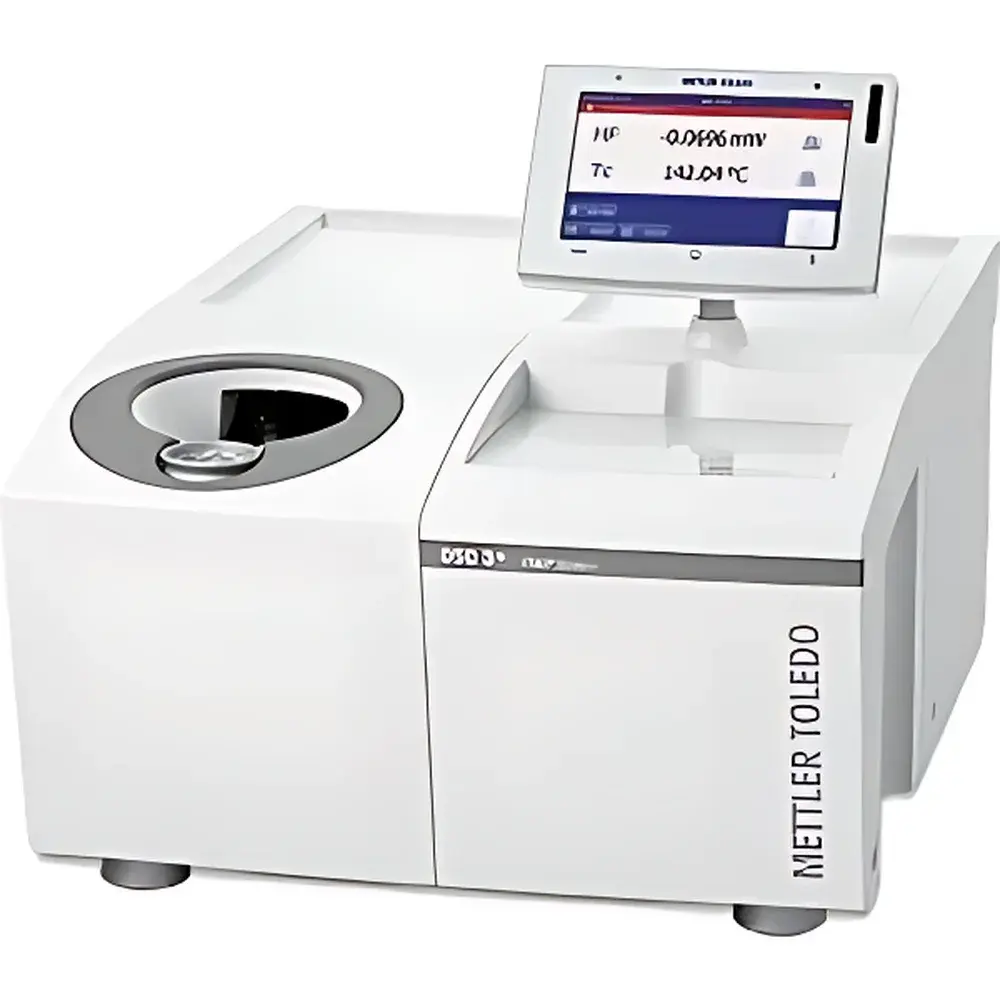
METTLER TOLEDO DSC 3+ Differential Scanning Calorimeter
| Brand | METTLER TOLEDO |
|---|---|
| Origin | Switzerland |
| Model | DSC 3+ |
| Temperature Range | -150 to 700 °C |
| Temperature Accuracy | ±0.1 °C |
| Heating/Cooling Rate | 0.02–300 K/min |
| Sensor Options | FRS 6+ (56 thermocouples) or HSS 9+ (120 thermocouples) |
| TAWN Resolution (FRS/HSS) | 0.12/0.2 °C |
| TAWN Sensitivity (FRS/HSS) | 11.9/56 µW/°C |
| Indium Response Ratio (FRS) | >155 mW/°C |
Overview
The METTLER TOLEDO DSC 3+ is a high-performance differential scanning calorimeter engineered for precision thermal analysis across research, quality control, and regulatory-compliant production environments. It operates on the principle of heat-flux DSC, measuring the difference in heat flow between a sample and an inert reference as both are subjected to identical, precisely controlled temperature programs. Its core innovation lies in the MultiSTAR DSC sensor architecture—available in two configurations: the FRS 6+ sensor with 56 gold/gold-palladium thermocouples arranged in a star pattern, and the HSS 9+ sensor with 120 thermocouples—both fabricated on ceramic substrates and coated with a thin, chemically inert alumina layer. This design delivers exceptional signal-to-noise ratio, sub-second time constants, flat baseline stability, and outstanding resistance to chemical corrosion from aggressive solvents, acids, or residual monomers. With a continuous operational temperature range spanning –150 °C to 700 °C in a single run, the DSC 3+ supports both ultra-low-temperature glass transitions and high-temperature decomposition or crystallization events without hardware reconfiguration.
Key Features
- MultiSTAR sensor platform offering dual configuration options: FRS 6+ for robust routine analysis and high heating rates up to 300 K/min; HSS 9+ for ultra-sensitive detection of weak thermal events using microgram-scale samples.
- Thermal accuracy of ±0.1 °C traceable to NIST-certified standards, supported by integrated multi-point calibration routines for temperature, enthalpy, and sensitivity.
- Modular instrument architecture enabling seamless integration of optional modules—including TOPEM® (Temperature-Modulated DSC), UV-DSC coupling for photo-initiated reaction studies, and DSC-microscopy for real-time morphological correlation.
- Robust, high-cycle automated sample changer capable of unattended operation over extended periods, compatible with standard aluminum, gold-plated, or high-pressure crucibles.
- Ceramic-based sensor construction with alumina passivation ensures long-term stability and resistance to degradation in corrosive analytical environments common in polymer, pharmaceutical, and fine chemical applications.
- Comprehensive thermal history control via programmable cooling, isothermal holds, and multi-step ramps—critical for simulating industrial processing conditions such as annealing, quenching, or curing cycles.
Sample Compatibility & Compliance
The DSC 3+ accommodates diverse sample types—from homogeneous polymers and crystalline APIs to heterogeneous composites, gels, and low-mass biological formulations—with minimal mass requirements (down to 10 µg for HSS 9+). It supports standard crucible formats (40 µL aluminum, 70 µL gold-plated, and 150 bar high-pressure cells), ensuring compatibility with ASTM E794, ISO 11357, USP , and ICH Q5C guidelines. Instrument firmware and data acquisition software comply with FDA 21 CFR Part 11 requirements, including electronic signatures, audit trails, and role-based access control—making it suitable for GLP and GMP-regulated laboratories conducting stability studies, excipient compatibility screening, or polymer batch release testing.
Software & Data Management
Powered by STARe Evaluation Software, the DSC 3+ provides fully validated workflows for peak deconvolution, kinetic modeling (e.g., Ozawa-Flynn-Wall, Kissinger), phase diagram construction, and quantitative crystallinity assessment. All raw data are stored in vendor-neutral, timestamped .qdb files with embedded metadata (operator ID, calibration status, environmental logs). The software supports automated report generation compliant with internal SOPs or external regulatory submissions, and integrates with LIMS via OPC UA or CSV export protocols. Full audit trail functionality records every parameter change, calibration event, and data manipulation step—ensuring full traceability for inspection readiness.
Applications
The DSC 3+ serves as a foundational tool in materials science and process development labs. In polymer science, it quantifies Tg, melting enthalpy, degree of crystallinity, oxidative induction time (OIT), and cure kinetics. In pharmaceutical development, it characterizes polymorphic transitions, hydrate/dehydrate behavior, amorphous content, and API-excipient compatibility. In food science, it evaluates starch gelatinization, fat crystallization profiles, and thermal stability of functional ingredients. Its wide dynamic range and sensor versatility also support advanced applications such as nanomaterial thermal stability screening, battery electrode material characterization, and catalytic reaction calorimetry under modulated conditions.
FAQ
What distinguishes the FRS 6+ and HSS 9+ sensors beyond thermocouple count?
The FRS 6+ prioritizes mechanical durability and thermal response speed—ideal for high-rate scans and repetitive QC testing—while the HSS 9+ maximizes thermal resolution and signal amplitude per unit mass, enabling reliable detection of sub-milliwatt transitions in nanogram-scale or highly diluted samples.
Can the DSC 3+ perform TOPEM experiments without hardware modification?
Yes—TOPEM capability is enabled via firmware activation and requires no additional hardware; it leverages the instrument’s high-speed temperature control and digital signal processing to resolve reversing and non-reversing heat flows simultaneously.
Is calibration traceable to international standards?
All calibrations (temperature, enthalpy, sensitivity) are performed using certified reference materials (e.g., indium, zinc, tin) with documented NIST-traceable certificates, and results are automatically embedded into measurement reports.
How does the alumina coating enhance sensor longevity in corrosive applications?
The conformal alumina layer acts as a diffusion barrier against halogenated solvents, residual catalysts, and acidic degradation products—preventing intermetallic diffusion and thermocouple drift over thousands of heating cycles.
Does the system support method transfer between instruments?
Yes—STARe software includes cross-instrument method portability features, allowing identical temperature programs, evaluation settings, and baseline corrections to be replicated across DSC 3+, DSC 2+, and legacy DSC 1 platforms with documented uncertainty propagation.



