
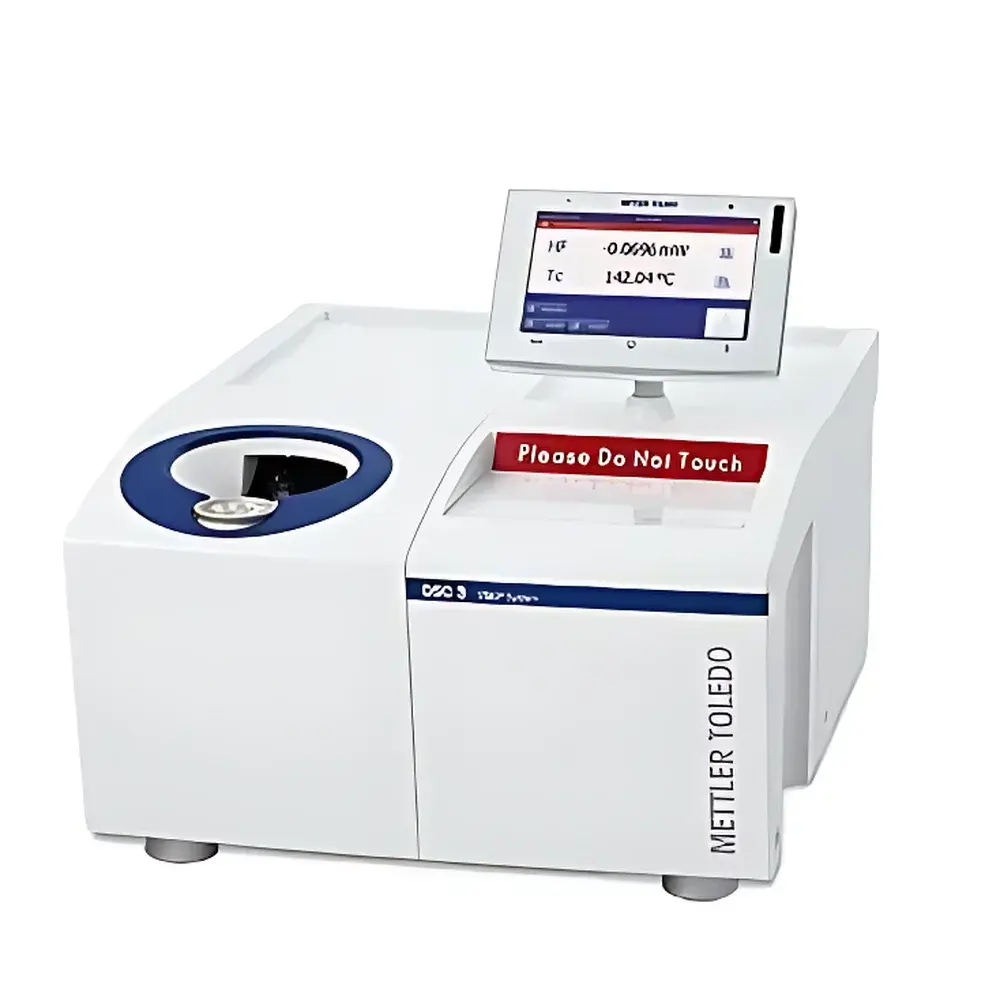
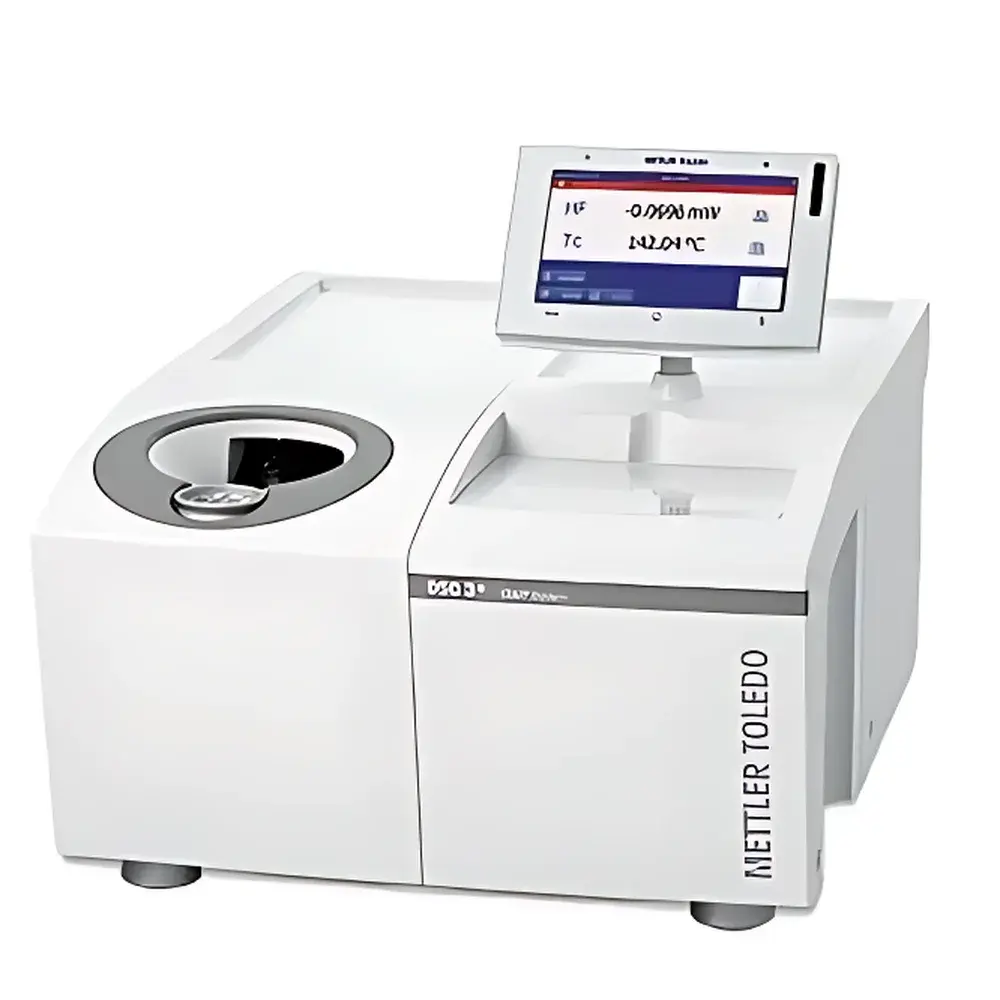
METTLER TOLEDO DSC 3 / DSC 3+ Differential Scanning Calorimeter
| Brand | METTLER TOLEDO |
|---|---|
| Origin | Switzerland |
| Model | DSC 3 / DSC 3+ |
| Temperature Range | RT to 1100 °C |
| Temperature Accuracy | ±0.05 °C |
| Heating/Cooling Rate | 0.1–150 K/min (DSC 3) or 0.1–250 K/min (DSC 3+) |
Overview
The METTLER TOLEDO DSC 3 and DSC 3+ are high-performance differential scanning calorimeters engineered for precision thermal analysis across industrial, pharmaceutical, polymer, and academic laboratories. Based on the heat-flux principle, these instruments measure the difference in heat flow between a sample and an inert reference as both are subjected to identical, precisely controlled temperature programs. This enables quantitative determination of enthalpic transitions—including glass transitions (Tg), melting points (Tm), crystallization behavior, curing kinetics, oxidative induction time (OIT), and specific heat capacity (Cp). Designed as part of METTLER TOLEDO’s Excellence Thermal Analysis platform, both models feature a modular architecture that supports seamless integration into automated workflows while retaining full manual operability for method development and troubleshooting.
Key Features
- High-resolution DSC sensors: The DSC 3 employs a robust MultiSTARe sensor with 56 thermocouple pairs, delivering balanced sensitivity and baseline stability for routine QC and R&D applications. The DSC 3+ integrates an advanced 120-thermocouple-pair sensor, significantly enhancing signal-to-noise ratio—enabling reliable detection of weak thermal events (e.g., low-concentration additives, subtle polymorphic transitions, or early-stage degradation).
- Wide dynamic temperature and rate capability: Operating from ambient (RT) up to 1100 °C, the system accommodates diverse material classes—from pharmaceuticals and polymers to metals and ceramics. Programmable heating/cooling rates span 0.1–150 K/min (DSC 3) or 0.1–250 K/min (DSC 3+), supporting both high-resolution slow scans and rapid screening protocols.
- Temperature accuracy of ±0.05 °C—traceable to NIST-certified standards—ensures compliance with ASTM E794, ISO 11357, and USP <131> for thermal transition validation.
- One Click™ operation streamlines method execution: Pre-configured, instrument-verified methods (e.g., Tg per ISO 11357-2, OIT per ASTM D3895) launch with a single touch, minimizing operator variability and supporting 21 CFR Part 11-compliant audit trails when used with STARe software.
- Automated sample handling: A field-proven, maintenance-optimized auto-sampler operates continuously under GLP/GMP conditions, accommodating up to 64 pans (standard aluminum or hermetic crucibles) with integrated lid-piercing and purge gas management.
Sample Compatibility & Compliance
The DSC 3/DSC 3+ supports standard and specialized crucibles—including aluminum, gold-plated aluminum, stainless steel, and high-pressure hermetic cells—enabling analysis under inert (N2, Ar), oxidative (air, O2), or reactive atmospheres. All sensor and furnace components are manufactured in Switzerland to ISO 9001-certified processes. Instrument qualification follows IQ/OQ/PQ protocols aligned with GAMP 5 guidelines. Data integrity is maintained through electronic signatures, user access levels, and immutable audit trails—fully compliant with FDA 21 CFR Part 11 and EU Annex 11 requirements for regulated environments.
Software & Data Management
STARe Software (v15.x or later) provides unified control, real-time visualization, and standardized reporting. It includes automated peak identification, baseline correction algorithms (tangent, sigmoidal), Cp calibration routines, and kinetic modeling modules (e.g., Friedman, Ozawa-Flynn-Wall). Raw data files (.mq4) are stored in vendor-neutral formats compatible with third-party analysis tools. Secure network deployment supports centralized instrument monitoring, remote diagnostics, and integration with LIMS via ASTM E1384-compliant interfaces.
Applications
- Pharmaceutical solid-state characterization: Polymorph screening, amorphous content quantification, excipient compatibility, and stability-indicating assay development.
- Polymer processing & quality control: Crystallinity assessment, melt flow index correlation, crosslink density estimation, and thermal aging studies per ISO 14520.
- Materials science: Phase diagram construction, reaction enthalpy measurement, and decomposition kinetics of composites, catalysts, and battery electrode materials.
- Food science: Fat crystallization profiling, starch gelatinization analysis, and shelf-life prediction via accelerated oxidation testing.
FAQ
What distinguishes the DSC 3+ sensor from the DSC 3 sensor?
The DSC 3+ uses a next-generation heat-flux sensor with 120 thermocouple pairs versus 56 in the DSC 3—resulting in higher sensitivity (lower detection limit for ΔH) and improved resolution for closely spaced transitions.
Is the system compliant with regulatory requirements for pharmaceutical labs?
Yes—when configured with STARe Software and appropriate user access controls, it meets 21 CFR Part 11, EU GMP Annex 11, and ICH Q5C thermal stability protocol expectations.
Can the DSC 3/DSC 3+ perform heat capacity (Cp) measurements?
Yes—using the sapphire calibration method per ISO 11357-4, the system delivers traceable, repeatable Cp data across its full temperature range.
What purge gas options are supported?
Standard configurations support N2, air, and Ar; optional mass-flow controllers enable precise O2 or synthetic air dosing for oxidation studies.
Is remote operation and data export supported?
Yes—STARe supports secure remote desktop access, scheduled unattended runs, and export to CSV, PDF, and XML formats with customizable report templates.



