
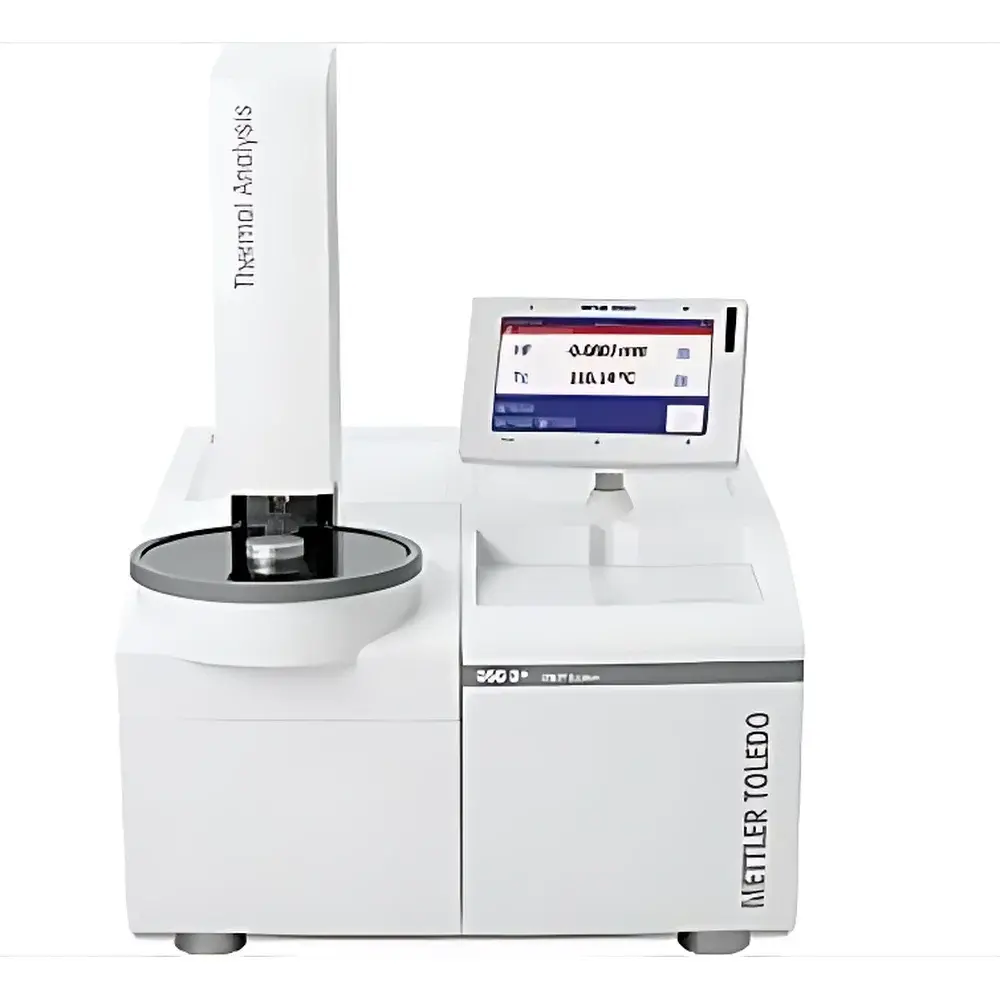
METTLER TOLEDO DSC3+ Advanced Differential Scanning Calorimeter
| Brand | METTLER TOLEDO |
|---|---|
| Origin | Switzerland |
| Model | DSC3+ |
| Temperature Range | −150 °C to 700 °C (standard), up to 1100 °C (optional furnace) |
| Temperature Accuracy | ±0.1 °C |
| Heating/Cooling Rate | 0.02–250 K/min |
| Heat Flow Sensitivity | 0.04 µW (FRS 5+ sensor), 0.02 µW (HSS 8+ sensor) |
| Sensor Type | MultiSTAR® DSC Sensor (56- or 120-pair Au/Au-Pd thermocouples, star-arranged on ceramic substrate with Al₂O₃ coating) |
Overview
The METTLER TOLEDO DSC3+ is a high-performance differential scanning calorimeter engineered for precision thermal analysis across research, quality control, and regulatory-compliant production environments. Operating on the heat-flux principle, the DSC3+ measures endothermic and exothermic transitions—including glass transitions (Tg), melting points (Tm), crystallization behavior, curing kinetics, oxidative induction time (OIT), and specific heat capacity (Cp)—by quantifying the differential heat flow between a sample and inert reference as both are subjected to controlled, identical temperature programs. Its core innovation lies in the patented MultiSTAR® DSC sensor: a ceramic-based platform integrating either 56 or 120 pairs of gold/gold-palladium thermocouples arranged radially in a star configuration. This architecture delivers exceptional signal-to-noise ratio, minimal thermal lag (signal time constant < 0.1 s), and baseline flatness critical for high-fidelity Cp determination and resolution of overlapping thermal events. The sensor’s alumina-coated surface ensures long-term chemical resistance against aggressive solvents, acids, and reactive polymers—enabling reliable operation in pharmaceutical, polymer, and specialty chemical labs.
Key Features
- MultiSTAR® DSC Sensor platform with dual-sensor compatibility: FRS 5+ (0.04 µW sensitivity) for routine high-accuracy work and HSS 8+ (0.02 µW sensitivity) for ultra-low-energy transitions—among the highest sensitivities available in commercial DSC instrumentation.
- Extended temperature capability: Standard operation from −150 °C to 700 °C; optional high-temperature furnace supports measurements up to 1100 °C with maintained accuracy and stability.
- Dynamic thermal control: Programmable heating and cooling rates from 0.02 to 250 K/min, enabling rapid screening, isothermal holds, and non-isothermal kinetic modeling per ASTM E698 and ISO 11357 standards.
- One Click™ operation: Intuitive touchscreen interface reduces method setup time; pre-validated SOP templates support GLP/GMP workflows without scripting.
- Modular hardware architecture: Supports seamless integration of optional modules including TOPEM® (multi-frequency temperature-modulated DSC), UV-DSC (photo-thermal coupling), and DSC-microscopy (real-time morphological correlation during thermal events).
- Ergonomic, space-efficient design with front-access sample chamber, tool-free sensor exchange, and integrated purge gas management (N2, Ar, O2, synthetic air).
Sample Compatibility & Compliance
The DSC3+ accommodates standard aluminum, gold-plated aluminum, and high-pressure stainless-steel crucibles (up to 100 bar), supporting solids, powders, gels, films, and small-volume liquids (0.1–50 mg). Its corrosion-resistant sensor and sealed furnace enable direct analysis of halogenated polymers, lithium-ion battery electrolytes, and acidic pharmaceutical intermediates without performance degradation. Instrument compliance includes full traceability per ISO/IEC 17025, validation support for USP , ICH Q5C, and FDA 21 CFR Part 11 (audit trail, electronic signatures, role-based access control). All calibration procedures follow METTLER TOLEDO FlexCal® methodology—requiring only two reference materials (e.g., indium and zinc) to establish temperature, enthalpy, and Cp response across the full operating range.
Software & Data Management
STARe Software (v16.x or later) provides unified control, real-time visualization, and advanced post-processing—including peak deconvolution, kinetic modeling (Friedman, Ozawa-Flynn-Wall), Cp normalization, and TOPEM® spectral analysis. Raw data is stored in vendor-neutral .mpf format compliant with ASTM E1970. Integrated reporting tools generate PDF/Excel outputs with embedded metadata (instrument ID, operator, calibration status, environmental logs) required for internal audits and regulatory submissions. Network deployment supports centralized instrument monitoring, method library sharing, and automated backup to secure NAS or LIMS via OPC UA protocol.
Applications
The DSC3+ serves as a primary analytical tool in polymer science (crystallinity quantification in PP/PE, crosslink density in epoxies, degradation onset in composites), pharmaceutical development (polymorph screening, excipient compatibility, lyophilization cycle optimization), food science (fat crystallization profiling, starch gelatinization enthalpy), and advanced materials (phase-change material characterization, catalyst thermal stability, nanocomposite dispersion analysis). Its HSS 8+ sensor extends applicability to microcalorimetric regimes—such as protein unfolding thermodynamics and low-concentration additive interactions—traditionally reserved for dedicated isothermal titration or power-compensated calorimeters.
FAQ
What distinguishes the MultiSTAR® sensor from conventional DSC sensors?
Its radial thermocouple array on a low-thermal-mass ceramic substrate minimizes axial thermal gradients and improves spatial averaging—yielding superior baseline stability and resolution of closely spaced transitions.
Can the DSC3+ perform quantitative specific heat capacity (Cp) measurements?
Yes—its flat baseline, high signal fidelity, and FlexCal® Cp calibration protocol meet ASTM E1269 requirements for absolute Cp determination with ≤1.5% uncertainty.
Is TOPEM® included as standard or optional?
TOPEM® is an optional software/hardware module requiring the DSC3+ with high-speed furnace and HSS 8+ sensor; it enables separation of reversing and non-reversing heat flow components for complex amorphous phase analysis.
How does the DSC3+ support regulatory compliance in pharmaceutical QC labs?
It provides full 21 CFR Part 11 compliance via STARe Software—including electronic signatures, audit trails, and configurable user permissions—as validated in METTLER TOLEDO’s GxP-ready qualification packages.
What maintenance is required for long-term sensor performance?
No routine recalibration is needed; the ceramic substrate and Au/Au-Pd thermocouples exhibit negligible drift. Annual verification using certified reference materials is recommended per ISO/IEC 17025 quality systems.
Related Products



