
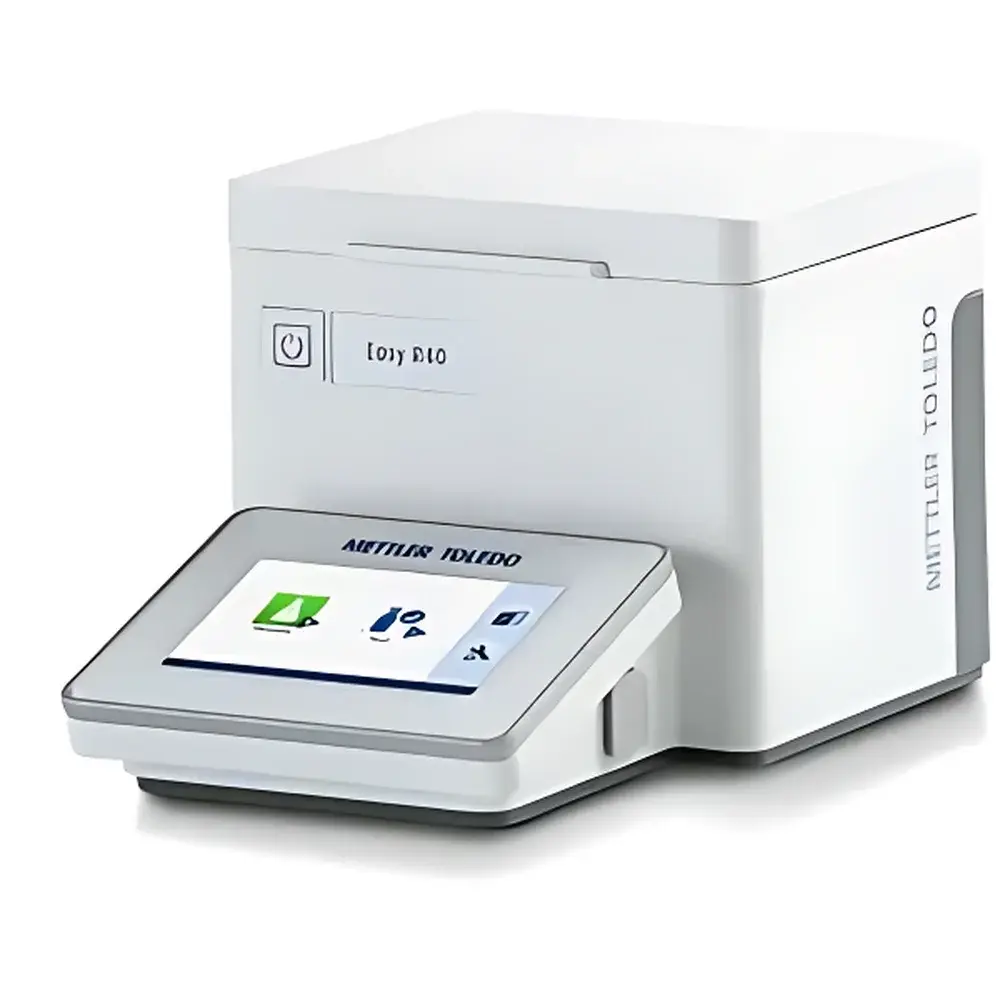
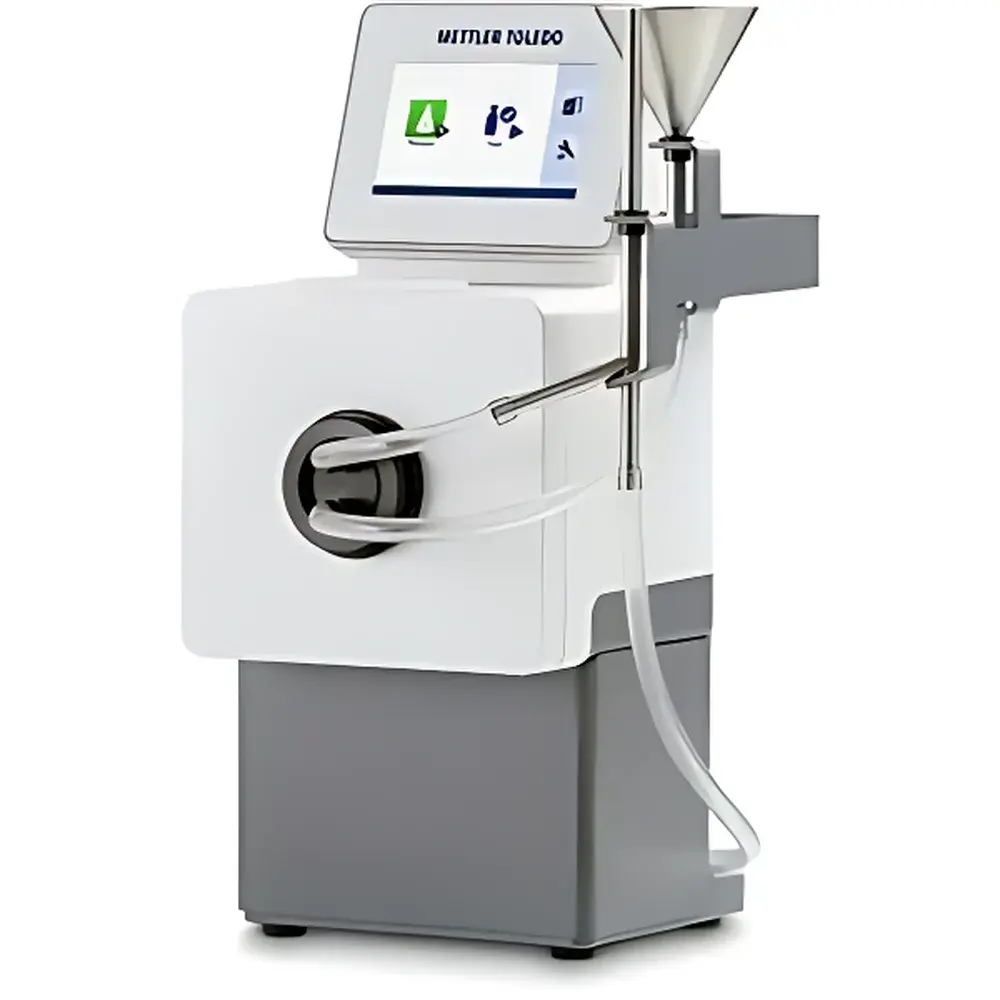
METTLER TOLEDO Easy R40 Refractometer / Brix Analyzer / Beverage Refractometer
| Brand | METTLER TOLEDO |
|---|---|
| Origin | Switzerland |
| Model | Easy R40/Brix/Bev |
| Instrument Type | Benchtop Refractometer |
| Temperature Control | Peltier-based, active heating & cooling |
| Display | Digital LCD |
| Refractive Index Range | 1.3200–1.5800 nD |
| Built-in Performance Verification | SimpleCheck™ certified reference standards |
| Compliance | Designed for GLP/GMP environments with audit-ready verification workflow |
Overview
The METTLER TOLEDO Easy R40 Refractometer is a benchtop optical instrument engineered for precise, repeatable measurement of refractive index (nD) and derived concentration units—including Brix (% w/w sucrose), alcohol content, and beverage-specific parameters—across quality control, R&D, and production environments. It operates on the principle of total internal reflection at the prism-sample interface, where the critical angle of incident light is determined by the sample’s refractive index. The instrument integrates a high-stability sapphire measuring prism and a temperature-controlled optical path to eliminate thermal drift—a key requirement for compliance with ISO 21746:2019 (optical methods for refractometry) and ASTM D1218 (standard test method for refractive index of hydrocarbon liquids). Its compact, IP54-rated enclosure and robust mechanical architecture support deployment in both regulated laboratory settings and industrial production floors.
Key Features
- Peltier-based temperature control system enabling rapid, bidirectional regulation (heating and cooling) of the measuring cell within ±0.1 °C accuracy; maintains sample at user-defined setpoints from 10 °C to 40 °C without external chillers or baths.
- Digital LCD display with intuitive icon-driven interface; supports multilingual operation (English, German, French, Spanish, Chinese) and real-time unit switching between nD, % Brix, % alcohol, and custom concentration scales.
- SimpleCheck™ performance verification protocol embedded in firmware: guides users through automated calibration verification using traceable, NIST-traceable reference standards (e.g., water, sucrose solutions); generates timestamped verification reports compliant with FDA 21 CFR Part 11 requirements when paired with LabX software.
- Prism surface constructed from monolithic sapphire—chemically inert, scratch-resistant, and compatible with aggressive solvents including ethanol, acetic acid, and caustic cleaning agents used in beverage and pharmaceutical CIP cycles.
- Compact footprint (220 × 280 × 240 mm) and low power consumption (<15 W standby) facilitate integration into fume hoods, QC benches, or mobile analytical stations.
Sample Compatibility & Compliance
The Easy R40 accommodates liquid, semi-liquid, and low-viscosity suspensions—including fruit juices, soft drinks, syrups, wine must, dairy whey, and pharmaceutical excipient solutions—with minimum sample volume of 0.5 mL. Its sealed optical path prevents contamination and eliminates evaporation artifacts during extended measurement sequences. The instrument meets IEC 61010-1 safety standards for laboratory equipment and conforms to electromagnetic compatibility (EMC) requirements per EN 61326-1. For regulated industries, its verification workflow supports GLP and GMP documentation needs—including electronic signature capability, audit trail logging, and instrument qualification (IQ/OQ) templates available upon request.
Software & Data Management
While fully functional as a standalone instrument, the Easy R40 is interoperable with METTLER TOLEDO’s LabX laboratory software platform. LabX enables centralized instrument management, automated data capture, customizable report generation (PDF/CSV), and secure storage aligned with 21 CFR Part 11 electronic record requirements. All measurements include metadata: date/time stamp, operator ID, temperature setpoint, verification status, and instrument serial number—ensuring full traceability for internal audits or regulatory inspections. Raw refractive index values are mathematically converted to application-specific units using built-in, ISO-validated polynomial algorithms (e.g., ICUMSA Methods for sugar analysis).
Applications
- Beverage manufacturing: Real-time Brix monitoring in juice blending, soft drink formulation, and fermentation process control (e.g., wort gravity tracking).
- Pharmaceutical excipients: Concentration verification of glycerin, propylene glycol, and syrup bases per USP <788> and Ph. Eur. 2.2.47.
- Food & dairy: Fat content estimation in milk via refractive index correlation; quality screening of honey adulteration.
- Chemical synthesis: Reaction progress tracking for esterification or polymerization where refractive index shifts correlate with conversion.
- Academic research: Teaching labs requiring stable, low-maintenance refractometry with pedagogical verification workflows.
FAQ
Does the Easy R40 require external calibration fluids beyond the included SimpleCheck™ standards?
No—SimpleCheck™ kits contain two pre-certified, traceable reference liquids (e.g., water and 30% sucrose solution) sufficient for daily performance verification. Optional third-party calibration services are available for annual metrological validation.
Can the instrument store measurement history internally?
It retains the last 100 measurements with timestamps and temperature data in non-volatile memory; full historical export requires connection to LabX or optional USB data logger.
Is the sapphire prism replaceable by the user?
Yes—the prism assembly is field-replaceable using standard Torx tools; replacement parts and alignment instructions are documented in the service manual.
What is the warm-up time required before first use?
Less than 3 minutes from power-on to thermal stabilization at 20 °C ambient; Peltier ramping time to target temperature depends on ΔT but typically ranges from 2–5 minutes.
How does the Easy R40 handle viscous or particulate-laden samples?
Samples exceeding 500 mPa·s viscosity or containing suspended solids >50 µm require filtration or centrifugation prior to measurement to avoid prism coating and optical scattering errors.





