
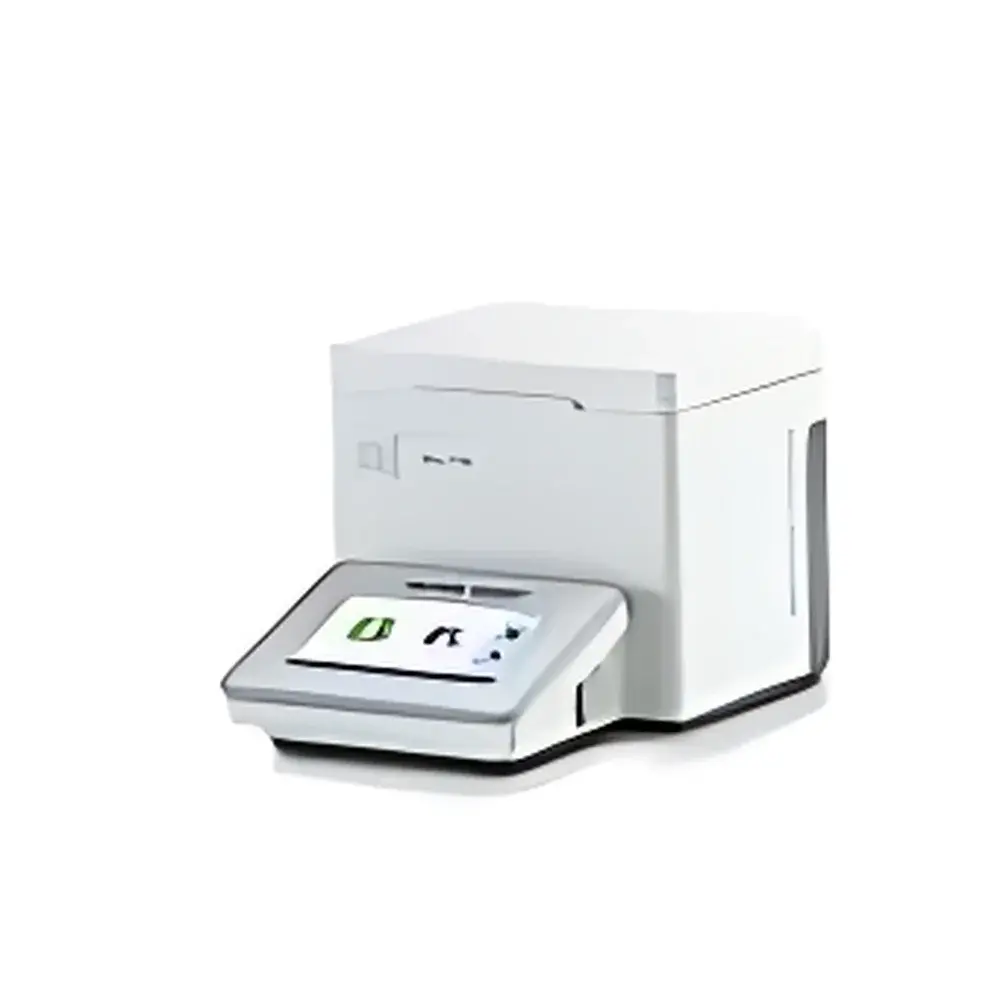
METTLER TOLEDO Easy Series Digital Refractometers
| Brand | METTLER TOLEDO |
|---|---|
| Origin | Switzerland |
| Product Type | Benchtop Refractometer |
| Temperature Control | Yes |
| Digital Display | Yes |
| Refractive Index Range | 1.30–1.72 |
| Measurement Accuracy | ±0.0001 |
| Resolution | 0.0001 |
| Brix Range | 0–100% w/w |
| Brix Accuracy | ±0.05 (at ~10–80% w/w) |
| Temperature Range | 10–65 °C |
| Temp. Accuracy | ±0.1 °C |
| Supported Units | nD, % Brix, °Oechsle, °Babo, HFCS-42/55, Invert Sugar, Custom Concentration Tables, Freeze Point Depression |
| Preloaded Methods | Up to 66 |
| Auto Sample Detection (FastStart™) | Yes (on Easy Brix & EaSy R4O) |
| Minimum Sample Volume | 0.2 mL (Easy Brix), ~50 µL (EaSy R4O), 0.2 mL (Easy Bev) |
| Dimensions (W×H×D) | 170×156×273 mm (Easy Brix), 198×382×200 mm (EaSy R4O), 170×156×273 mm (Easy Bev) |
Overview
The METTLER TOLEDO Easy Series Digital Refractometers are precision benchtop instruments engineered for reliable, repeatable measurement of refractive index (nD) and derived concentration units—including % Brix, °Oechsle, °Babo, HFCS-42/55, invert sugar, and custom-defined concentration scales—across diverse liquid samples. Based on the principle of total internal reflection at a prism–sample interface, these instruments utilize high-stability LED light sources and temperature-compensated optical detection to deliver traceable, ISO/IEC 17025-aligned measurements. Designed for routine quality control in food & beverage, pharmaceutical, chemical, and academic laboratories, the Easy Series integrates Peltier-based active temperature control, automatic sample recognition (FastStart™), and intuitive touchscreen operation—all within a compact, robust chassis compliant with IEC 61010-1 safety standards.
Key Features
- Peltier-controlled temperature regulation (10–65 °C range; ±0.1 °C accuracy), enabling precise thermal equilibration per ASTM D1218 and ISO 21748 guidelines
- High-resolution digital display with 0.0001 resolution for refractive index and 0.01% for Brix—meeting USP and Ph. Eur. 2.2.2 requirements for refractometric assay validation
- Three model variants optimized for distinct workflows: Easy Brix (general-purpose), EaSy R4O (broad refractive index range: 1.30–1.72), and Easy Bev (beverage-specific calibration and reporting)
- Preloaded method library supporting up to 66 user-configurable measurement protocols—including temperature-compensated Brix at 20 °C, Oechsle for wine must, and freeze-point depression calculations for antifreeze solutions
- Minimal sample requirement: as low as 0.2 mL (or ~50 µL for EaSy R4O), reducing reagent consumption and enabling analysis of precious or viscous samples
- Robust, space-efficient design (e.g., 170 × 156 × 273 mm for Easy Brix) suitable for crowded QC labs or production-floor deployment without sacrificing metrological integrity
Sample Compatibility & Compliance
The Easy Series accommodates aqueous solutions, syrups, juices, alcohols, glycols, acids, bases, and organic solvents—provided they do not etch or permanently coat the sapphire measuring prism. Each instrument complies with CE marking requirements, RoHS 2011/65/EU, and electromagnetic compatibility (EMC) Directive 2014/30/EU. For regulated environments, the devices support audit-ready data handling when paired with METTLER TOLEDO LabX software—enabling full 21 CFR Part 11 compliance through electronic signatures, secure user access levels, and immutable audit trails. Calibration verification is facilitated via certified NIST-traceable sucrose standards and built-in prism cleaning diagnostics.
Software & Data Management
While standalone operation requires no external software, seamless integration with LabX™ PC-based software unlocks advanced functionality: automated report generation (PDF/CSV), statistical process control (SPC) charting, real-time data archiving, and multi-instrument network synchronization. All measurement metadata—including timestamp, operator ID, temperature, method name, and raw nD values—is logged with cryptographic hashing to ensure data integrity. Optional Ethernet or USB connectivity enables direct linkage to LIMS or MES platforms, fulfilling GLP/GMP documentation requirements for pharmaceutical excipient testing or beverage formulation release.
Applications
- Food & Beverage: Brix quantification in fruit juices, soft drinks, honey, and dairy products per AOAC 932.12 and ICUMSA methods
- Pharmaceuticals: Excipient concentration verification (e.g., glycerin, propylene glycol) and osmolality estimation in liquid dosage forms
- Chemical Manufacturing: Quality assurance of ethylene glycol, diethylene glycol, and caustic soda solutions using custom concentration curves
- Winemaking & Brewing: Must density assessment (°Oechsle, °Babo) and alcohol potential prediction prior to fermentation
- Academic Research: Teaching fundamental optical properties of liquids and validating thermodynamic models of binary mixtures
FAQ
What temperature control options are available?
All Easy Series models feature integrated Peltier elements with programmable setpoints from 10–65 °C (±0.1 °C accuracy); temperature control can be disabled manually for rapid screening where thermal equilibrium is not critical.
Can the instrument measure non-Brix concentration units?
Yes—users may define custom calibration tables for proprietary formulations or import industry-standard tables (e.g., HFCS-42/55, invert sugar, freeze point depression) directly via LabX or the onboard interface.
Is cleaning validation supported?
Each unit includes prism surface inspection prompts and supports documented cleaning procedures per SOP templates included in LabX, ensuring consistent optical performance between measurements.
How is measurement traceability maintained?
Refractive index readings are traceable to NIST SRM 1701 (refractive index standard) via factory calibration certificates; users may perform intermediate verification using certified sucrose standards at defined concentrations.
What is the minimum sample volume required for reliable measurement?
The Easy Brix and Easy Bev require approximately 0.2 mL; the EaSy R4O achieves equivalent precision with only ~50 µL due to its optimized flow cell geometry and enhanced optical path sensitivity.




