
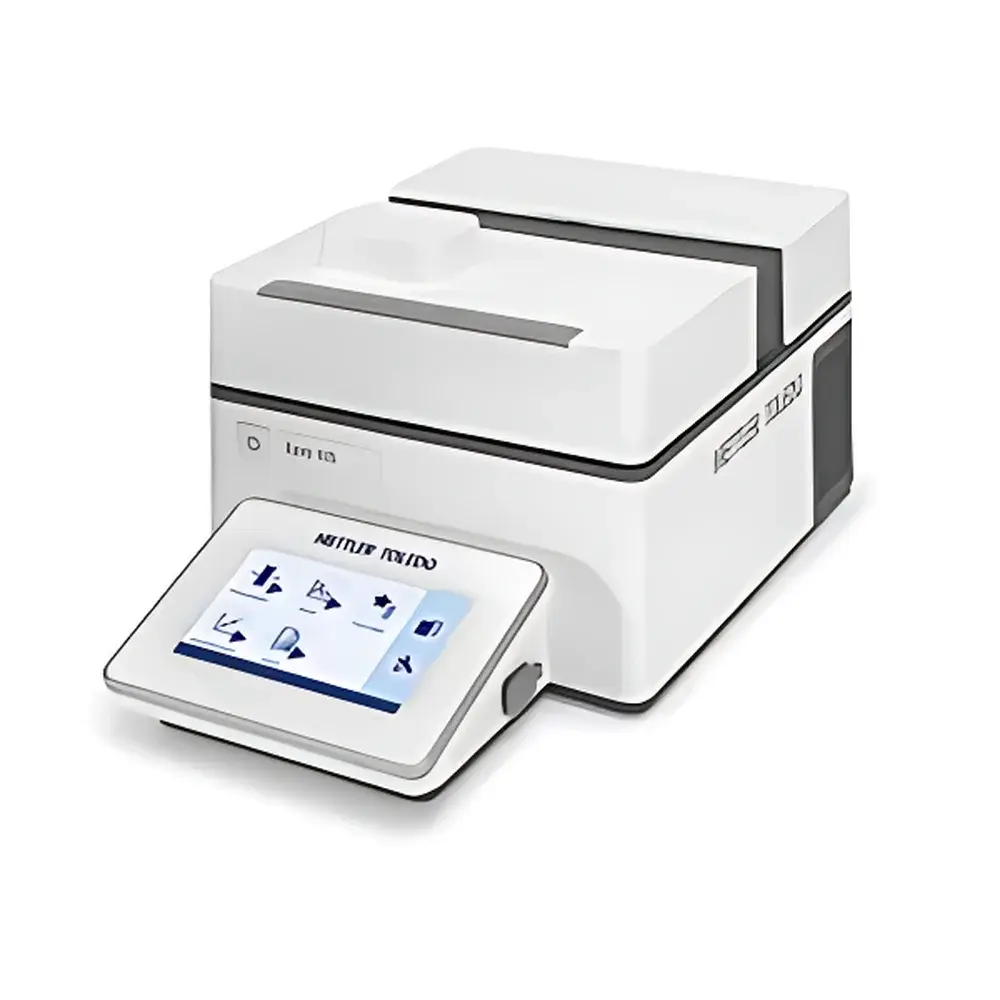
METTLER TOLEDO Easy VIS Visible Spectrophotometer
| Brand | METTLER TOLEDO |
|---|---|
| Origin | Switzerland |
| Model | Easy VIS |
| Wavelength Range | 330–1000 nm |
| Photometric Accuracy (K₂Cr₂O₇) | ±0.005 A |
| Wavelength Accuracy | ±1.5 nm |
| Light Source | Tungsten Halogen Lamp |
| Optical Path Options | 10, 16, 20, 30, 40, 50 mm (1 inch) |
| Display | 4.3-inch capacitive touchscreen |
| Dimensions (H × W × D) | 176 × 201 × 362 mm |
| Weight | 4.25 kg |
| User-Defined Methods | Up to 80 |
| Quick Access Keys per User | 10 |
| Supported Languages | English, Spanish, French, German, Italian, Portuguese, Polish, Japanese, Korean, Chinese, Thai, Indonesian |
| Barcode Reader Compatibility | SQKitReader™ handheld scanner (optional) |
| Printer Interface | USB-P25 |
| USB Host Port | Yes |
| Cuvette Changer | Not integrated |
| Pharmacopeia Compliance | Not specified |
| Colorimetric Standards | 25 pre-programmed methods (CIELAB, APHA, Gardner, etc.) |
Overview
The METTLER TOLEDO Easy VIS is a compact, entry-level visible spectrophotometer engineered for routine quantitative analysis, colorimetry, and water quality testing in regulated and non-regulated laboratory environments. Operating across a wavelength range of 330–1000 nm, the instrument employs a stable tungsten halogen lamp as its broadband light source and utilizes fixed-slit monochromator optics to deliver reproducible absorbance measurements with photometric accuracy of ±0.005 A (verified with potassium dichromate reference solution) and wavelength accuracy of ±1.5 nm. Its design emphasizes operational simplicity without compromising analytical integrity—particularly suited for QC labs, environmental testing facilities, and educational institutions where cost-efficiency, ease of use, and method portability are critical. Unlike UV/VIS systems requiring frequent lamp alignment or spectral recalibration, the Easy VIS features a modular, user-replaceable lamp assembly that enables rapid field maintenance without service technician intervention.
Key Features
- Modular tungsten halogen lamp with plug-and-play replacement—minimizes downtime and eliminates optical realignment procedures.
- 4.3-inch high-resolution capacitive touchscreen interface supporting 12 languages, including English, Spanish, German, Japanese, Chinese, and Korean—enabling seamless multilingual operation across global sites.
- Flexible optical path support: accommodates standard cuvettes with path lengths of 10, 16, 20, 30, 40, and 50 mm (1 inch), allowing direct compatibility with Spectroquant® test kits and custom sample holders.
- Preloaded colorimetric library with 25 standardized methods—including CIELAB, APHA, Gardner, Pt-Co, and Hazen—ensuring traceable, calculation-free reporting aligned with ISO 11477, ASTM D1209, and DIN EN ISO 6271.
- Integrated USB host port for direct connection to USB-P25 thermal printers and optional SQKitReader™ handheld barcode scanners—automating method selection and data logging during water analysis workflows.
- Up to 80 user-defined methods stored locally; each user profile supports 10 dedicated quick-access keys for one-touch recall of frequently used assays.
Sample Compatibility & Compliance
The Easy VIS accepts standard rectangular quartz or glass cuvettes (10 mm nominal path length) and supports extended-path cells up to 50 mm for low-absorbance samples. It is routinely deployed in applications compliant with ISO/IEC 17025-accredited testing protocols, particularly in water and wastewater laboratories using Spectroquant® reagent kits. While not certified to USP or EP 2.2.25 for pharmaceutical UV/VIS validation, its photometric performance meets general requirements for non-GMP color and concentration measurements. The device does not include audit trail functionality or electronic signature support required under FDA 21 CFR Part 11; therefore, it is intended for use in environments where full ALCOA+ data governance is managed externally via LIMS integration or manual recordkeeping.
Software & Data Management
Instrument control and data handling are fully embedded within the onboard firmware—no external PC or proprietary software installation is required. All measurement data, method parameters, and user annotations are stored internally with timestamping and operator ID tagging. Export is supported via USB mass storage mode: CSV files containing absorbance spectra, quantitative results, and color coordinates can be transferred to external systems for further statistical analysis or regulatory documentation. When paired with the SQKitReader™, barcode-scanned test kit IDs automatically trigger corresponding pre-validated methods—including calibration curves, dilution factors, and unit conversions—reducing transcription errors and improving workflow consistency across shift changes.
Applications
- Quantitative Analysis: Determination of analyte concentration via Beer-Lambert law-based calibration curves across visible wavelengths—commonly applied to iron, copper, nitrate, phosphate, and residual chlorine in environmental and industrial water samples.
- Color Measurement: Objective assessment of liquid color according to international standards (e.g., APHA for potable water clarity, Gardner for resin yellowness index, CIELAB for perceptual uniformity in food and beverage QA).
- Educational Use: Teaching core spectroscopic principles—including transmittance/absorbance relationships, spectral scanning, and baseline correction—in undergraduate chemistry and biology laboratories.
- Process Support: On-site verification of cleaning agent concentrations, dye lot consistency, and catalyst activity in small-scale production settings where benchtop footprint and operational robustness are prioritized.
FAQ
Does the Easy VIS support UV-range measurements below 330 nm?
No. The instrument is optimized exclusively for the visible spectrum (330–1000 nm) and does not incorporate a deuterium lamp or UV-optimized optics.
Can I import custom calibration curves or equations?
Yes—up to 80 user-defined methods may be configured manually or imported via USB stick, including polynomial, linear, and multi-point calibration models.
Is the touchscreen glove-compatible or resistant to chemical splashes?
The display is rated IP20 and designed for standard lab use; however, it is not chemically resistant or glove-optimized. Routine cleaning with isopropyl alcohol wipes is recommended.
What is the typical warm-up time before first measurement?
Less than 15 minutes after power-on, with photometric stability verified per internal self-test sequence prior to assay initiation.
Does METTLER TOLEDO provide IQ/OQ documentation for this model?
No formal qualification packages are supplied for the Easy VIS; users must develop site-specific protocols aligned with internal SOPs and applicable regulatory expectations.




