
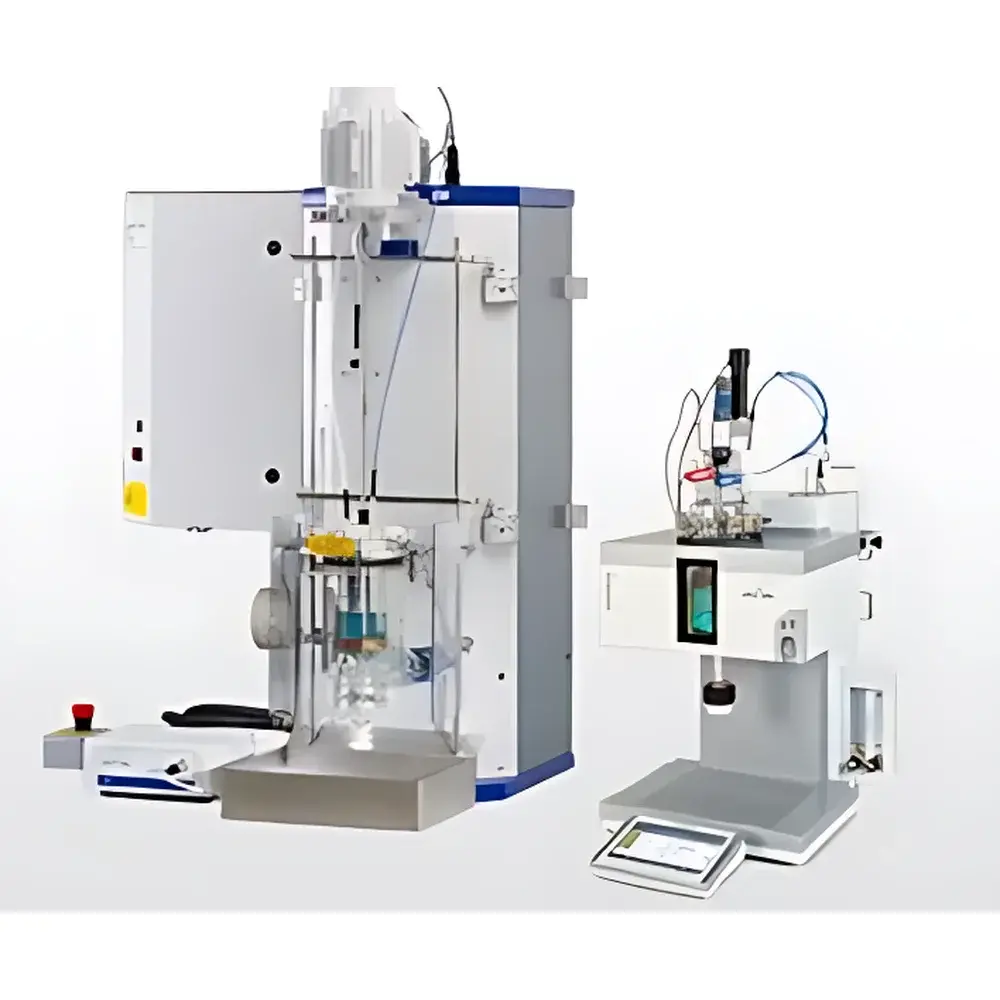
METTLER TOLEDO EasyMax 102/402 HFCal & OptiMax HFCal Reaction Calorimeters
| Brand | METTLER TOLEDO |
|---|---|
| Origin | Switzerland |
| Model | EasyMax 102/402 HFCal / OptiMax HFCal |
| Principle | Heat-Flow Calorimetry |
| Temperature Range | −20 to 180 °C (configurable) |
| Pressure Rating | Up to 20 bar (g) |
| Reactor Volume | 10–400 mL |
| Thermal Sensitivity | < ±0.5 W |
| Data Acquisition Rate | Up to 10 Hz |
| Compliance | ASTM E698, ISO 11358, USP <1031>, FDA 21 CFR Part 11 (with optional audit trail) |
Overview
METTLER TOLEDO EasyMax 102/402 HFCal and OptiMax HFCal are bench-scale reaction calorimeters engineered for precise, real-time thermal monitoring of chemical reactions under process-representative conditions. Unlike infrared thermal imaging cameras—which measure surface temperature distributions via emitted radiation—these instruments operate on the heat-flow calorimetry principle: they quantify heat generation or absorption by measuring the temperature differential across a thermally resistive wall separating the reactor vessel from a precisely controlled jacket. This architecture enables direct determination of thermal power (W), cumulative heat flow (J), and reaction enthalpy (kJ/mol) with high reproducibility and minimal calibration drift. Designed for early-phase process development and scale-up support, the HFCal systems integrate seamlessly with METTLER TOLEDO’s automated synthesis platforms, allowing concurrent control of temperature, dosing, stirring, pH, and gas evolution while capturing thermodynamic data at up to 10 Hz. Their robust, all-metal construction and validated thermal modeling ensure compliance with industrial safety standards and regulatory expectations for thermally hazardous reaction assessment.
Key Features
- Modular heat-flow calorimetry platform supporting both isothermal and non-isothermal operation modes
- Integrated temperature control via Peltier or circulating fluid jacket (−20 to 180 °C, ±0.1 °C stability)
- Simultaneous acquisition of thermal power, reaction progress (via in situ FTIR or Raman optional), and process parameters (stirring torque, dosing volume, pressure)
- Calibration traceable to NIST-certified reference materials; thermal sensitivity < ±0.5 W with < 2% relative uncertainty over full dynamic range
- Explosion-proof variants available (ATEX/IECEx certified) for handling flammable solvents or exothermic runaway scenarios
- Automated safety interlocks including emergency cooling activation, overtemperature cutoff, and pressure-relief coordination
Sample Compatibility & Compliance
The EasyMax and OptiMax HFCal systems accommodate a broad spectrum of chemistries—including Grignard additions, nitration, hydrogenation, polymerization, and crystallization—across organic, aqueous, and multiphase media. Reactor vessels are constructed from borosilicate glass (EasyMax) or Hastelloy C-276 (OptiMax), enabling compatibility with corrosive reagents (e.g., HCl, HF, strong bases) and elevated pressures (up to 20 bar g). All configurations meet ISO 11358 for polymer thermal analysis and ASTM E698 for kinetic evaluation of decomposition reactions. When configured with electronic signature, time-stamped audit trail, and role-based access control, the systems satisfy FDA 21 CFR Part 11 requirements for regulated environments. Full documentation packages—including IQ/OQ/PQ protocols, uncertainty budgets, and raw data export in .csv and .tdms formats—support GLP/GMP audits and technology transfer to pilot or manufacturing sites.
Software & Data Management
Reaction data acquisition and analysis are managed through METTLER TOLEDO’s iC Safety software—a validated, Windows-based application compliant with ALCOA+ data integrity principles. The software provides real-time visualization of thermal power curves, cumulative heat release, and adiabatic temperature rise projections (ΔTad). Advanced modules enable kinetic modeling (e.g., nth-order, autocatalytic, parallel/consecutive pathways), criticality assessment (e.g., TMRad, SADT), and scalability analysis using the “heat accumulation factor” (Φ) and “thermal runway onset time” metrics. Raw datasets are stored with immutable metadata (operator ID, timestamp, instrument configuration, calibration status), and exports support LIMS integration via OPC UA or direct SQL database linkage. Optional cloud backup and remote monitoring (via secure TLS 1.2 connection) facilitate cross-site collaboration without compromising data sovereignty.
Applications
- Identification and quantification of thermal hazards during route scouting and DoE studies
- Determination of reaction enthalpy (ΔHr) and heat capacity (Cp) for mass & energy balance closure
- Validation of kinetic models used in dynamic simulation (e.g., gPROMS, Aspen Batch, DynoChem)
- Assessment of mixing effects, addition rate sensitivity, and secondary reaction onset
- Generation of safe operating envelopes (SOEs) and critical process parameters (CPPs) for QbD implementation
- Supporting CCPS (Center for Chemical Process Safety) Layer of Protection Analysis (LOPA) and HAZOP studies
FAQ
How does heat-flow calorimetry differ from power compensation or adiabatic calorimetry?
Heat-flow calorimetry measures thermal power via steady-state conduction across a known thermal resistance, offering superior baseline stability and lower detection limits for low-energy reactions. Power compensation maintains constant reactor temperature by adjusting jacket power, while adiabatic methods (e.g., ARC) simulate worst-case runaway but lack real-time control fidelity.
Can HFCal data be directly used for plant-scale thermal safety review?
Yes—when combined with appropriate scaling laws (e.g., constant power per unit volume, geometric similarity), HFCal-derived thermal profiles and criticality indices are accepted by regulatory agencies (e.g., FDA, EMA, UK HSE) as primary evidence for safe scale-up justification.
Is calibration required before each experiment?
No—system calibration is performed annually or after major maintenance using electrical substitution. In-run verification is achieved via standardized exothermic test reactions (e.g., NaOH/HCl neutralization) with known ΔHr.
What level of training is needed to operate the system reliably?
Operators require foundational knowledge of reaction engineering and calorimetric principles. METTLER TOLEDO provides certified 3-day application training covering experimental design, data interpretation, and regulatory reporting workflows.
Does the system support PAT (Process Analytical Technology) integration?
Yes—via analog/digital I/O, Modbus TCP, or OPC UA, the HFCal platform interfaces with in-line probes (FTIR, Raman, FBRM) and DCS/SCADA systems to enable closed-loop thermal control and real-time quality assurance.






