
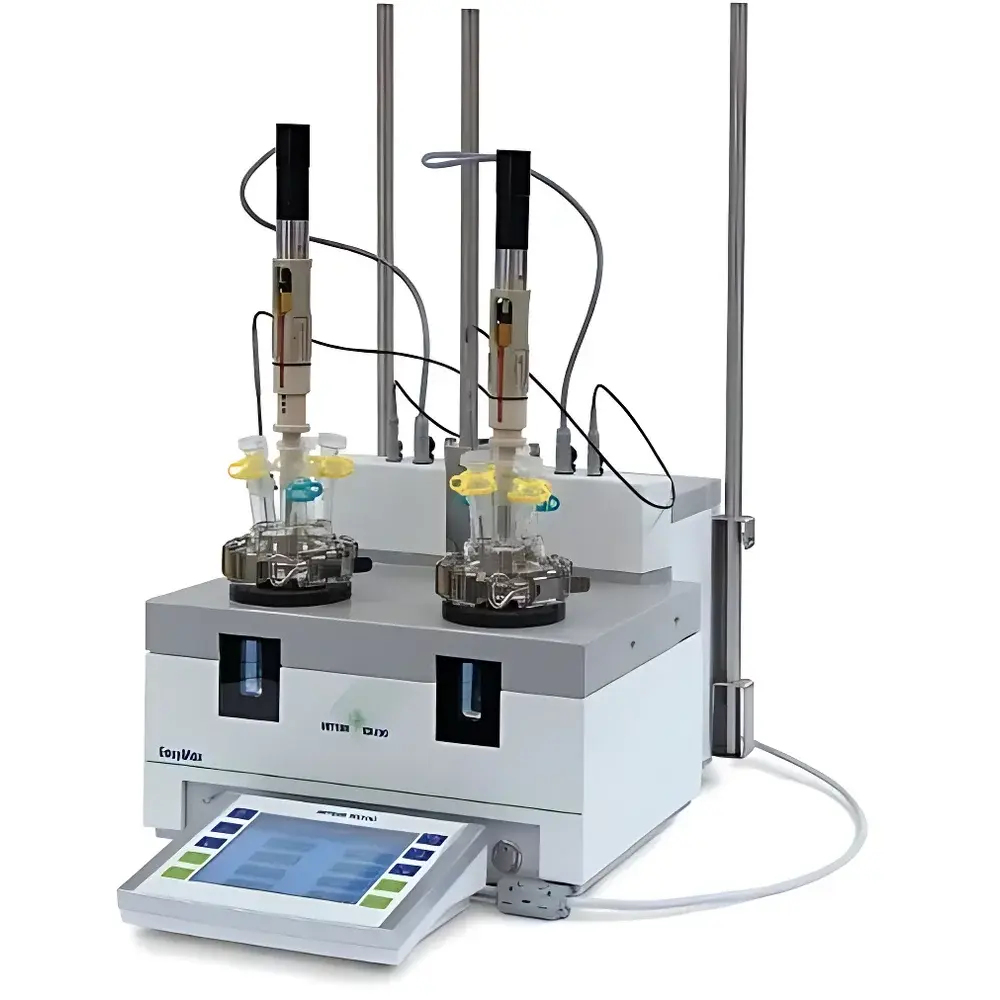
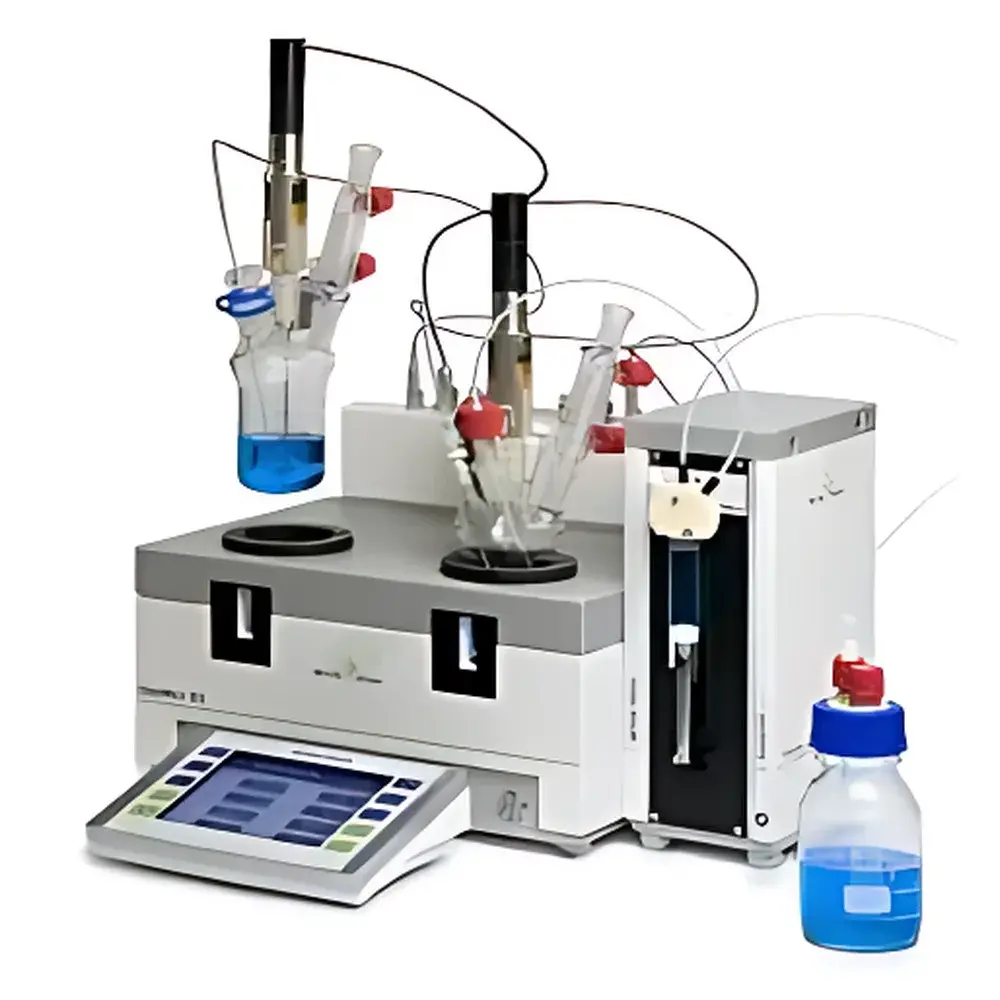
METTLER TOLEDO EasyMax™ 102 HFCal Reaction Calorimeter
| Brand | METTLER TOLEDO |
|---|---|
| Origin | Switzerland |
| Model | EasyMax™ 102 HFCal |
| Temperature Range | –40 to 180 °C |
| Temperature Control Accuracy | ±0.2 mK |
| Reaction Vessel Capacity | 8–1000 mL |
| Number of Reaction Units | 1–10 |
Overview
The METTLER TOLEDO EasyMax™ 102 HFCal is a benchtop reaction calorimeter engineered for early-stage process development, safety screening, and scalable synthesis in pharmaceutical, fine chemical, and polymer R&D laboratories. It implements heat-flow calorimetry (HFCal) — a validated, model-free technique that quantifies thermal power released or absorbed during chemical reactions by measuring the heat flux across the reactor jacket under precisely controlled temperature conditions. Unlike traditional adiabatic or power-compensation calorimeters, the HFCal method enables real-time, high-fidelity thermodynamic profiling without requiring calibration with reference reactions or assumptions about heat transfer coefficients. The system operates within a broad temperature envelope (–40 to 180 °C), supported by an integrated Peltier-based modular temperature control unit that eliminates dependence on external cryogenic fluids, oil baths, or ice baths — significantly reducing operational hazards and infrastructure requirements.
Key Features
- Integrated heat-flow calorimetry platform delivering quantitative reaction enthalpy (ΔHr), heat transfer coefficient (U·A), specific heat capacity (Cp), adiabatic temperature rise (ΔTad), and thermal conversion profiles
- High-precision temperature control with ±0.2 mK stability over the full operating range, enabling reproducible isothermal and non-isothermal reaction studies
- Modular reactor architecture supporting 1–10 parallel reaction units, each configurable with vessel volumes from 8 mL to 1000 mL — facilitating both microscale screening and kilolab-relevant optimization
- Compact footprint with front-access transparent viewport and LED backlighting for real-time visual monitoring of phase changes, precipitation, gas evolution, or mixing behavior
- Intuitive 10-inch capacitive touchscreen interface running iControl™ software — no specialized training required for routine operation or method setup
- Self-contained thermal management system with no external chiller, pump, or coolant reservoir — compliant with ISO 14001 lab space efficiency guidelines
Sample Compatibility & Compliance
The EasyMax™ 102 HFCal accommodates a wide range of chemistries, including exothermic cross-coupling reactions, hydrogenations, nitrations, Grignard additions, polymerizations, and biocatalytic transformations. Its inert wetted materials (316L stainless steel, PTFE, FFKM, sapphire viewport) ensure compatibility with aggressive reagents (e.g., strong acids, organometallics, halogenated solvents). The system meets key regulatory expectations for process safety data generation: it supports audit-ready data integrity per FDA 21 CFR Part 11 (with electronic signatures, user access controls, and immutable audit trails), aligns with ICH Q5C and Q7 guidance for biopharmaceutical process characterization, and generates data suitable for Process Safety Management (PSM) reporting under OSHA 29 CFR 1910.119. All calorimetric outputs are traceable to NIST-traceable temperature and power standards.
Software & Data Management
iControl™ software provides a unified environment for method definition, real-time visualization, automated data acquisition, and thermodynamic post-processing. It computes and exports time-resolved heat flow (W), cumulative reaction enthalpy (J), instantaneous thermal conversion (%), and jacket heat transfer parameters — all synchronized with stirring speed, dosing events, and pH/temperature sensor inputs. Raw data files (.hfc) are stored in HDF5 format with embedded metadata (user, timestamp, method ID, instrument serial number), ensuring long-term readability and interoperability with LIMS and ELN systems (e.g., LabVantage, Benchling, Dotmatics). Batch reports comply with GLP/GMP documentation standards, including automatic generation of summary PDFs with signature fields and revision-controlled templates.
Applications
- Early identification of thermal runaway risks and determination of critical process safety parameters (e.g., MTSR, TD24) for RC1-style hazard assessment
- Quantitative comparison of alternative synthetic routes to select the most thermally robust and scalable pathway
- Optimization of addition rate, temperature ramping, and dosing profiles to minimize side reactions and improve selectivity
- Derivation of kinetic models (e.g., nth-order, autocatalytic) from calorimetric heat flow profiles coupled with in situ FTIR or Raman data
- Supporting Quality-by-Design (QbD) initiatives through Design Space definition and risk-based control strategy development
- Generating regulatory submission packages for FDA IND/IMPD filings, particularly for API process validation and impurity control justification
FAQ
Can the EasyMax™ 102 HFCal be used for highly viscous or heterogeneous reaction mixtures?
Yes — its high-torque magnetic drive stirrer (up to 1000 rpm) and optimized baffle geometry ensure uniform mixing across viscosity ranges up to 10,000 mPa·s, while the jacketed vessel design maintains consistent heat transfer even with suspended solids.
Is calibration required before each experiment?
No — the HFCal method is inherently calibration-free for relative heat flow measurements. System verification is performed semi-annually using certified electrical heaters per ASTM E1269 and ISO 11357-4 protocols.
How does the system handle solvent evaporation during high-temperature reactions?
The reactor headspace is sealed and optionally configurable with pressure-rated components (up to 10 bar g) and reflux condensers; mass loss is monitored via optional integrated gravimetric dosing modules.
Can existing EasyMax™ 102 Advanced systems be upgraded to HFCal capability?
Yes — the EasyMax™ HFCal Upgrade Kit (P/N 30090576) includes hardware modules, firmware update, and iControl™ license activation for full calorimetric functionality.
What level of support is provided for method transfer to larger-scale reactors?
METTLER TOLEDO offers QbD-focused scale-up services, including dimensionless number analysis (e.g., Reynolds, Nusselt), geometric similarity mapping, and predictive modeling using the acquired HFCal dataset to inform pilot-plant reactor design and control logic.



