
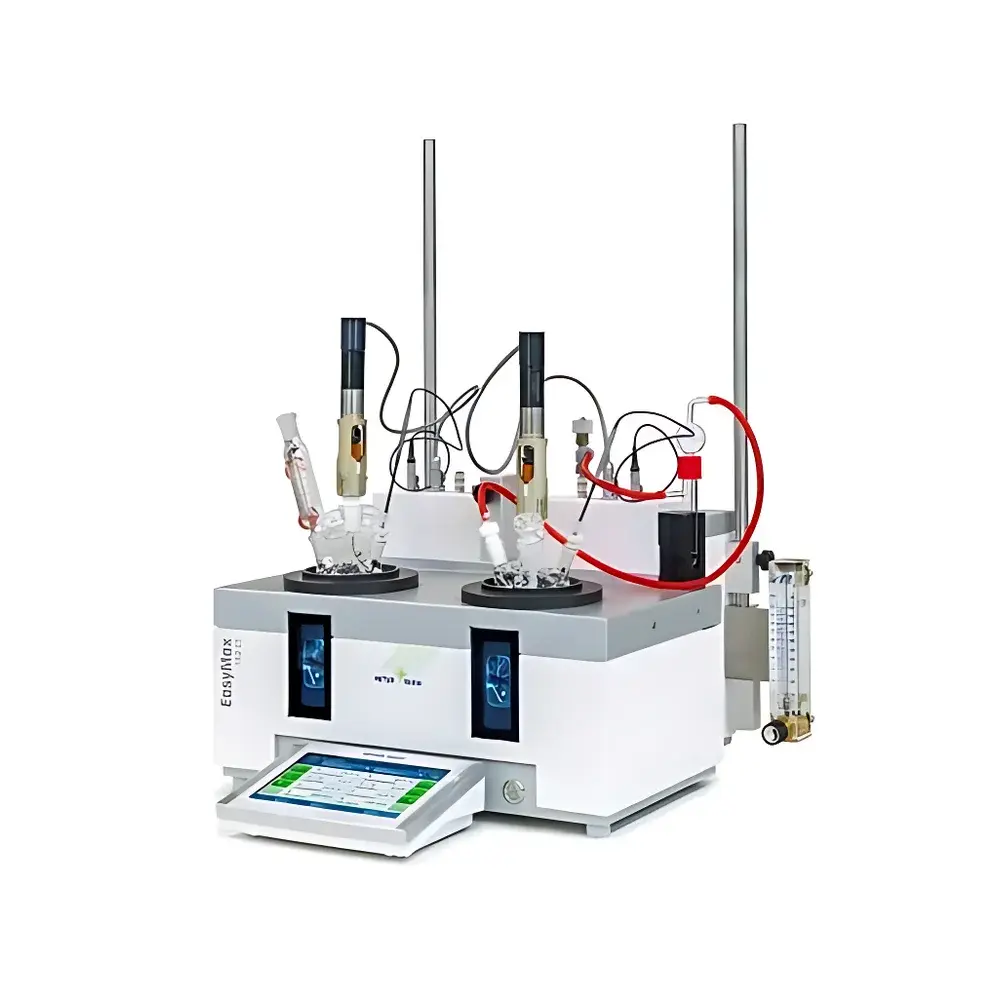
METTLER TOLEDO EasyMax 102 LT/ULT Automated Synthesis Reactor
| Brand | METTLER TOLEDO |
|---|---|
| Origin | Switzerland |
| Model | EasyMax 102 LT/ULT |
| Temperature Range | −90 °C to 150 °C |
| Temperature Control Accuracy | ±0.2 mK |
| Reaction Vessels | 1–10 units |
| Reaction Volume per Vessel | 8–100 mL |
| Cooling Method | Solid-State Thermoelectric (Peltier) |
| Real-Time Data Acquisition | Yes |
| Software Platform | iControl 6.1 |
| Low-Temperature Observation Capability | Yes (frost-free reactor wall down to −80 °C) |
Overview
The METTLER TOLEDO EasyMax 102 LT/ULT is an automated, benchtop synthesis reactor engineered for precise thermal control and reproducible chemical reaction execution across an exceptionally wide temperature range—from −90 °C to +150 °C. Unlike conventional low-temperature reactors constrained to fixed setpoints (e.g., −21 °C or −78 °C), the EasyMax 102 LT/ULT employs solid-state thermoelectric (Peltier) cooling combined with active gas purge and proprietary insulation to achieve stable, programmable sub-zero operation without external cryogenic baths. Its core architecture implements closed-loop temperature regulation with ±0.2 mK stability—critical for kinetic studies, crystallization screening, exothermic reaction control, and process safety assessment during early-stage route scouting and scale-up development. Designed for integration into modern laboratory workflows, the system supports fully autonomous execution of multi-step synthetic protocols while continuously logging temperature, stirring speed, addition rates, and heat flow data.
Key Features
- Ultra-low temperature capability: Stable operation down to −90 °C using integrated Peltier-based cooling—eliminating dependence on liquid nitrogen or dry ice baths.
- Frost-free observation window: Engineered thermal barrier and tangential inert gas purge prevent condensation and ice formation on reactor walls—even at −80 °C—enabling direct visual monitoring of phase transitions, precipitation, or mixing behavior.
- Rapid thermal ramping: Cools 100 mL of ethanol from 20 °C to −80 °C in under 50 minutes, demonstrating high thermal efficiency and responsiveness.
- Modular scalability: Configurable for 1–10 parallel reaction vessels (8–100 mL each), supporting both sequential and parallel reaction screening under identical environmental conditions.
- High-precision thermal control: Achieves ±0.2 mK temperature stability via PID-controlled feedback loops, validated per ISO/IEC 17025-compliant calibration protocols.
- Intuitive HMI: 10.4-inch capacitive touchscreen interface with drag-and-drop protocol builder; requires no prior programming expertise for routine method setup.
Sample Compatibility & Compliance
The EasyMax 102 LT/ULT accommodates a broad spectrum of organic, organometallic, and aqueous reaction systems—including moisture-sensitive, air-sensitive, and highly exothermic transformations. Reaction vessels are constructed from borosilicate glass with PTFE-coated magnetic stir bars and gas-tight septum caps compatible with Schlenk-line integration. The system meets CE marking requirements and conforms to IEC 61010-1 (safety of laboratory equipment) and IEC 61326-1 (EMC). For regulated environments, iControl 6.1 supports 21 CFR Part 11-compliant electronic records—including user authentication, audit trails, and immutable data archiving—making it suitable for GLP and GMP-aligned R&D laboratories conducting API process development or DOE-driven optimization.
Software & Data Management
iControl 6.1 serves as the central software platform for method design, real-time visualization, and post-run analysis. It enables creation of complex, time- or event-triggered reaction sequences—including temperature ramps, reagent additions, pH adjustments, and calorimetric integration. All sensor data (temperature, torque, jacket pressure, dosing volume) are timestamped and stored in .csv and native .icd formats. Built-in reaction calorimetry functionality allows calculation of heat flow (W) and cumulative enthalpy change (kJ), supporting RC1-style thermal hazard evaluation. Data export is compatible with MATLAB, Python (via Pandas), and industry-standard LIMS platforms through OPC UA and RESTful API interfaces.
Applications
- Low-temperature lithiation, deprotonation, and enolate formation requiring precise sub-zero control
- Crystallization polymorph screening across extended thermal gradients
- Exothermic Grignard or nitration reactions with real-time thermal runaway detection
- DOE-based optimization of residence time, stoichiometry, and addition rate under controlled thermal profiles
- Reaction calorimetry for heat balance modeling and safety dossier generation (e.g., for CHETAH or TSS validation)
- Automated replication of literature procedures with full parameter traceability
FAQ
Does the EasyMax 102 LT/ULT require external coolant or cryogens?
No—it uses solid-state Peltier elements for cooling and heating, eliminating the need for liquid nitrogen, dry ice, or recirculating chillers.
Can it perform reaction calorimetry?
Yes—when equipped with optional heat flow sensors and calibrated jackets, it delivers quantitative reaction calorimetry data compliant with ASTM E698 and ISO 11358 standards.
Is remote monitoring supported?
Yes—iControl 6.1 supports secure web-based access via HTTPS, enabling real-time dashboard viewing and alarm notifications from off-site locations.
What validation documentation is provided?
Factory-installed IQ/OQ documentation is included, with optional PQ support packages available for GxP environments.
How is data integrity ensured for regulatory submissions?
iControl 6.1 implements role-based access control, electronic signatures, and tamper-evident audit trails meeting FDA 21 CFR Part 11 and EU Annex 11 requirements.



