
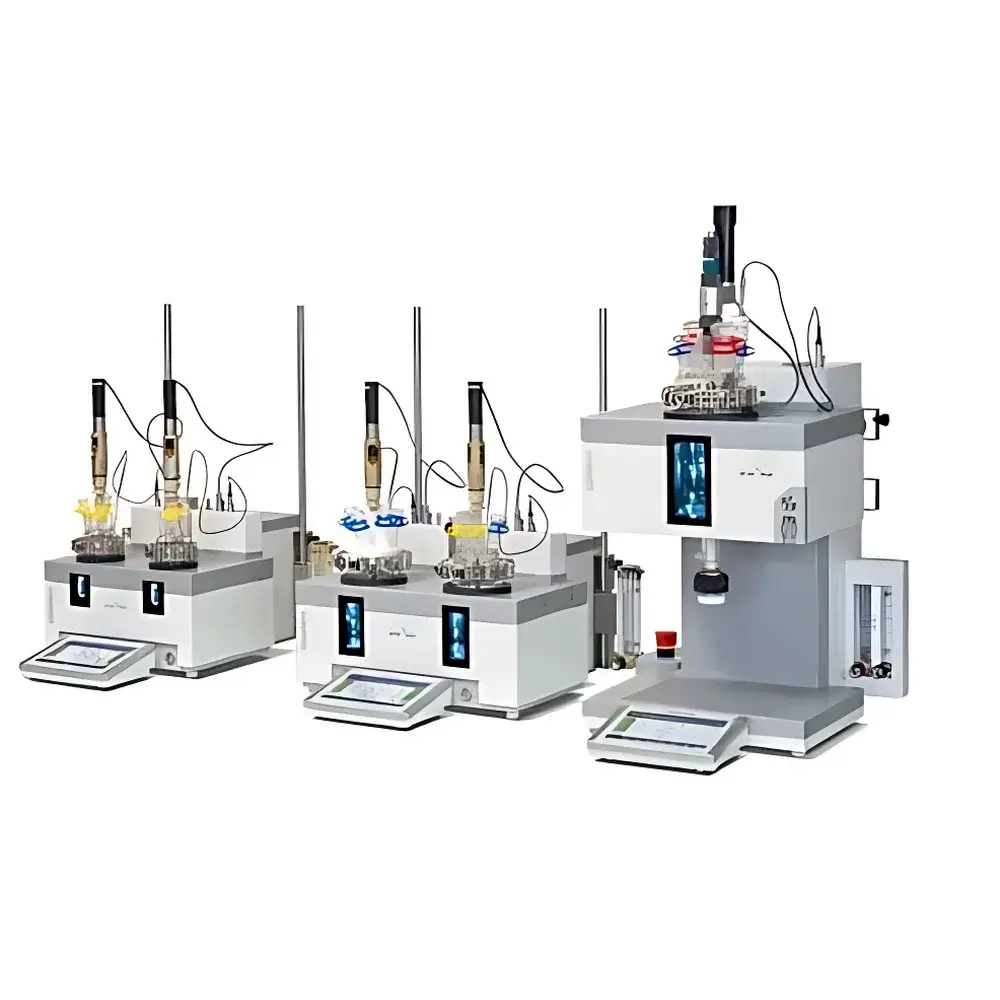
METTLER TOLEDO EasyMax/Optimax Automated Chemical Synthesis Workstation
| Brand | METTLER TOLEDO |
|---|---|
| Origin | Switzerland |
| Model | EasyMax/Optimax |
| Temperature Range | –40 to 180 °C |
| Temperature Control Accuracy | ±0.2 mK |
| Reaction Vessels | 1–10 units |
| Reaction Volume Capacity | 8 mL to 1000 mL |
Overview
The METTLER TOLEDO EasyMax and OptiMax Automated Chemical Synthesis Workstations are modular, benchtop-scale reaction platforms engineered for precise, reproducible, and safe process development in fine chemical, specialty chemical, and biopharmaceutical R&D laboratories. These systems operate on the principle of active solid-state thermal control—employing integrated Peltier-based heating and cooling modules—to deliver rapid, bidirectional temperature regulation without reliance on external baths, cryogenic fluids, or bulky chillers. Unlike conventional jacketed reactors requiring auxiliary utilities, EasyMax and OptiMax maintain thermal stability across the full operational range (–40 °C to +180 °C) with an accuracy of ±0.2 mK under dynamic load conditions—including highly exothermic or endothermic reactions. This enables true kinetic fidelity during reaction profiling, eliminating thermal lag artifacts that compromise mechanistic interpretation and scale-up predictability.
Key Features
- Integrated solid-state thermal management system with independent heating/cooling capability, eliminating dependency on external circulators or bath media
- High-precision temperature control (±0.2 mK) verified under real-time reaction load, supporting both isothermal and non-isothermal operation modes
- Modular architecture accommodating 1–10 parallel reaction vessels, with scalable volume options from 8 mL micro-vessels to 1000 mL jacketed glass reactors
- Touchscreen-driven iControl software interface enabling intuitive parameter configuration, real-time monitoring, and automated sequence execution
- Embedded safety monitoring system with hardware-level interlocks, fault detection logic, and automatic emergency response (e.g., cooling activation upon thermal deviation or pressure anomaly)
- Compliance-ready design supporting audit trails, electronic signatures, and data integrity frameworks aligned with FDA 21 CFR Part 11 and ALCOA+ principles
Sample Compatibility & Compliance
The EasyMax/Optimax platform supports a broad spectrum of chemistries—including Grignard, lithiation, hydrogenation, nitration, polymerization, and enzymatic transformations—across organic solvents, aqueous media, slurries, and heterogeneous catalytic systems. All wetted parts conform to USP Class VI and ISO 10993 biocompatibility standards; reactor vessels are constructed from borosilicate glass (DIN/ISO compliant), with optional Hastelloy C-276 or sapphire windows for aggressive reagent compatibility. The system meets IEC 61000-6-2 (EMC immunity) and IEC 61010-1 (electrical safety) requirements. Full documentation packages—including IQ/OQ protocols, calibration certificates traceable to NIST standards, and GxP validation support—are available for GLP and GMP-regulated environments.
Software & Data Management
iControl software serves as the unified control, acquisition, and analysis engine for all EasyMax/OptiMax operations. It acquires synchronized time-stamped data streams from temperature, stirring torque, pH, conductivity, FTIR probe signals (when interfaced), and optional HFCal reaction calorimetry modules. Raw datasets are stored in vendor-neutral HDF5 format with embedded metadata (user, timestamp, method ID, instrument serial number). Automated calculation modules generate standardized reports for heat flow, cumulative enthalpy, adiabatic temperature rise (ΔTad), maximum rate of temperature increase (dT/dt)max, and reaction onset timing—all traceable to ASTM E698 and ISO 11358 methodologies. Audit trail functionality records every user action, parameter change, and system event with immutable timestamps, satisfying regulatory expectations for data integrity in pharmaceutical process development.
Applications
- Rapid screening of reaction conditions (temperature, stoichiometry, addition rate, catalyst loading) to establish design space per ICH Q5 and Q8 guidelines
- Quantitative reaction calorimetry for thermal hazard assessment (e.g., RC1e-equivalent data generation for CCPS and NFPA 49 guidelines)
- Development of robust crystallization and polymorph screening protocols under controlled supersaturation profiles
- Process safety evaluation including determination of MTSR (Maximum Temperature of Synthesis Reaction) and TD24 (time-to-maximum-rate at 24 h)
- Supporting Quality-by-Design (QbD) initiatives through multivariate data collection and DoE-enabled experimental planning
- Technology transfer documentation generation with fully traceable, exportable datasets for regulatory submissions (e.g., IND, IMPD, BLA)
FAQ
Can EasyMax/Optimax be used for hazardous chemistry involving high exotherms or gas evolution?
Yes—its integrated safety architecture includes real-time thermal runaway detection, automatic cooling escalation, pressure monitoring integration (via optional sensors), and programmable emergency shutdown sequences compliant with OSHA 1910.119 and EU Seveso III Directive requirements.
Is the system compatible with third-party analytical probes (e.g., ReactIR, FBRM, UV-Vis)?
Yes—iControl provides open OPC UA and Modbus TCP interfaces for seamless synchronization with PAT tools; dedicated mounting kits and probe alignment fixtures are available for common in situ spectroscopic and particle characterization devices.
How does the system support regulatory compliance for clinical-stage API development?
It delivers full 21 CFR Part 11 compliance out-of-the-box—including role-based access control, electronic signatures, and permanent audit logs—with validated methods and IQ/OQ documentation packages suitable for FDA and EMA inspections.
What level of training is required for new users?
Minimal—intuitive touchscreen workflow navigation, context-sensitive help, and preloaded method templates reduce onboarding time to under two hours; advanced features (e.g., DoE scripting, calorimetric modeling) are accessible via optional certified training modules.
Does the system support unattended overnight operation?
Yes—hardware-enforced safety interlocks, redundant temperature monitoring, and remote alarm notification (email/SMS via optional connectivity module) enable secure lights-out operation in accordance with institutional biosafety and chemical hygiene plans.



