
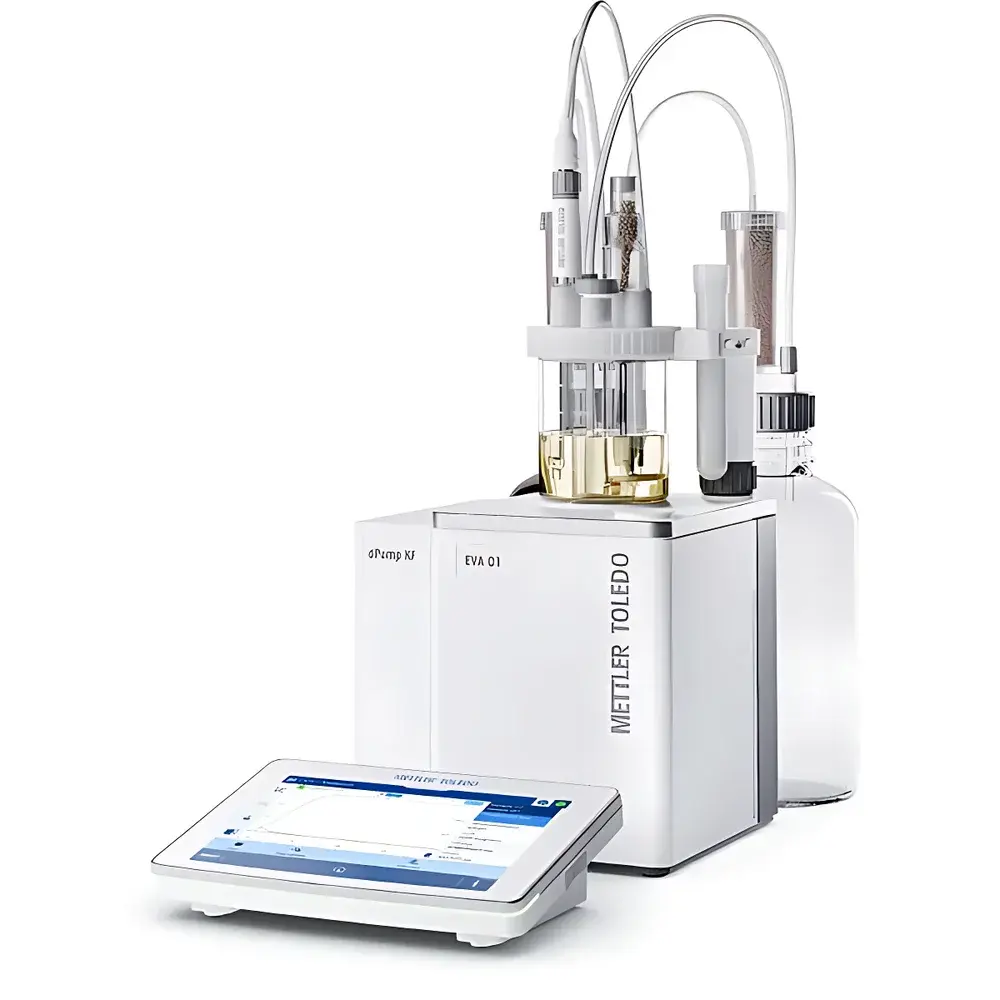
METTLER TOLEDO EVA C1 Coulometric Karl Fischer Titrator
| Brand | METTLER TOLEDO |
|---|---|
| Principle | Coulometric Karl Fischer Titration |
| Measurement Range | 1 µg – 200 mg H₂O |
| Detection Limit | ≤ 0.1 µg H₂O |
| Electrode Recognition | Integrated Smart Chip Interface |
| Cell Design | Modular Two-Part Coulometric Titration Vessel |
| Optional Accessories | Amber Cell, Thermostatted Cell, InMotion KF Oven Integration |
| Compliance | ASTM D6304, ISO 8534, USP <921>, EP 2.5.12, GLP/GMP Data Integrity Ready |
Overview
The METTLER TOLEDO EVA C1 is a high-precision coulometric Karl Fischer titrator engineered for trace-level moisture determination in pharmaceuticals, polymers, lithium battery materials, and fine chemicals. It operates on the fundamental electrochemical principle of coulometric KF titration: iodine is generated *in situ* at the anode via controlled electrolysis of iodide ions (I⁻), with the quantity of iodine directly proportional to the electric charge passed (Faraday’s law). This enables absolute quantification of water content without reliance on standardized titrant solutions—ensuring exceptional accuracy for samples containing ≤ 1000 ppm water. The EVA C1 delivers reproducible results across heterogeneous matrices, including hygroscopic solids, viscous oils, and thermally labile compounds, where volumetric methods face limitations in sensitivity and reagent stability.
Key Features
- FFA (Fast Forward Algorithm) Current Control: Dynamically modulates electrolysis current based on real-time titration curve slope, accelerating iodine generation during initial reaction phases and tapering current near endpoint—reducing analysis time by up to 40% while maintaining stoichiometric fidelity.
- Smart Electrode Recognition: Integrated RFID chip embedded in the electrolysis electrode housing transmits manufacturer ID, serial number, calibration history, and operational lifetime data to the instrument firmware—enabling automatic configuration, audit-trail linkage, and prevention of mismatched electrode use.
- Modular Two-Part Titration Vessel: Separates the generator and detector compartments into mechanically independent, snap-fit components. Eliminates tube disconnection/reconnection during maintenance, preserves hermetic seal integrity after repeated assembly, and allows rapid solvent exchange or electrode replacement without system purging.
- Adaptable Cell Configurations: Standard clear glass cell for routine analysis; amber-colored cell for light-sensitive reagents (e.g., iodine-rich electrolytes exposed to UV); thermostatted cell with Peltier-controlled ±0.2 °C stability for temperature-critical applications such as polymer film hydration kinetics.
- Unified Platform Architecture: Shares core software, method templates, and reporting logic with METTLER TOLEDO’s volumetric KF systems—enabling seamless method transfer and cross-platform validation under ICH Q2(R2) guidelines.
Sample Compatibility & Compliance
The EVA C1 accommodates solid powders (via direct weighing or automated dosing), liquids (including solvents with low dielectric constants), pastes, and films. Its coulometric design eliminates volumetric pipetting errors and reagent degradation concerns inherent in traditional KF reagents. Regulatory alignment includes full support for 21 CFR Part 11-compliant electronic records: user-defined roles, biometric or token-based authentication, immutable audit trails with timestamped operator actions, and encrypted raw data storage. Method validation documentation adheres to ASTM D6304 (petrochemicals), ISO 8534 (plastics), USP (pharmaceuticals), and Ph. Eur. 2.5.12—facilitating inspection readiness for FDA, EMA, and PMDA audits.
Software & Data Management
Powered by METTLER TOLEDO’s tiamo™ software, the EVA C1 provides method-driven workflow control, real-time titration curve visualization, and customizable report generation (PDF/CSV/XML). All measurement metadata—including electrode identification, environmental conditions (temperature/humidity logged via optional sensor), and raw current/time datasets—are embedded within each result file. Data export supports LIMS integration via ASTM E1384 or HL7 protocols. Electronic signatures comply with ALCOA+ principles: attributable, legible, contemporaneous, original, accurate, complete, consistent, enduring, and available.
Applications
- Quantification of residual moisture in lyophilized biologics (≤ 0.1 wt%) prior to vial stoppering
- Monitoring water ingress in NMC cathode materials during dry-room handling (target: <20 ppm)
- Stability-indicating assay of hydrolytically unstable APIs (e.g., beta-lactams, esters)
- Moisture mapping in multilayer polymer packaging films using micro-sampling and heated oven coupling
- QC release testing of silicone elastomers per ISO 3452-2
FAQ
What is the minimum detectable water mass using the EVA C1?
The instrument achieves a detection limit of ≤ 0.1 µg H₂O under optimized conditions (low-noise cell, stabilized environment, fresh electrolyte).
Can the EVA C1 be validated for GMP environments?
Yes—its firmware, tiamo™ software, and hardware architecture are pre-qualified for IQ/OQ/PQ execution per Annex 11 and GAMP 5; full validation packages are available upon request.
Is oven coupling limited to the InMotion KF system?
No—the EVA C1 supports third-party heated sample changers via RS232/USB-serial protocol emulation, provided they conform to ASTM D6304 Annex A3 timing specifications.
How does the modular cell affect calibration frequency?
The sealed, self-contained design minimizes atmospheric contamination and electrolyte evaporation, extending recalibration intervals to ≥ 72 hours under continuous operation—verified via daily system suitability tests with certified water standards.






