
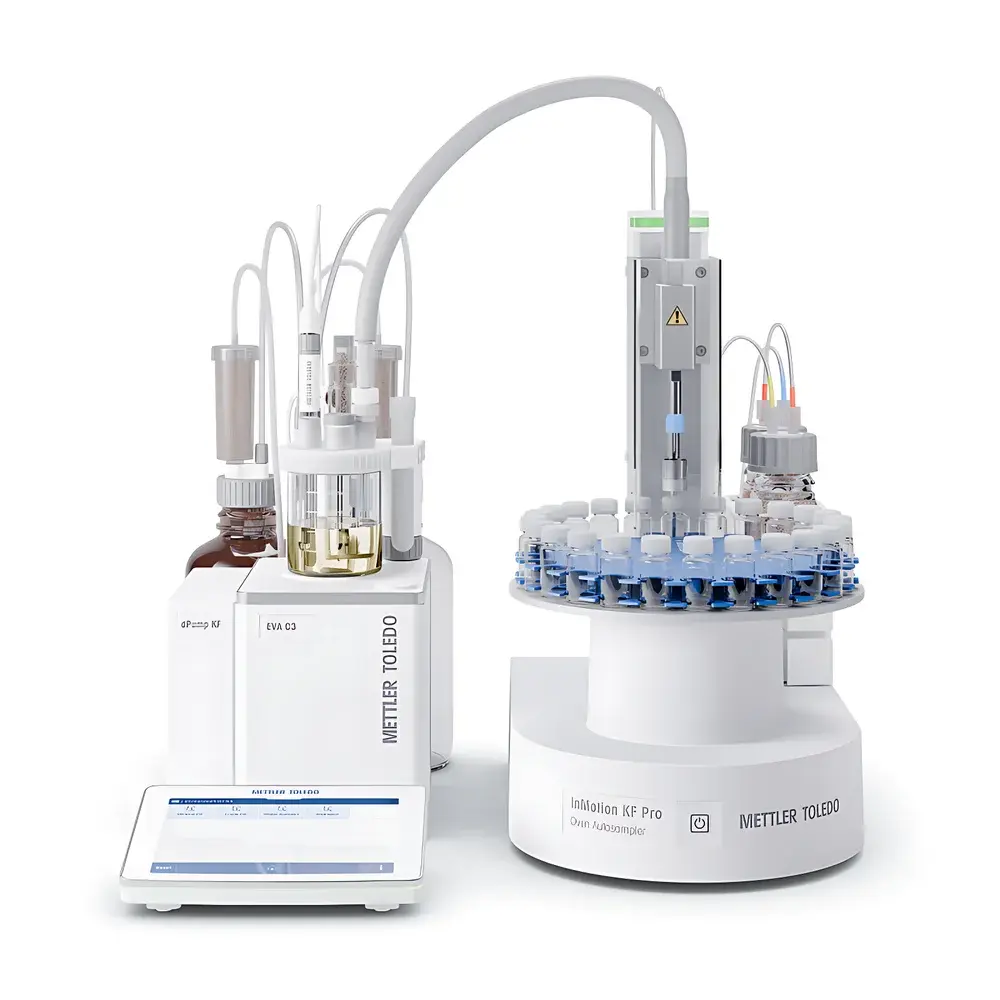
METTLER TOLEDO EVA C Coulometric Karl Fischer Moisture Analyzer with InMotion KF Automatic Sample Changer and Integrated Heating Oven
| Brand | METTLER TOLEDO |
|---|---|
| Origin | Switzerland (manufactured globally per ISO 9001-certified facilities) |
| Instrument Type | Coulometric Karl Fischer Titrator |
| Automation | Fully integrated InMotion™ KF Autosampler with programmable heating oven (50–250 °C) |
| Sample Capacity | 26 positions on 25 cm footprint |
| Compliance | ASTM D6304, ISO 8534, USP <921>, EP 2.5.12, GLP/GMP-ready with 21 CFR Part 11 audit trail capability |
| Data Management | Built-in One Click™ workflow automation, METTLER TOLEDO LabX® software compatibility |
Overview
The METTLER TOLEDO EVA C is a high-precision coulometric Karl Fischer moisture analyzer engineered for trace-level water quantification (0.1 µg – 200 mg H₂O) in demanding analytical environments. Unlike volumetric KF systems, the EVA C employs controlled-current coulometric generation of iodine at the anode—ensuring stoichiometric accuracy, minimal reagent consumption, and exceptional reproducibility across low-moisture matrices (<100 ppm). Its core architecture integrates seamlessly with the InMotion™ KF autosampler, which incorporates a temperature-controlled heating oven module capable of precise thermal desorption (50–250 °C) for difficult-to-dissolve or thermally labile samples—including polymers, pharmaceutical excipients, lithium battery cathode materials, and hygroscopic APIs. This configuration eliminates manual sample handling, reduces operator-induced variability, and enables unattended overnight analysis—making it suitable for QC laboratories operating under ISO/IEC 17025, FDA-regulated GMP, or ICH Q5C stability testing protocols.
Key Features
- Coulometric titration principle with dual-platinum generator electrode and microcell design—optimized for sub-ppm detection limits and long-term baseline stability.
- InMotion™ KF autosampler featuring 26-position carousel, programmable vial agitation, and integrated Peltier-cooled oven with ±0.5 °C temperature uniformity and real-time thermal profiling.
- One Click™ workflow engine: automates method selection, solvent conditioning, blank correction, sample weighing integration (via optional balance link), titration, and report generation in a single user action.
- Modular hardware architecture—supports optional external balance coupling, barcode reader, and nitrogen purge interface for oxygen-sensitive analyses.
- Robust cell design with quick-release septum ports, corrosion-resistant Pt/Ir electrodes, and sealed reagent reservoirs minimizing atmospheric moisture ingress during extended runs.
Sample Compatibility & Compliance
The EVA C + InMotion KF system accommodates solid, semi-solid, liquid, and viscous samples—including powders (e.g., silica gel, zeolites), films (e.g., packaging laminates), oils (e.g., transformer oil per ASTM D1533), and active pharmaceutical ingredients requiring controlled thermal release. All methods are validated per ICH Q2(R2) guidelines, with documented specificity, linearity (r² ≥ 0.999 over 0.1–200 µg H₂O), repeatability (RSD ≤ 1.5% at 10 µg level), and intermediate precision. System compliance includes full adherence to USP “Water Determination”, EP 2.5.12 “Loss on Drying and Karl Fischer Titration”, and ISO 8534 “Plastics — Determination of water content”. Audit trails, electronic signatures, and role-based access control meet 21 CFR Part 11 requirements when deployed with LabX® software.
Software & Data Management
LabX® software provides centralized method management, automated calibration tracking, and customizable reporting templates compliant with ISO 17025 clause 7.8. Raw titration curves, endpoint detection logs, drift correction records, and thermal desorption profiles are stored with immutable timestamps and user attribution. Data integrity safeguards include automatic backup to network drives, encrypted database storage, and configurable retention policies aligned with ALCOA+ principles (Attributable, Legible, Contemporaneous, Original, Accurate). Batch export to LIMS via ASTM E1384 or HL7 interfaces is supported without middleware.
Applications
- Pharmaceutical: Residual moisture in lyophilized proteins, tablet granules, and inhalation powders per ICH Q5C.
- Electronics: Water content in LiCoO₂ and NMC cathode slurries impacting battery cycle life.
- Polymers: Moisture in PET, PA6, and PBT prior to extrusion—critical for hydrolysis prevention.
- Fuel & Lubricants: Trace water in aviation turbine fuels (ASTM D6304 Class B) and synthetic ester lubricants.
- Food & Feed: Water activity correlation studies in dehydrated dairy powders and pet food formulations.
FAQ
What is the detection limit of the EVA C system in coulometric mode?
The system achieves a lower limit of quantification (LLOQ) of 0.1 µg H₂O with RSD ≤ 3.0% (n = 6) under optimized conditions using Hydranal®-Coulomat AG reagent.
Can the InMotion KF oven handle samples requiring inert atmosphere?
Yes—the autosampler supports optional nitrogen or argon purge connections to maintain oxygen-free conditions during thermal desorption of oxidation-prone samples.
Is method validation documentation provided with the instrument?
METTLER TOLEDO supplies a comprehensive IQ/OQ/PQ protocol package, including pre-validated test scripts for ASTM D6304 and USP , along with raw data templates for regulatory submission.
How does the One Click™ workflow ensure data integrity?
It enforces sequence-controlled execution—preventing manual parameter overrides, enforcing mandatory blank measurements, and auto-applying calibration corrections before result calculation—thereby eliminating transcription errors and procedural deviations.
What maintenance intervals are recommended for the coulometric cell?
Electrode cleaning is advised every 500 injections; full cell regeneration (electrolyte replacement, membrane inspection, and seal verification) is scheduled every 6 months or after 2,000 analyses—whichever occurs first.
Related Products






